2014 Summer in the south of France

Wednesday 7th May

Time to record a few thoughts and impressions of life in the French Pyrenees. 
I arrived on Sunday 4th after a trip by train and bus up from Barcelona, and one night in beautiful Girona. Everything went exactly as planned – trains, buses etc. Very easy to find the way to Pont de Reynes –  and to find Robert waiting at the bus stop to drive me up the last 6km to my mountain home for the next 2 months. (Robert’s an English guy who’s been working here with the family)
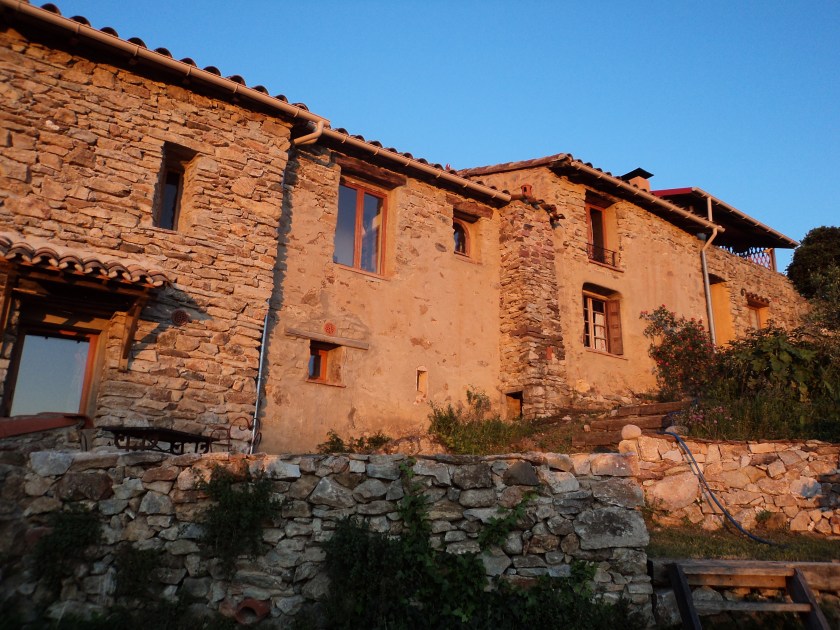
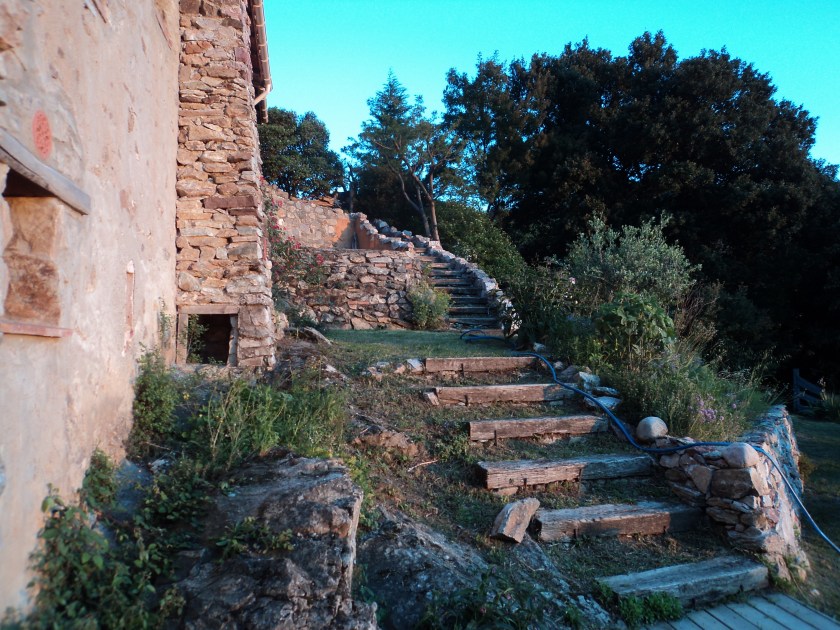
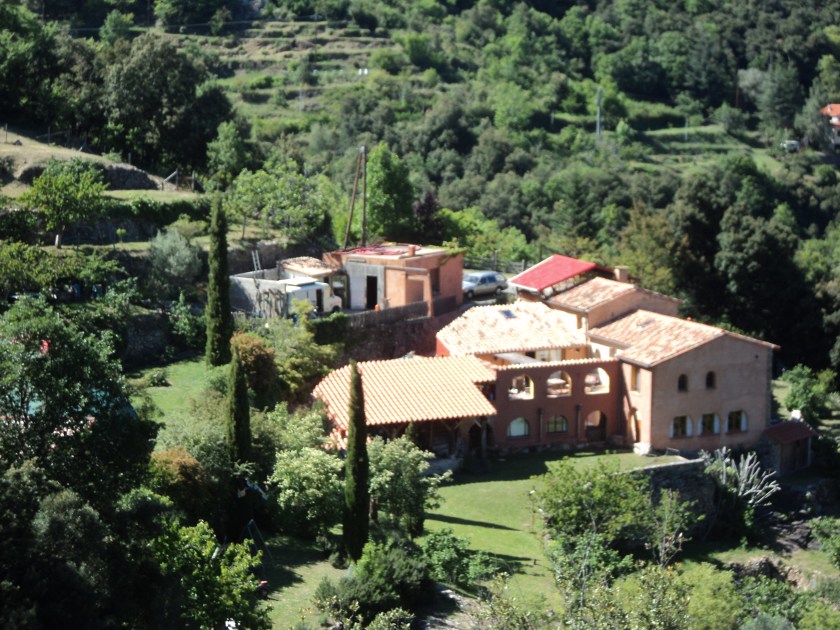
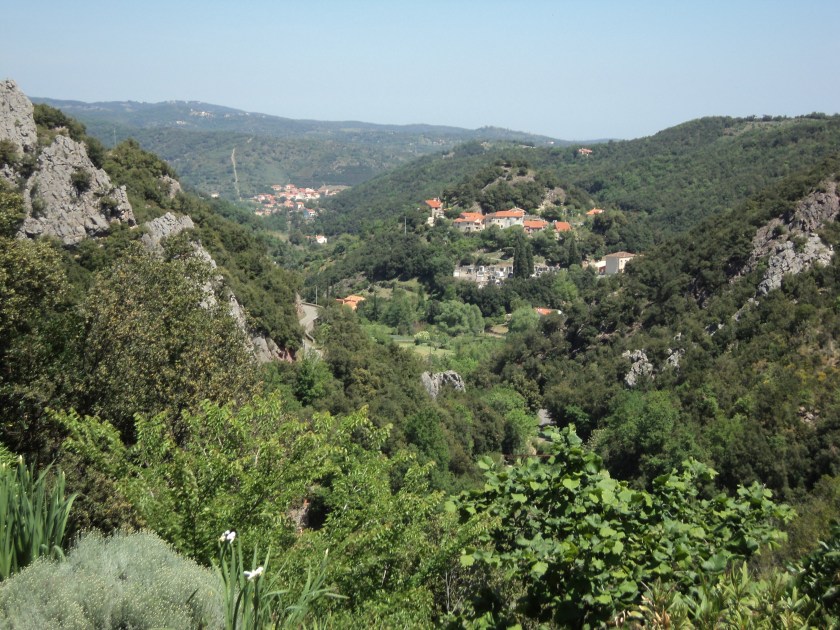
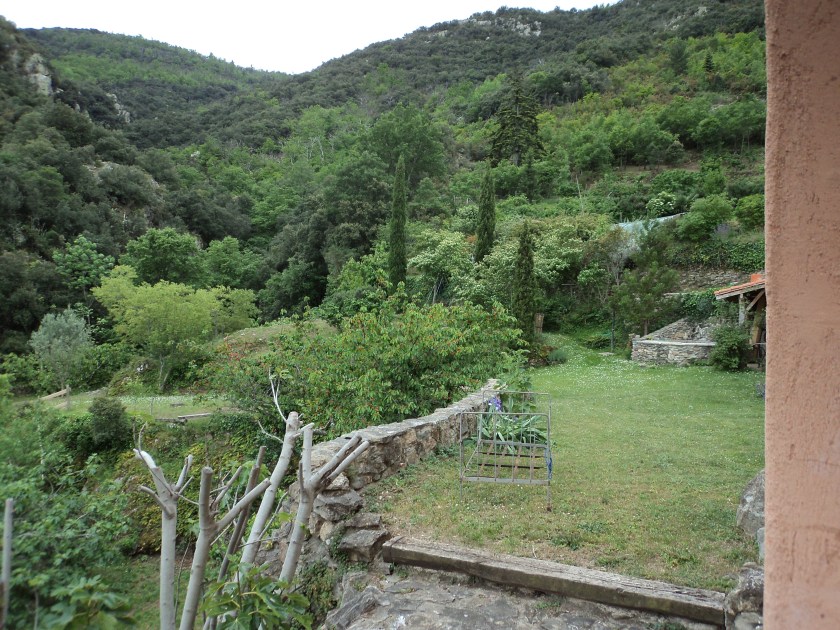
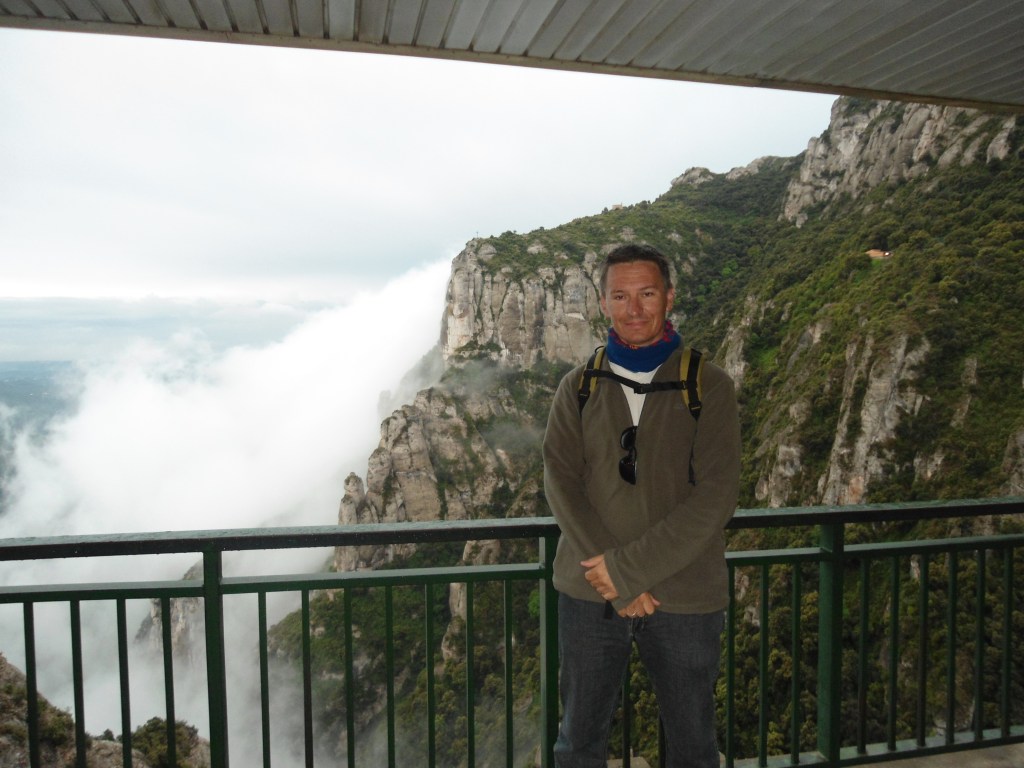
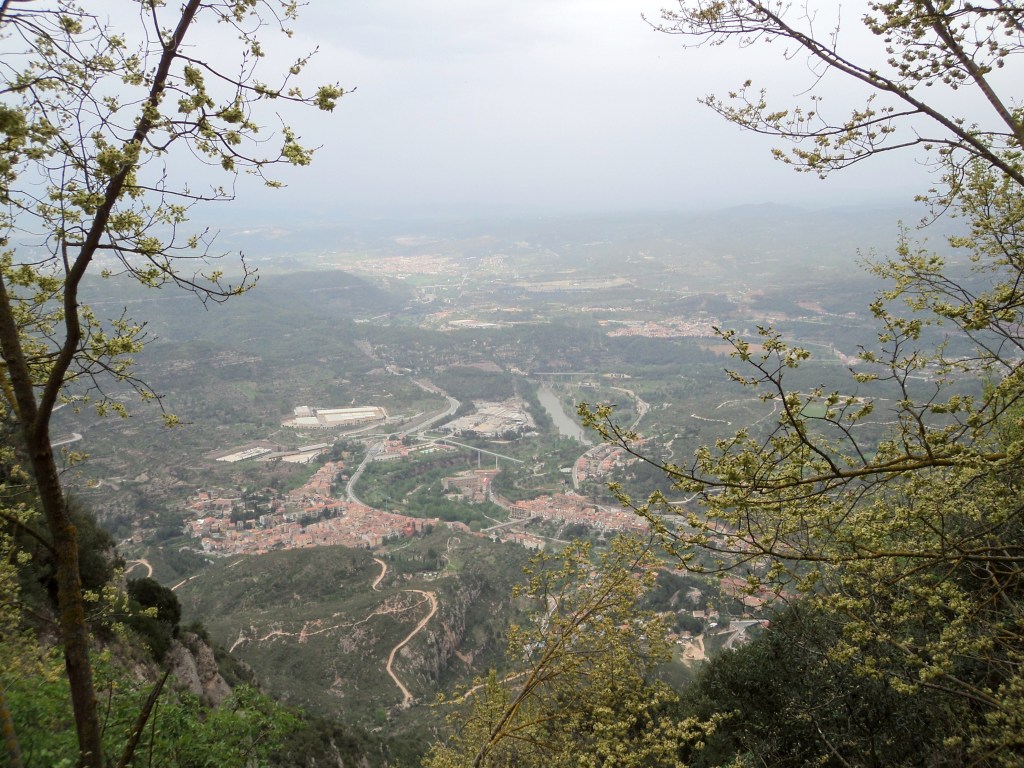
My studio isn’t much bigger than a large caravan, with a tiny en-suite attached. But it opens onto a small wooden terrace that overlooks the whole valley and mountains all around. It’s underneath the main family house and quite self-contained. The house is a big stone cottage that’s been added to over the years, built on the side of a heavily wooded canyon, one of many canyons in the region. Apparently the wild adventure sport of canyoning is a tourist attraction in these parts, but there are signs on the road up here that say that it’s prohibited in Can Guillet, ‘our’ canyon. I don’t think I’ll be trying to explore its higher reaches but it’s lovely to see the rocks and forests out of my windows and to hear the river and waterfalls pouring down.

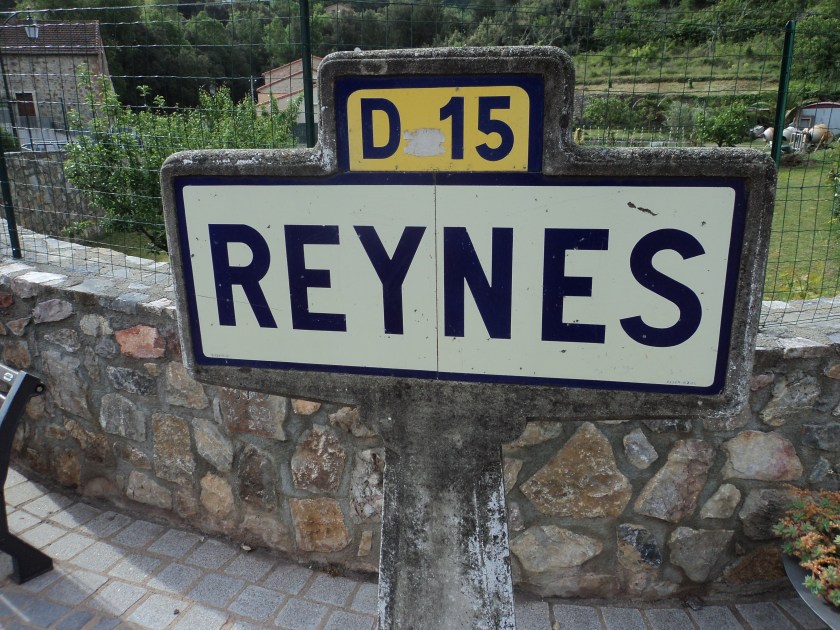
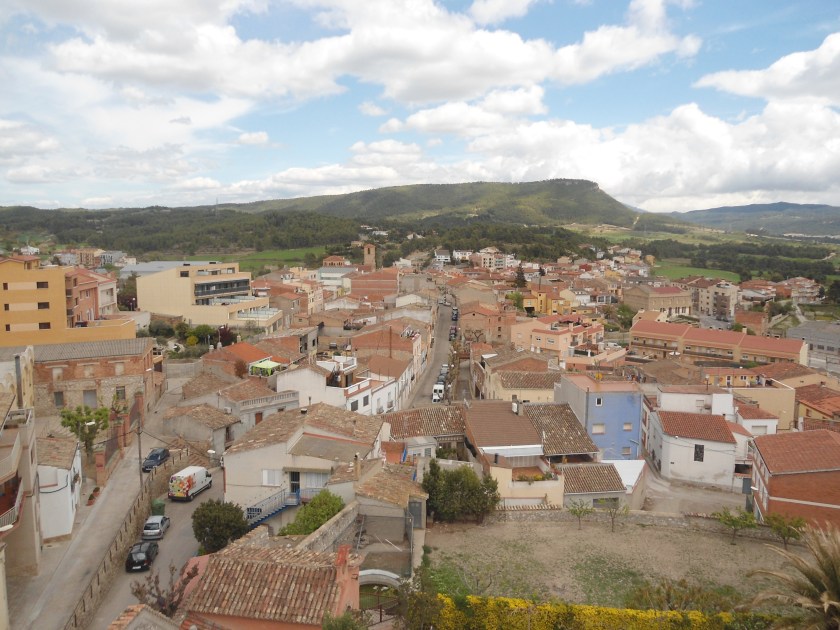
Reynes is the village down the mountain

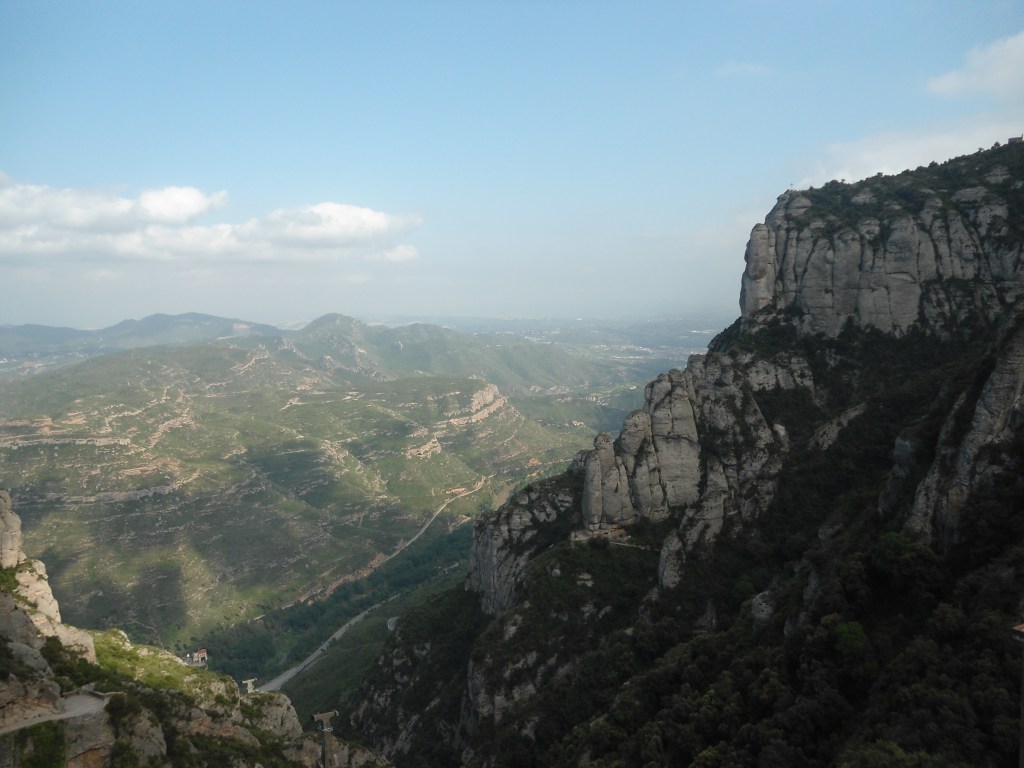
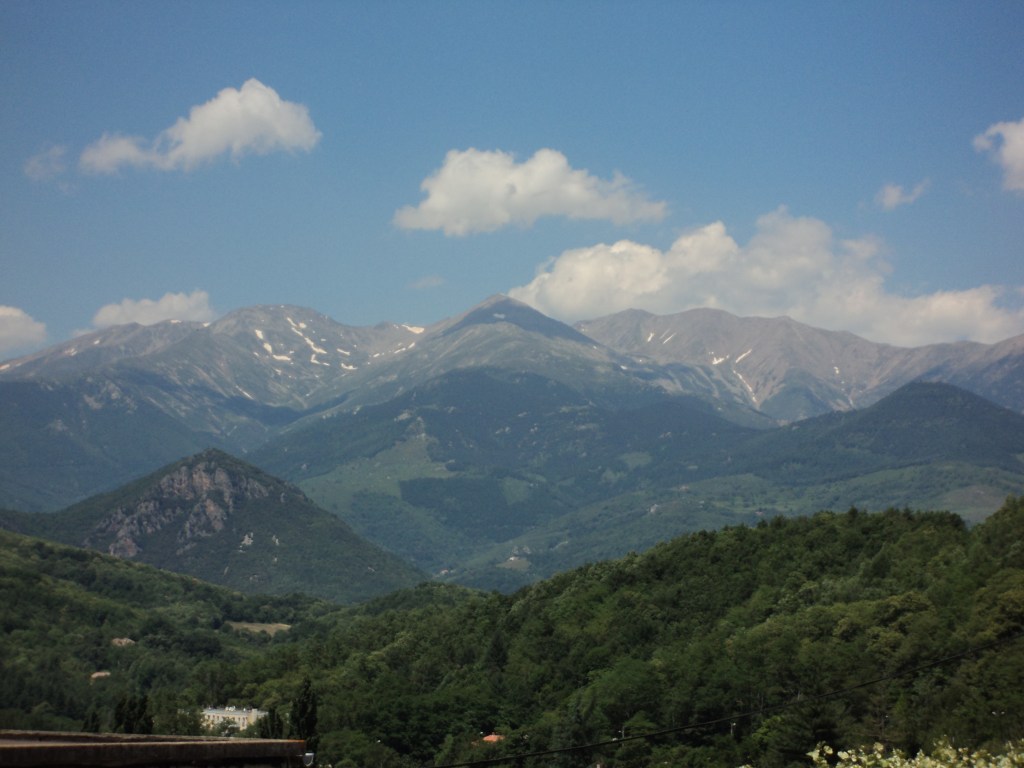
The house is fairly isolated, though other houses can be seen down in the valley. It’s also surprising how many houses and little farms you go past on the walk down the long winding road. It’s a 6km walk down to the main road with spectacular views in all directions. There are even snow-capped mountains in the not far distance. Once down on the main road, there’s a little bakery and a couple of small restaurants (not much goood according to the locals), but from here it’s possible to catch the bus. The bus system is amazing – not very frequent, but only costs €1 for any trip, no matter the distance. I’ll be able to travel all over the Languedoc Rousillon region for very few dollars. (€1 = approx $1.50) – and there’s so much to see and do. Wonderful walking, ancient abbeys, forts, art galleries and museums, and delightful French villlages, coffee and pastries….

Yesterday I walked to Ceret, the nearest market town, another 3 km along the way from Reynes. There’s a kind of bike path/walking trail from Reynes so you don’t have to walk on the busy main road. And visiting Ceret is something I’ll be doing often because it’s the only place I can get internet access. This is going to be my biggest challlenge of the whole two months – living without a home computer and immediate access…. but it’s part of the experience and might be good for me (I hope! )

Apart from an excellent cyber café,  Ceret has shops, supermarket, post office and all the other necessities. It also has a superb Modern Art gallery, which I visited yesterday. Many of the best-loved French and Catalan artists seemed to have lived and worked here at some time and it was fascinating to see all their tributes to Ceret… Picasso, Dufy, Chagall, Miro and Pinkus Kremegne, among others. I hadn’t heard of the last one but he seemed to be special in these parts. I spent a very enjoyable hour or two in there.

I’ve also arranged to have some 1-1 French conversation lessons withNatalie at the cyber café once a week. I’m managing with the basics of the language but still get very tongue-tied when I try to have any kind of chat for more than a minute. Understanding the written stuff is easy … and I can get the gist of what’s being said…. but trying to speak is another whole issue.

While I’m sitting here tapping away at this little tablet, there’s a mist hanging over the valley and it’s quite a bit cooler today than it’s been up to now. The first two days were hot and brilliantly sunny – just as the south of France is supposed to be. I’m sure there’ll be lots more wonderful days ahead.

Thursday 8th

Another lovely blue sky sunny day. I made it a lazy day, reading, snoozing, picking cherries from the garden. This is the centre of cherry growing in France. The French word is cerise… so no surprise how the little town of Ceret got its name. There are cherry trees all around just dripping with fruit. The garden here at the house is huge and the property seems to include the canyon and the surrounding mountains. It’s a beautiful place to walk around, clambering over rocks and up and down lots of levels. When it gets just a bit hotter I’m going to take advantage of the natural rock pools in the river. It’s really all quite idyllic, a truly lovely place to live – despite, or because of, its isolation and position overlooking the valley. Jocelyne and Jean-Pierre have made it into a more than just a home. It’s a whole natural and spiritual way of life for them. I’m quite envious.

It’s been good having Robert here to speak English… he’s been a ‘woofer’ for years (World Wide Opportunities on Organic Farms)..but is starting to assess his future and recognises that he’ll have to back to the UK some time and try to get a ‘proper’ paid job… He’s 52 with no money and not entitled to health benefits etc in Europe. A really nice guy… I wish him well. We’ve shared lots of travellers’ tales over the past couple of days.. one of the joys of travel, meeting kindred spirits who’ve been to many of the same places. 

22nd May

The past two weeks have been a great opportunity to get the feel of the Languedoc and this part of the French Pyrenees….. towns, villages and major cities. My table is loaded with maps, timetables and all the general guff about getting around and what to see. Not that it really matters because you could go anywhere in these mountains and valleys and be surrounded by spectacular views and amazing medieval history. There are forts, castles, towers, cathedrals, abbeys and old stone villages which all have a story to tell. And, of course, there are modern-day bakeries, shops, art galleries, markets and festivals.
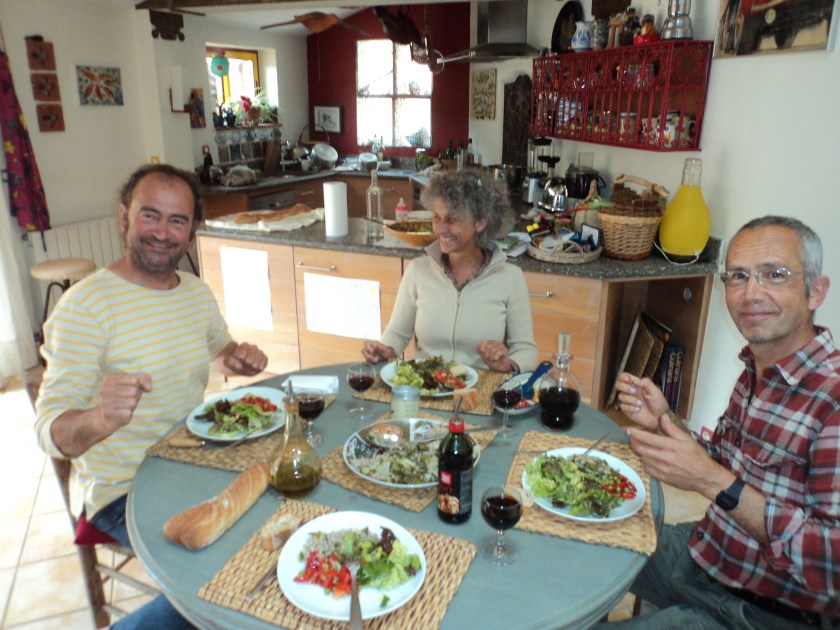
Jean-Pierre, Jocelyne and Robert – sharing lunch up in the house

Jocelyne and Jean-Pierre who own the house where I’m living are the kindest, loveliest people. Mostly I live quite independently and happily down below in my studio, but I have total access to the garden, the fruit trees, the river and its swimming holes (still too cold for me…) and I’ve been invited up to the house a couple of times for apperitifs or lunch… all organic salads straight from the garden. The house is a wonder of art and architecture. Lots of levels and interesting spaces which combine natural timber and stone, inside and outside.  It’s a house made for people to relax, communicate and enjoy. I’m still a bit limited with the communication aspect, but they speak a bit of English and I muddle along with my French.

The weather has been typically Spring-like and quite changeable. Quite hot in the beginning, but with an occasional windy, misty and overcast day. I’m sure it’s going to get even warmer in June.
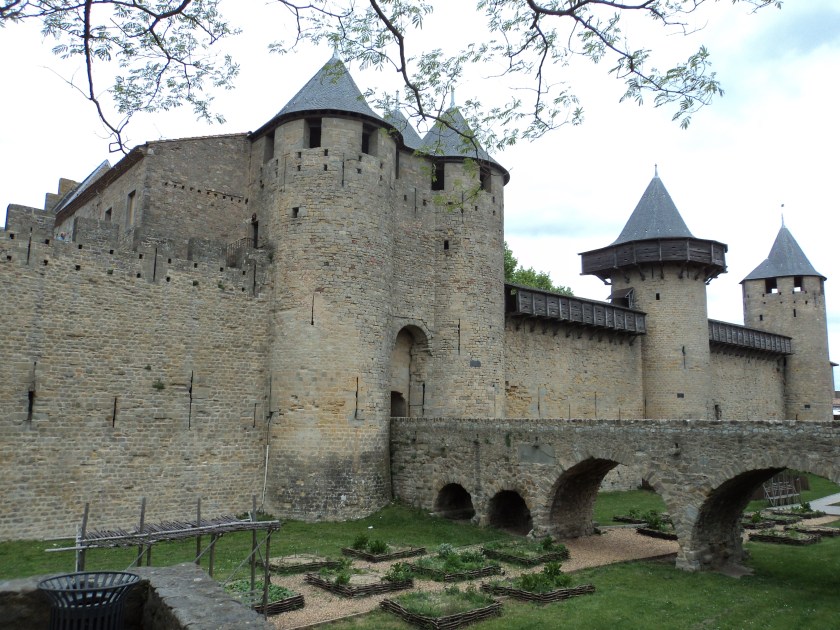
Carcassonne – the castle

I need to write something about the few days I spent travelling with Helen, Steve and Kate (friends from home). I took the train up to Toulouse and met them on their way down from Paris. We had 2 nights in Toulouse in a budget hotel in a seedier part of town, so probably didn’t get the best impression of this city, but it’s not a place I particularly want to visit again. Of course we ‘did’ the cathedral and other little churches, but mainly just strolled around visiting a market, watching artists by the river and eating and drinking. Next day took the train to Carcassonne where we had a great apartment in the old part of the city. Unlike Toulouse, Carcassonne had an immediate magic about it. Dominated by its massive castle, it’s a city one could spend ages in. It’s also on the Canal du Midi which would be a great trip to do on a barge some time. Carcassonne is world heritage listed, truly a lovely place. We spent most of a whole day inside the castle walls. As well as the structure of the castle itself, there are dozens of little shops, hotels and restaurants tucked into narrow streets and corners to tempt the tourist visitors. All quite delightful.
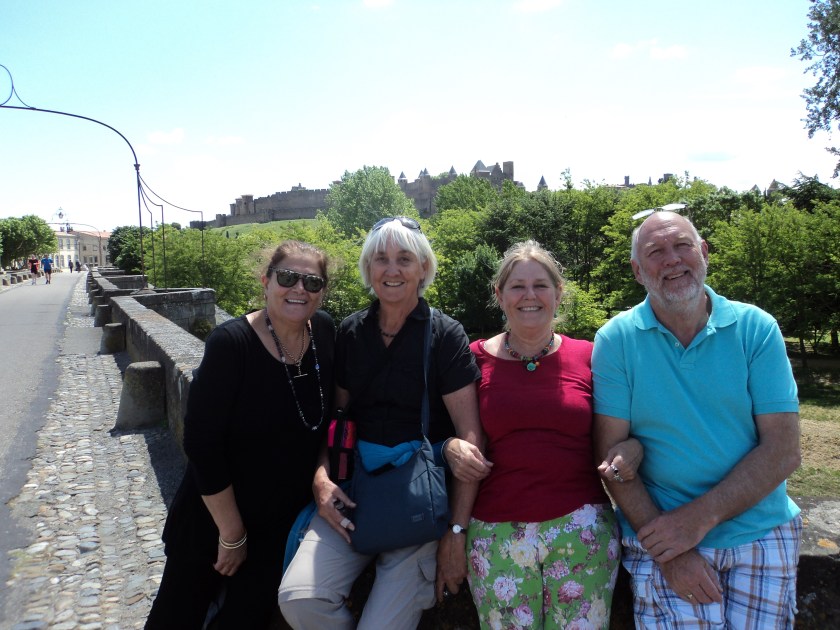
With Kate, Helen and Steve in Carcassonne (castle in the background)

From Carcassonne,  it was on to Montpellier.  Accommodation here was in another apartment about 10 minutes by tram from the huge central plaza, Place de Comedie. The tram system is fantastic…these modern, smooth machines snake their way all over the city and are as attractive as they are functional. They completely outdo the rattling, advertisement-covered trams in Adelaide. The Carcassonne ones are decorated with flowers, sea-creatures or elegant wallpaper, depending on which route they’re on. Everyone uses them because the streets inside the centre of the city are too small for lots of cars anyway. There’s also a little tourist train that winds its way around town – a much more tempting option than the hop-on hop-off buses that many cities have (and that I dislike intensely.) I don’t think we saw a great deal of what Montpellier has to offer, but Helen and I did visit the Museum of Languedoc and took in ancient Roman finds, as well as artworks, furnishings etc of more recent centuries. As a group we spent quite a bit of time in the open-air bars around the Place de Comedie and enjoyed watching the world go by.

I bid au revoir to the others in Montpellier and took the train by myself to Avignon. Seemed the best time to continue the touristy stuff while I was so close.

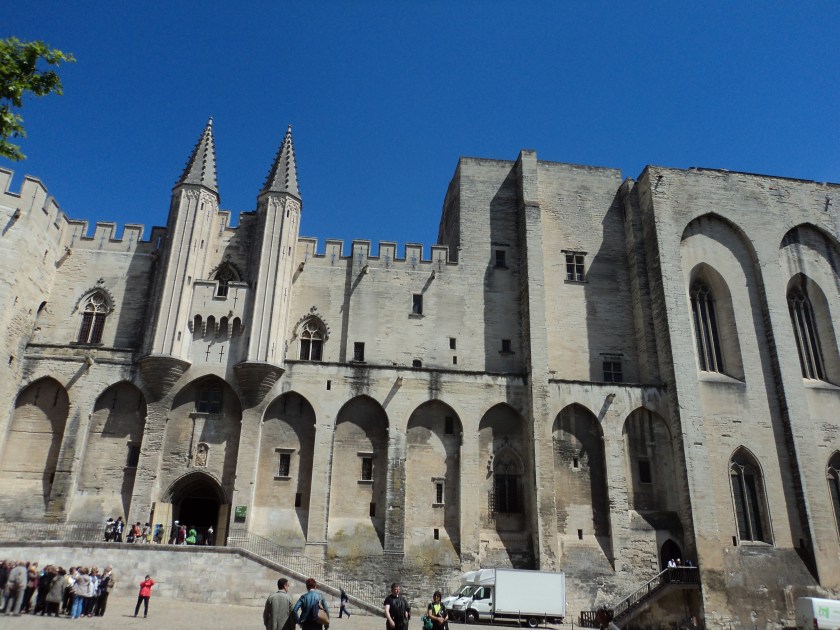
The major sights in Avignon are the Palace of the Popes and the Bridge made famous by the little song (Sur le Pont d’Avignon etc…). I visited both and learnt a bit in the process. Back in the Middle Ages, the centre of the Catholic church was in Avignon, not Rome. The Popes used to travel much more then through their vast tracts of land in Europe to consolidate and expand their dominance. Central France on the mighty Rhone river seemed like a good place to settle down at the time. Over the course of a few hundred years they built their huge palace, adding to and changing it over time. One really has to see it when in Avignon, but I think I’ve just about reached my limit when it comes to more vast draughty halls, stone stairways, ancient kitchens, store-rooms, cellars and chapels. This one was pretty impressive, but they all get a bit the same after a while.
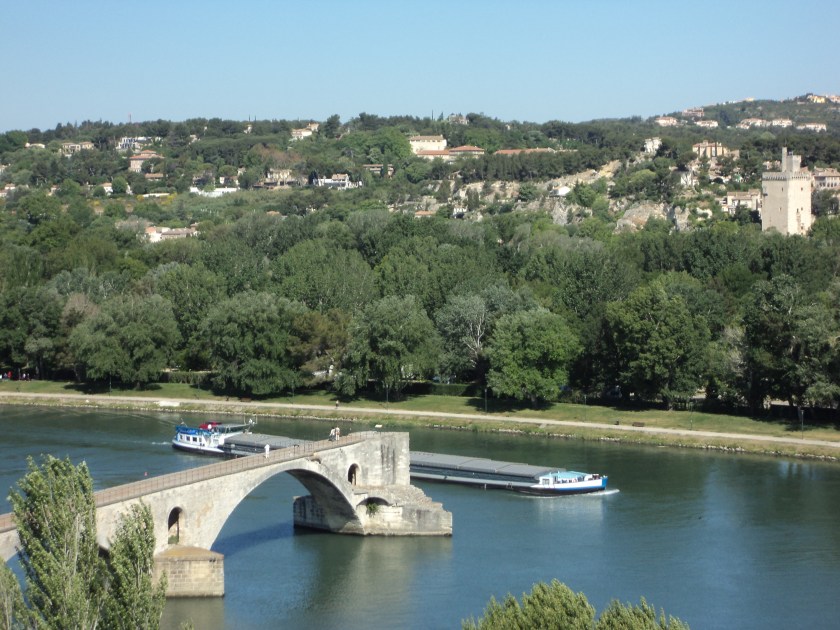
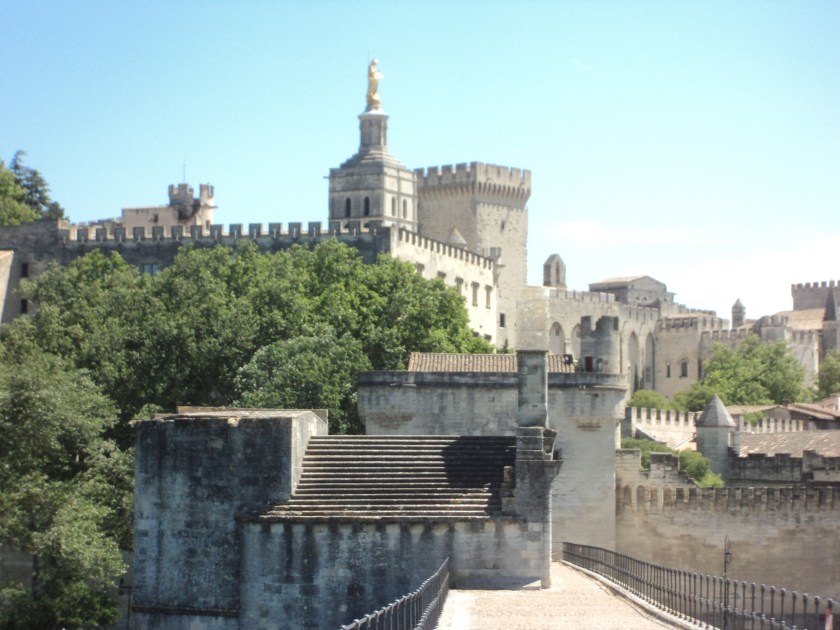
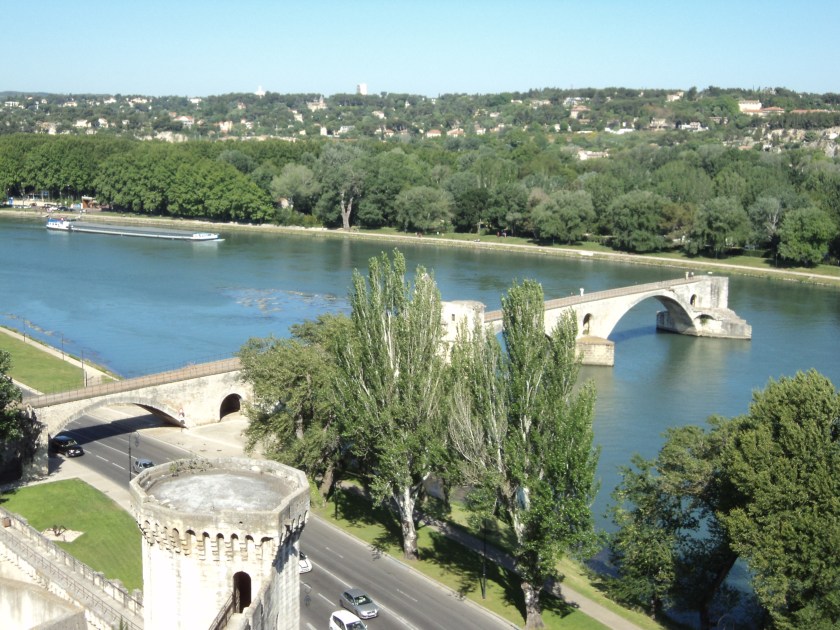
Sur le pont d’Avignon

The Bridge was interesting though…once upon a time it completely spanned the huge Rhone river, linking the territories of the Popes and the lands of the kings of France. Now it’s a bridge to nowhere. It stops in the middle of the river. It was destroyed by floods many times throughout the ages and historians today don’t really even know all of its story. There’s a project under way at present to rebuild a kind of virtual model of what the archaeologists and scholars have been able to piece together. Apparently they do know that it was originally built when a shepherd had a vision telling him that a bridge should be built in that location….hmmm? The little chapel in the middle of the bridge provided shelter to pilgrims back in early days. I’m glad the shelters for modern day Camino pilgrims are a bit more comfortable. Even a bunk in a dormitory beats a cold stone floor above a raging river.

Before leaving Avignon and taking the train back to Perpignan (then the bus home to Reynes), I spent an hour or so wandering in the gardens high up overlooking the city and the river. Great views. Also, mustn’t forget the lovely art gallery which was once the home of a great couterier and collector. He’d acquired some beautiful things, including many Impressionist paintings. There also happened to be a visiting exhibition of Toulouse Latrec. After my day of sight-seeing, I found an attractive little hole-in-the-wall restaurant for dinner…only one other woman in there and she turned out be American, extremely friendly and interesting and as fascinated with the Cathars as I’ve become. We had a very pleasant evening comparing notes. She was off to join a group doing water colour painting in Provence

Lots more to write, including a record of the day Helen, Steve, Kate and I hired a car in Carcassonne and explored some of the old Cathar villages…but the Cathar story deserves a whole entry of its own, so enough for now!

Tuesday 27th May

Several days to catch up on now, because it’s too easy to drift into the slow lane of life on a beautiful mountain in the south of France. Sleeping, reading and doing simple daily chores fill the hours when I’m not out walking and finding little mountain paths in the woods, or going down to Ceret, or enjoying a few glasses of wine with Robert at the end of the day…. or doing any of the other things that make this all so lovely and French.

However ….. we’ve also had a crisis in paradise up here over the past couple of days. Jean-Pierre has walked out. After 30 years of being with Jocelyne, he’s left. Robert and I arrived home from a superb day out on Sunday (more about this in a minute) to find Jocelyne in tears. She was sobbing in French and wanting to talk to Robert so all I could do was give her a hug and disappear to my little nest down below. Robert came down later, quite stunned, but still unaware of what actually happened, or why.
Now it’s 2 days later and there’s still been no word from J-P, and Jocelyne is still understandably quite fragile…. but I’m getting to know her better and Robert is being his very kind self and we’ve all been doing things together. We’ve just come home from a lovely drive through the mountains to the old stone village of Coursteges, almost on the Spanish border. We climbed to the top of one of the mountains, up a rocky stone stairway and a little path through the woods to emerge on what felt like the top of the world. Snow-capped mountains in one direction and the Mediterranean in the other – and all around us the most beautiful mountain vistas, valleys and the tiny village way down below. Impossible to describe the grandeur of the Pyrenees. Back down in the village again we had an excellent lunch at a petit café – the only place to eat – run by a couple of lovely Belgian women. The outing was good for Jocelyne, and a real bonus for me.
Sadly, Robert’s leaving here at the end of the week to go to another job…and I think Jocelyne will definitely miss him. (I’ve just heard that there’s another English woofer coming on Friday… Jocelyne tried to cancel him, but Robert persuaded her that it would be good to have someone here to help, and she can always send him away if it doesn’t work out…)
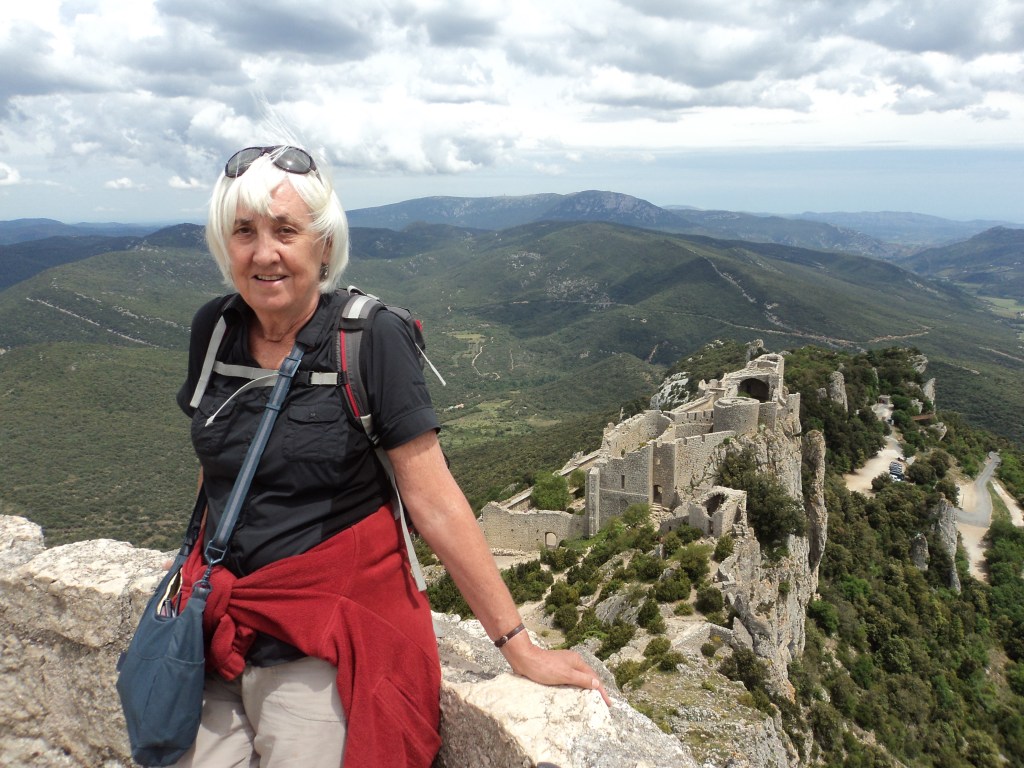
Overlooking Peyrepertruse

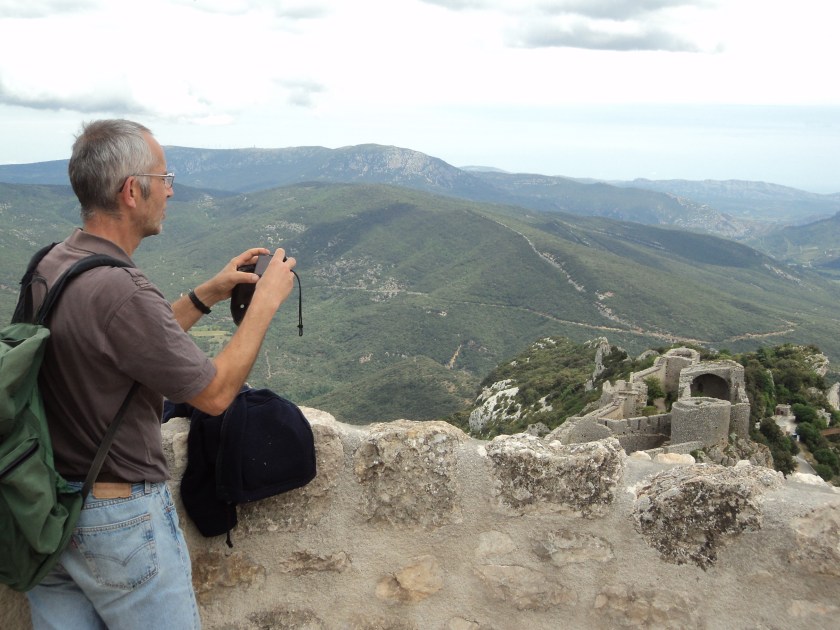
The day the Jean-Pierre drama happened – but before we knew about it – was one of those days when you know you’ve had the privilege of seeing and experiencing something quite special. Robert and I had borrowed the car to drive up to the Cathar castle region, about 2 hours from here – and we got to climb up to the incredible ruins of Queribus and Peyrepertuse, a couple of the last bastions of safety for the Cathars before the armies of the Popes and French kings destroyed them for ever. The castles (more like forts) date from around the year 600, and while they weren’t owned by the Cathars, they provided shelter for them during the days of the inquisition and mass killing. The Cathar story is one of the most tragic and brutal of any history I’ve ever read. I’m at a complete loss to know why I’ve never heard it before. The Roman Catholic church of the Middle Ages was hell-bent on expanding its power and dominance, so the tyrannical popes and their henchmen bishops, cardinals and noblemen set out to torture, rape and murder anyone they deemed to be heretics or non-believers. The Cathars were a peace-loving, Christian people who lived a simple life opposed to the material wealth and power of the church of Rome. And Languedoc (this region) was where their faith and culture was strongest. You need to read about the prolonged massacres, sieges and tyranny that occurred during the 12th century to get even some idea of the evil that was carried out in the name of Catholicism. I picked up an amazing book in Carcassonne that tells the whole story – brilliantly researched and very readable. It’s called “The Perfect Heresy” by historian Stehen O’Shea.
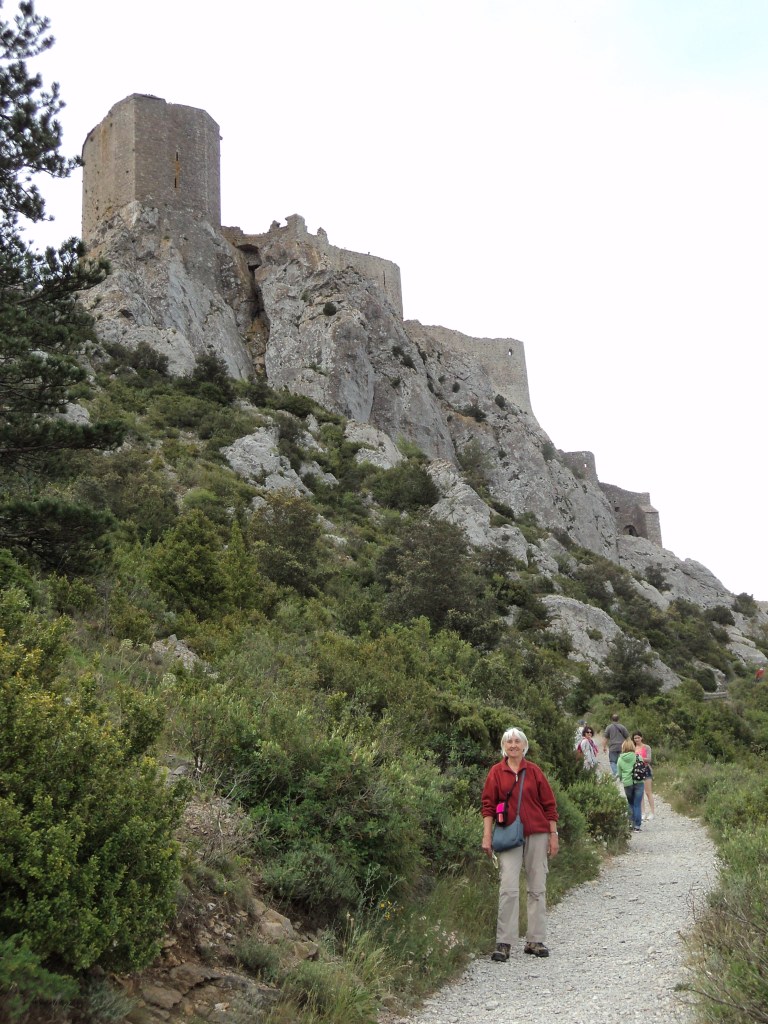
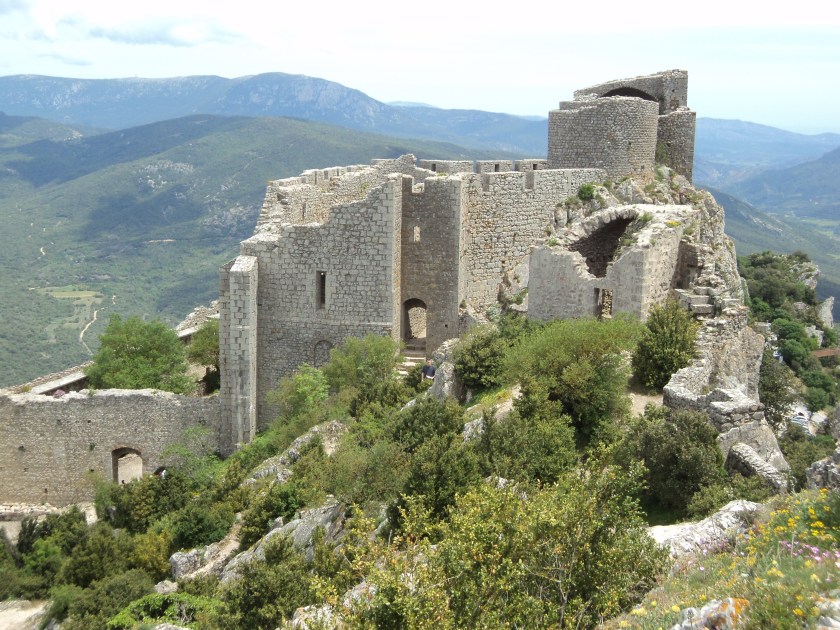
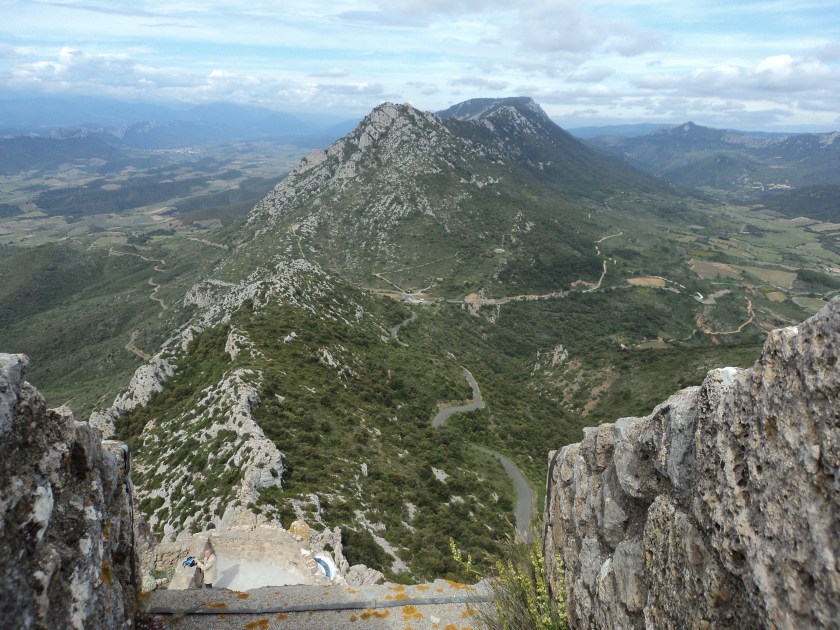
The castles are dotted on mountain tops, way up where eagles fly, all around Languedoc – and all have a very bloody history. The world below seems to spread forever with magnificent valleys miles down below the huge stone walls. How the marauding armies ever defeated the people inside is impossible to imagine, though the book provides some of the barbaric details. Even by the standards of the Middle Ages, the cruelty and inhumanity was appalling.
All the big cities in the Languedoc – Toulouse, Beziers, Montpellier, Albi and others – played a part in the Cathar drama for over a hundred years. It’s little wonder that even today the Catholic church is not strongly worshipped in these parts.
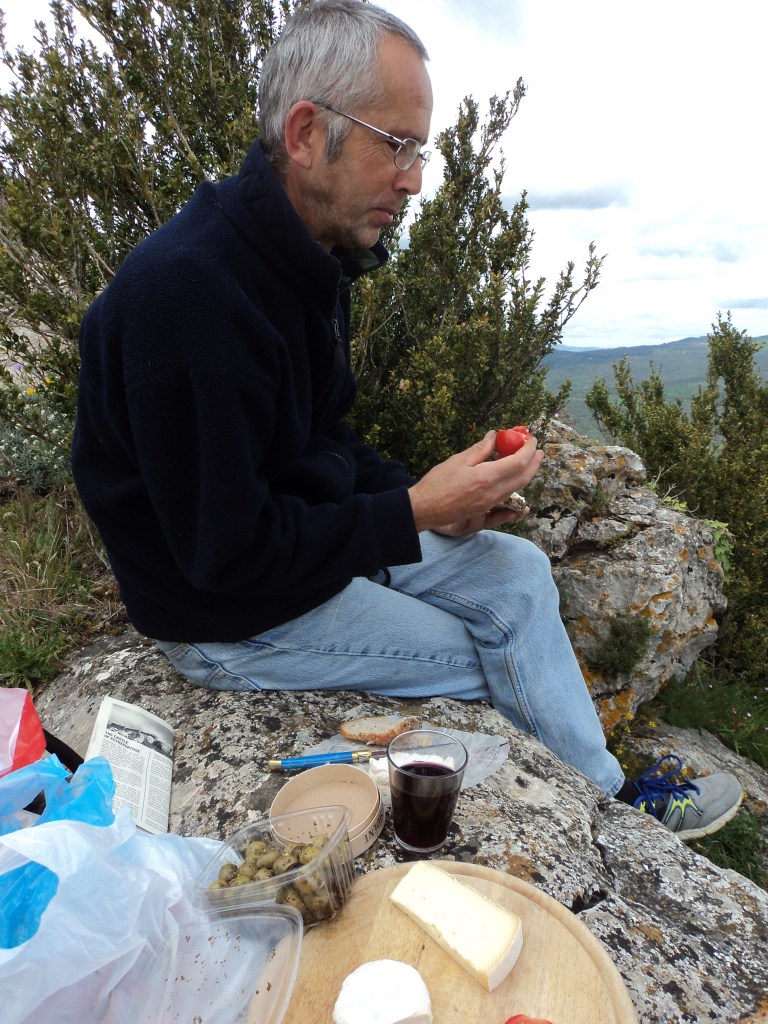
Robert and our picnic lunch high above the Cathar fortress


Robert and I climbed to the top of both castles we visited and it wasn’t too difficult to imagine what it must have been like to see huge armies of knights and foot soldiers advancing in the valleys below. But of course all was quiet and peaceful as we sat on a rock and enjoyed our picnic of bread, cheese, tomatoes, olives and wine, overlooking what felt like half of France and Spain.
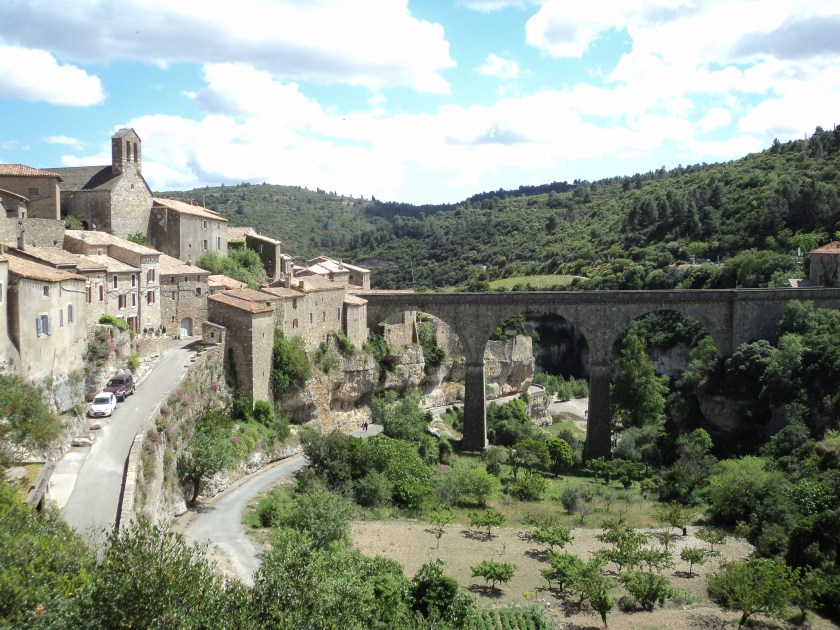
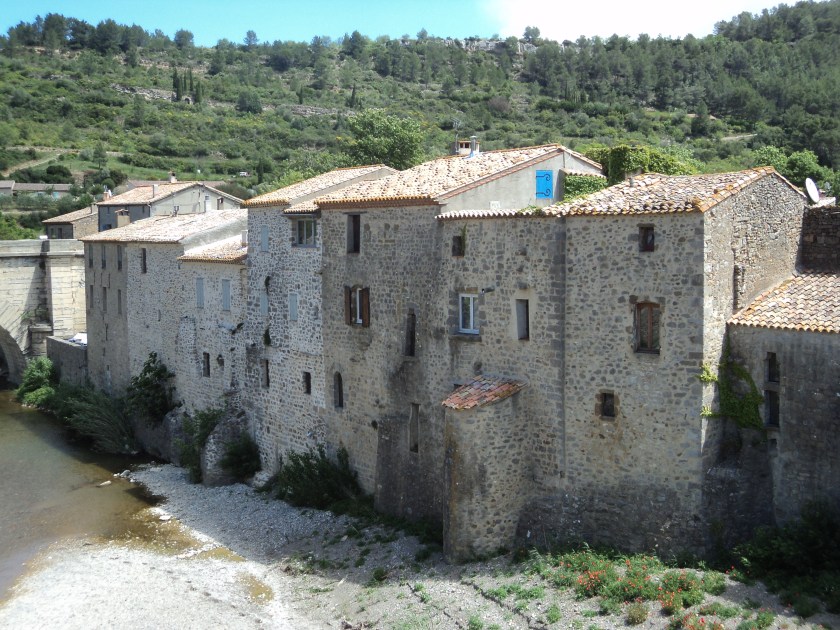
This wasn’t completely my first introduction to the Cathars ….. When we were in Carcassonne, Steve, Helen, Kate and I hired a car for a day and drove to some of the smaller villages that also had a role in the Cathar story. In some places it felt as if not much had changed since the Middle Ages…. an old abbey at Lagrasse, another fortress high on a hill at Lastours and a beautiful bridge and ancient village streets at Minerve. Minerve was once home to a Cathar community, but the entire population was killed by Simon de Montfort in 1210. Modern-day historians have built a model of the deadly trebuchet that was used to pound the village with rocks and destroy the only path the people had to get down to their water supply in the river. Unbelievable, sadistic, power-hungry mania swept across the region until every one of the Cathars had been eliminated. Sadly of course there are more recent, similar atrocities to remember (the Jewish holocaust, Pol Pot in Cambodia, Syria etc) but it remains unfathomable to me how mass murder could have been masterminded on such a scale by the proclaimed head of the dominant church. In the name of the God they believed in. If anyone gets to read this, I urge you to Google the Cathars … and, in particular, have a look at Queribus and Peyrepertuse to learn something of the story and to see how truly beautiful these old ruins are, sited on their mountain tops.
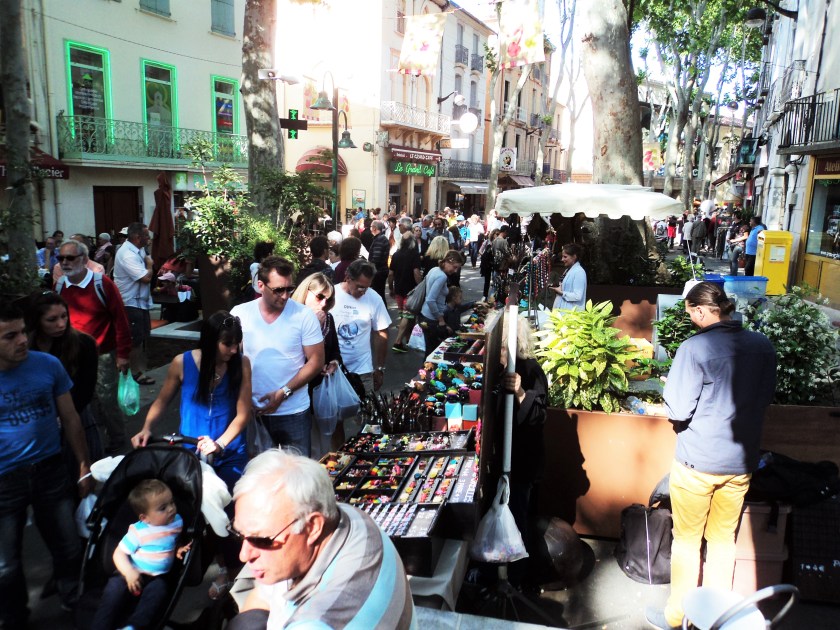
Saturday morning market in Ceret

But now on to happier things, and back to the present day – the Ceret market. I’ve been to some pretty spectacular markets over the years in many places, but Ceret on a Saturday morning would have to beat them all. Every winding street through the whole town is lined with the most attractive stalls and umbrellas, and everyone is there with their baskets to buy delicious local cheese, wine, fruit and vegetables, as well as clothes, hats, arts and crafts, baby pigs, beautiful fabrics, towels, linen, shoes, bags, books, flowers…. everything and more. There’s music, wine, coffee and food in all the cafés – and this all happens every Saturday. Next weekend is the big annual Cherry Festival in Ceret, so the streets will be thronged with people, music, dancing and celebration.

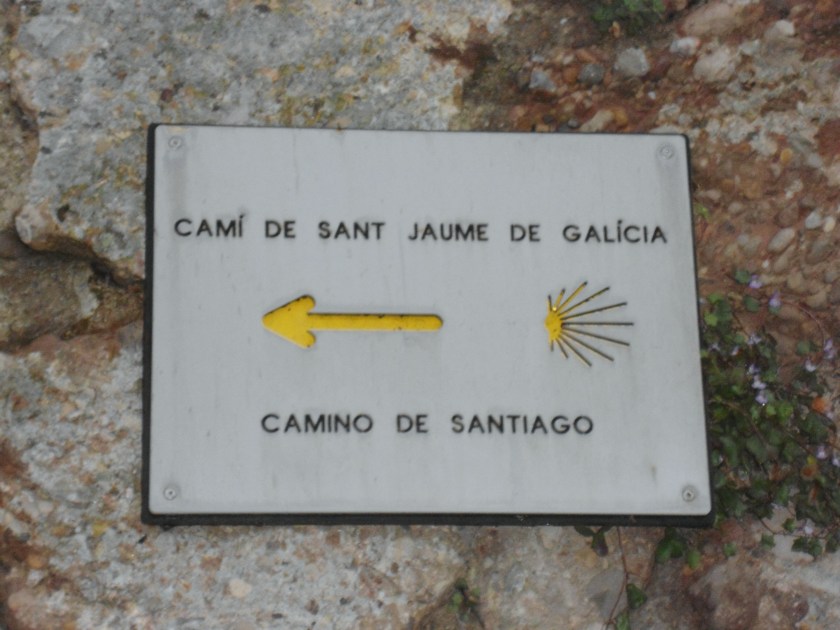
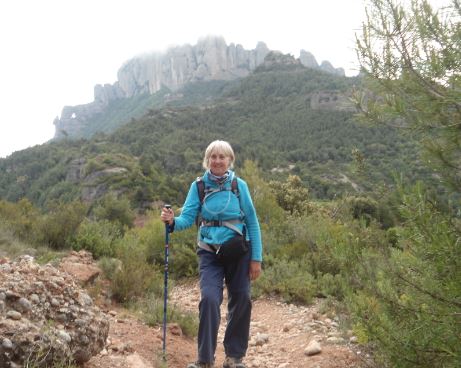
I’m still doing the long walk down the mountain nearly every day (6km), either by the road or on the narrow tracks through the woods -and then up again at the end of the day. Thank heaven for the Camino, I say… I’d never have been able to do this if I hadn’t achieved the Camino. Walking here every day reminds me so much of all those weeks in Spain… even the little paths look and feel the same. I almost expect to meet up with my Camino buddies at the next bar along the way. I’m still enjoying every minute of it and each day seems to bring a new surprise.

Just remembered …. Robert and I went for another drive before he left … up the valley to visit old friends of his at a vegan commune. Only three people left living there and a good veggie garden, but it seems that they barely eat anything … only what’s in season in the garden. Robert told me he just lived on carrots when he was there. Anyway, it was an interesting old house and a different way of life. We meandered our way back through the small villages dotted along the valley and stopped off at a bar for lunch.
Sunday 1st June

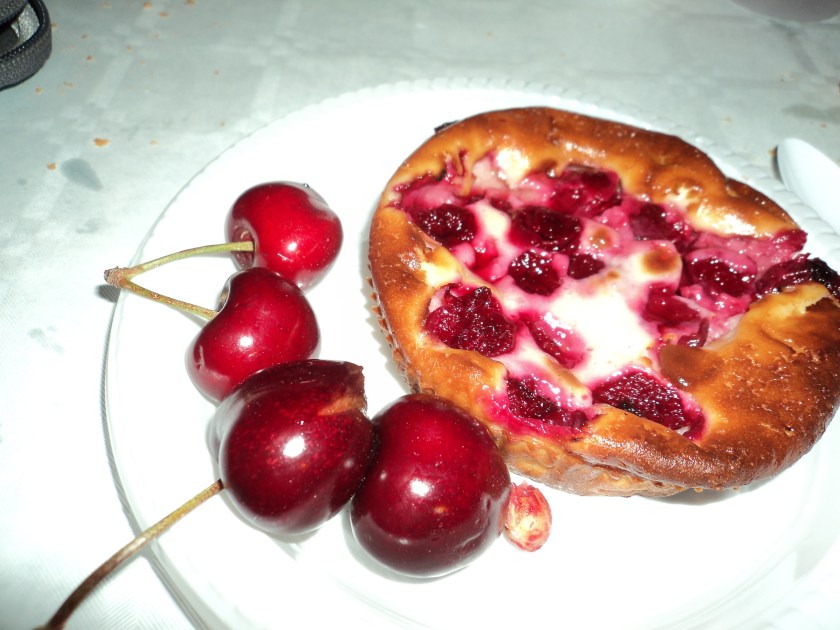
This weekend is the big Cherry Festival in Ceret… markets, music, food, wine and crowds of people. Everything is decorated with cherries and every second market stall is selling them.  All the restaurants have menus based around this little red fruit too. I had a fantastic night last night at the huge open-air Festival feast in one of the town squares. There must have been 500-600 people seated at mile-long tables, absolutely filling the square, sharing a great dinner with lashings of wine, armfuls of baguettes and non-stop music, singing and dancing. I went with Sue and Simon, our English neighbours…. they come and stay in their French home just down the road from Jocelyne’s whenever they can… lovely people.
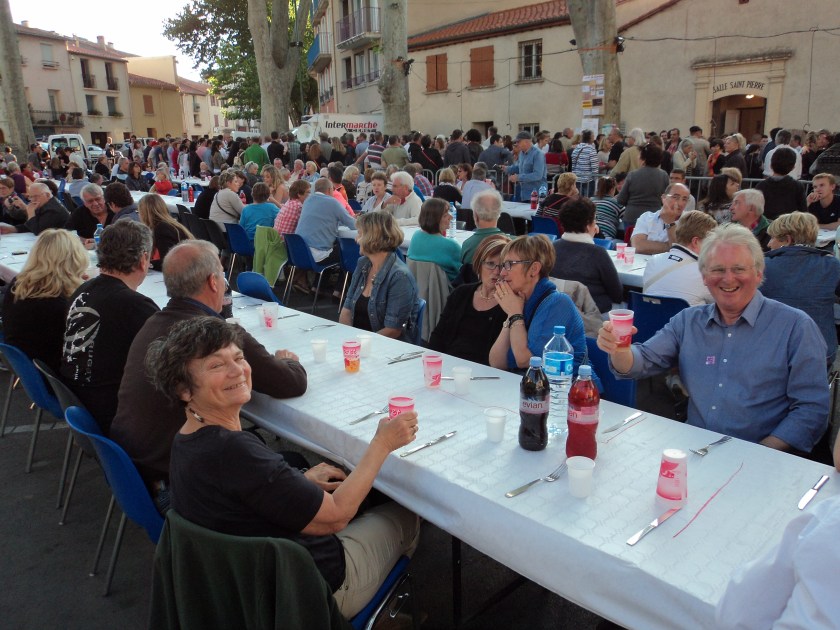
There’s no doubt about it…. French, Spanish and Basque people really know how to enjoy themselves. Everyone sang, cheered, linked arms and swayed to the music… even stood on chairs and danced. The band moved around between the long tables and kept the party atmosphere swinging. All great fun! Got home around midnight

Other events of the past week have included Robert’s departure and Nelson’s arrival. Nelson’s another Brit, and another gentle, semi-hippy soul. He lives on a river boat on the canals in England and comes to France occasionally to do a bit of farm work or similar. Jocelyne is glad he’s here to give her a hand on this huge property. I hadn’t realised just how much land she and Jean-Pierre own until I went with her on an introductory tour when she was showing Nelson around. And it’s even more of a paradise than I’d realised…there are secret paths up the canyon and through the woods that lead to beautiful natural swimming holes, rocky outcrops and old stone-walled terraces with yet more gardens. On one little terrace, some former friends and helpers built the most exquisite little cabin which the family have enjoyed over the years. You’d never have any idea it was there, but when you make the climb up the rocks there’s this gorgeous place with a little kitchen, and sitting room, and tiny bedroom up a ladder in the loft. We sat in the garden enjoying the peace and stillness, and the views across distant mountains to the sea
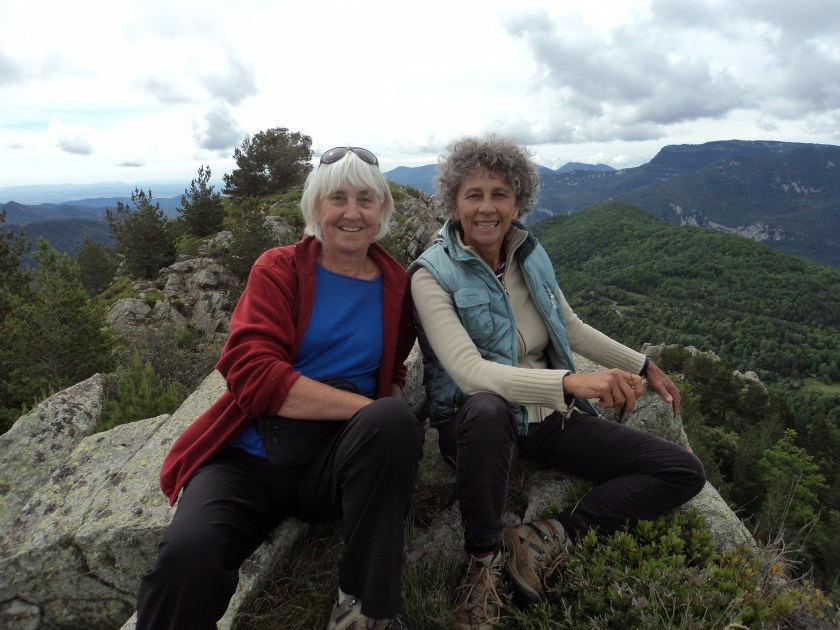
There’s still no word from Jean-Pierre. Jocelyne’s putting on a very brave face and trying to be philosophical but there are still tears from time to time.  A day or two before he left, Robert suggested that we all go for a drive to Coursteges, a village almost on the border of Spain, about an hour from here. A tiny place with an ancient Roman eglise (church), a few old graves, typical shuttered houses and a pretty little café/store with a sunny terrace where we had a simple lunch of locally grown chicken, sausage and salad… after we’d climbed one of the mountains. Up, up, up a rocky track and through a forest until we emerged at the top with a view of snow-capped mountains on one side and the Mediterranean in the distance on the other. A lovely place to just sit and share some time. I couldn’t keep up with all the conversation in French, but I think I’m getting better, and Jocelyne and I communicate well enough with her bit of English and my attempts at francais. (Sorry, I just realised I’ve already written about this ….)

The following day (Wednesday) Jocelyne and I went into Perpignan to both buy new walking shoes. My old faithfuls are still going strong after 5 years of hiking in Spain, the Cotswolds, Scotland and the Adelaide Hills, but they’re looking fairly battered and must meet their demise soon. She took me to an enormous outdoor sports store (more like IKEA than Kathmandu) and we both came away happy. I found a pair for half the price I’d pay at home.

French lessons with Nathalie continue each week but it’s still hard work. I really like her so will keep trying. She also had a little stall at the market this weekend selling her hand-crafted fabric necklaces and bags… I bought one, of course.

Later… Sunday evening:
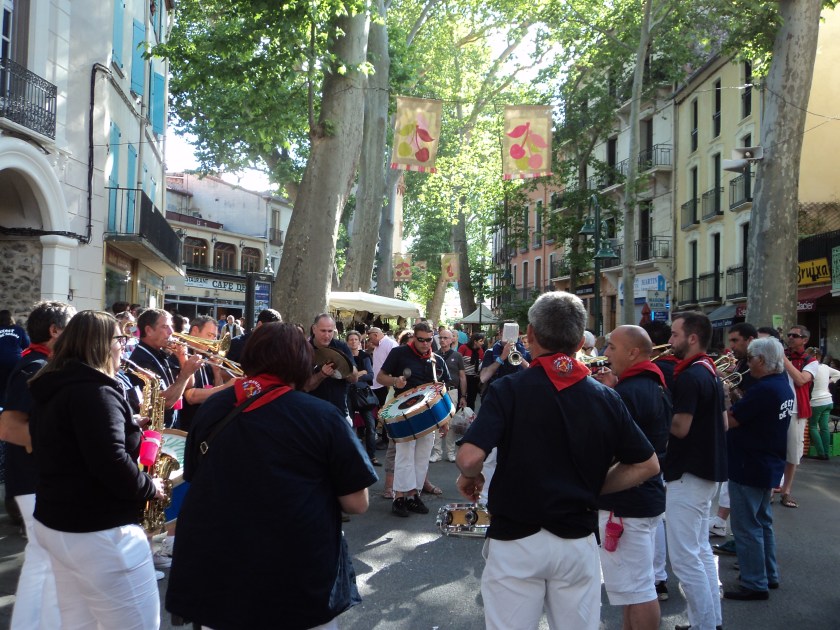
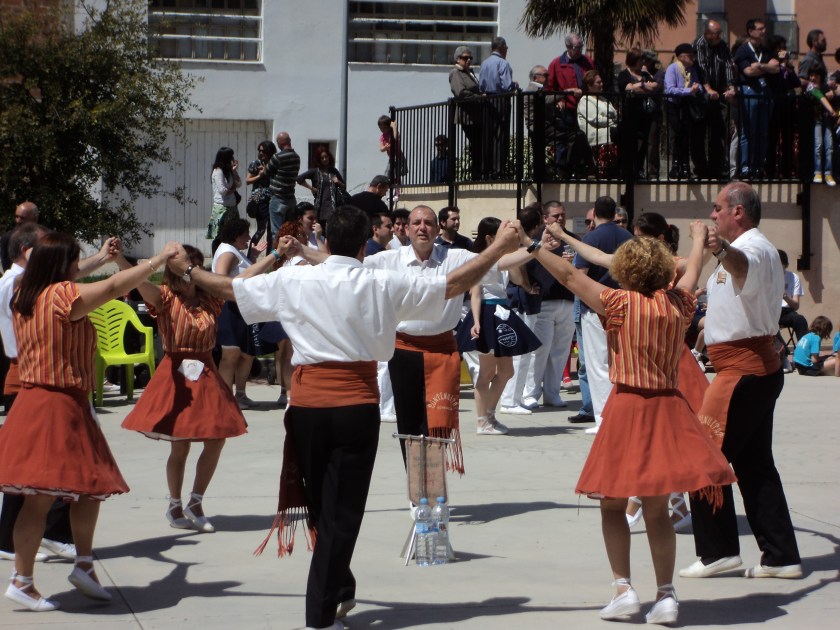
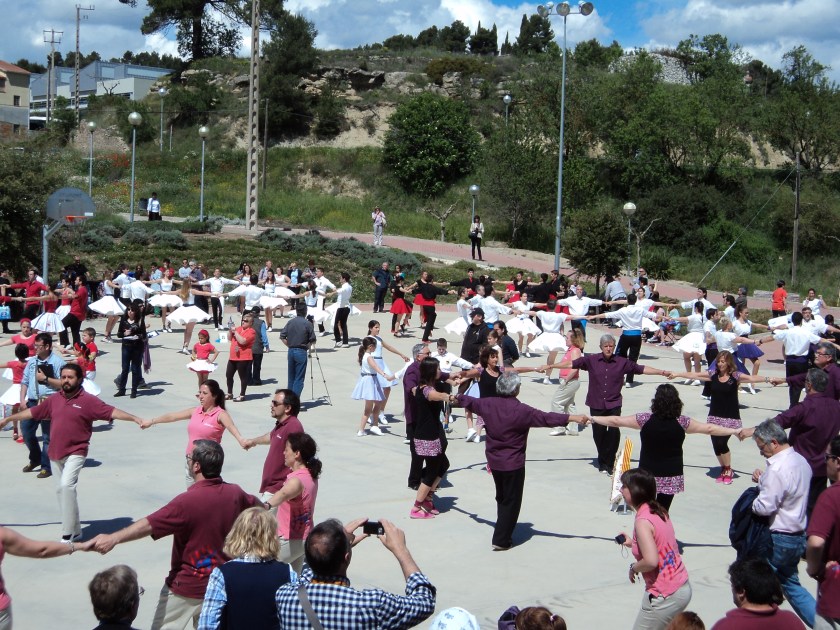
Having lazed away the morning reading and writing, I decided to walk down to the Cherry Festival again. Nelson came with me, across the mountain on the little paths. He’s a very pleasant guy and I think he enjoyed the walk and the beers we had down in the town as much as I did -also, the tradtional music and dancing we watched in the streets, the same slow circle dance I saw in Odena on the other side of the Pyrenees 2 years ago – the Sardane.

The days drift by…. only 4 more weeks here

Friday 6th June

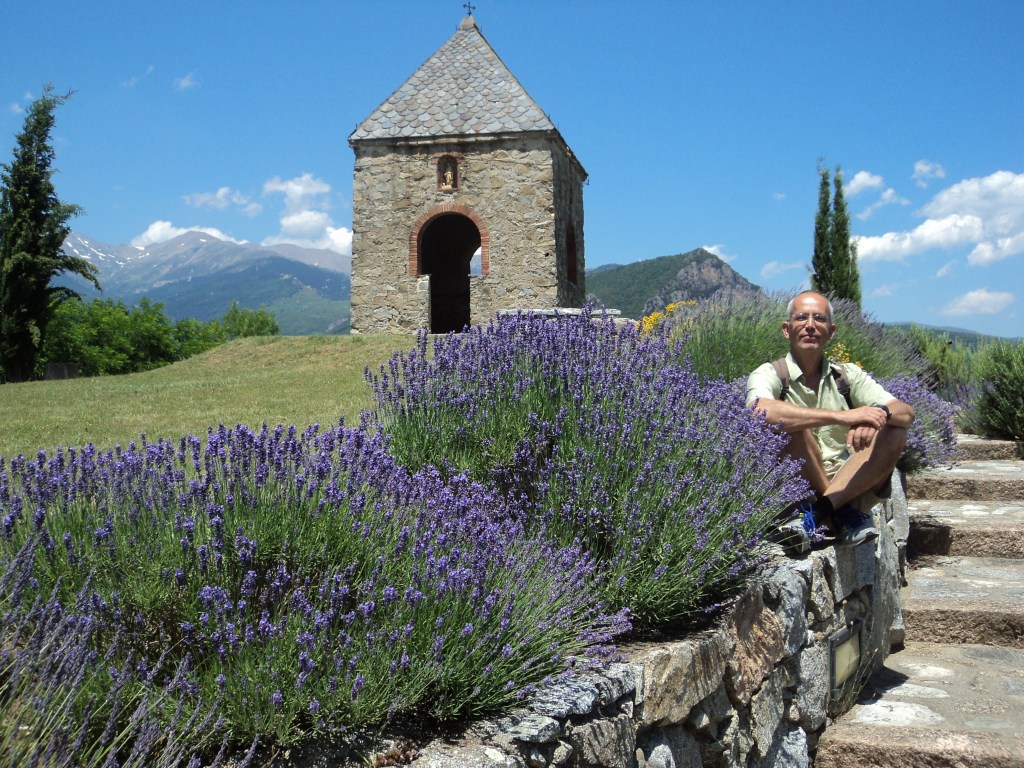
I’m sitting on an ancient bench under a 12th century bell tower in the village of Villefranche (near Prades) in the middle of the Pyrenees. Came up here this morning on the €1 bus – about 3 hours from Reynes, via Perpignan. It’s another quaint little place, like a mini version of Carcassonne…ramparts all around and the houses and shops protected from the marauding Spaniards a couple of mountains away. There are so many of these old fortified towns and villages. A few centuries ago it must have been quite noisy with every lord and nobleman wanting to conquer his neighbour’s territory. Of course it’s all flowers and tourist delights these days with a photo opportunity around every corner. I’ve just had lunch of the most perfect crepe and café au lait in one of the many picturesque little bars down one of the narrow streets. My plan was to visit this valley for a couple of days and take the Petit Train Jaune (little yellow train) up to Mont Louis… but found out on arrival that the train was vandalised during the week and is not running at present. Guess you can’t live under a lucky star for ever!  However, I can still get up there by bus later this afternoon so I’m whiling away time now tapping out this diary note… and life remains very pleasant. I’ll stay overnight in Mont Louis and return ‘home’ some time tomorrow.

Before trying to remember and describe the last few days, it seems I need to explain who some of the people are that I’ve been writing about. Have had a few emails from confused friends trying to sort out who’s who! Here goes…. skip the next paragraph if you have a handle on all the characters in this story ….

Jocelyne and Jean-Pierre own the beautiful place where I’m living…except that Jean-Pierre has unexpectedly taken flight, after more than 20 years with Jocelyne. This happened about a week after I arrived (though the two events are NOT connected, I hasten to add!). It’s a bit of a mystery because he seemed such a happy, outgoing, crazy Frenchman, and they seemed to be great together. Things have been a little fraught since he left, but Jocelyne is putting on a brave face and seems to appreciate having company around the place… the company being me and one or other of the 2 English guys who’ve been at the house since I arrived. The first one was Robert who’s been woofing around France for many years (Woofing = Working on Organic Farms.. voluntary work for food and board). He had another (paid) job lined up so had to leave soon after Jean-Pierre’s departure, but another helper arrived the next day. He, of course, is Nelson. So, as you can see, all these people are new to me, but we’ve become like a strange little ‘family’ up on the mountain. Jocelyne is lovely, and the 2 Brits have both been gentle, kind, interesting guys. To complete the picture of friends and neighbours, I’ve also really enjoyed meeting Sue and Simon who live in London but have a French home about 10 mins walk from Jocelyne’s place. They’re going back to the UK today but have entrusted me with a key to their house so that I can use their wifi, borrow books etc for the remainder of my stay. This is a huge bonus for me, and very kind of them. Nearest internet and wifi otherwise is 9km away in Ceret…unless I strike it lucky in a bar somewhere

Anyway, back to the diary….while the bell above me in Villefranche chimes every now and then, and people continue to stroll through this little square…..
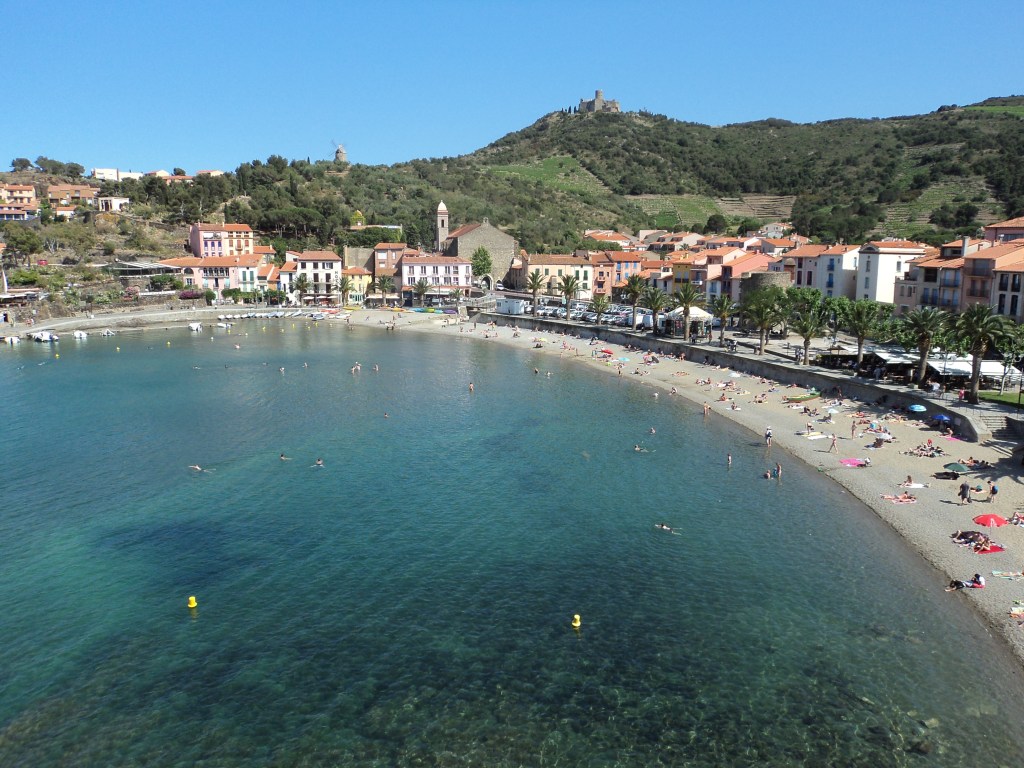
Collioure

On Tuesday, I took myself to the beach on the bus. Argeles-sur-Mer and Collioure are not far away, but the bus took ages, winding its way through every little village en route. But I enjoyed just going with the flow and exploring Argeles when I got there. It’s a very laid-back south-of-France holiday resort place…lots of tourists, restaurants, shops etc and a beautiful wide beach. No one in the water, but lots of people soaking up the sun. I discovered the next bus would take me onto Collioure, and from there I could get back to Perpignan and on to Reynes. And what an absolute gem I discovered Collioure to be…if anyone is planning a trip over this way, put it on the itinerary. It’s gorgeous…a mix of Crete, the Greek islands and a dash of the Cinque Terre, all sprinkled with French chic. Yes, a bit touristy, but so pretty that you just have to love it. The beach is overlooked by a massive fort/castle and there are great walks all around. The shops have beautiful local arts and crafts, trendy clothes, delicious ice-creams and everything else that makes you feel you’re in a special kind of heaven.

The next day was another trip to the beach – but this time it was in the car with Jocelyne & Nelson, so it only rook 25 minutes! Jocelyne, of course, knew the little secret bays and beaches, so we found one all to ouselves and had a gorgous swim in the crystal clear Mediterranean. Then went for a walk around the beach-side paths, past quaint holiday houses, and had coffee at a bar overlooking another beach.. and then had another swim. It was a great morning, and really good to see Jocelyne being happy. Nelson has proven to be a great companion for her and very capable with all the work that needs to be done around the huge garden. He and I also share the odd cup of tea together (unlike Robert, he doesn’t drink wine). We continue to analyse the Jocelyne/Jean-Pierre situation without yet coming up with any answers.

Yesterday (Thursday) was my French lesson in Ceret, so I decided to try a new walk to get there, via a little chapel that was supposed to be worth a look. Turned out to be quite an adventure, and a 4 &1/2 hour hike across mountains, getting lost in the woods, and just having to try to find any path that would lead to a bridge across the river! Finally made it but then had the mental exhaustion of French conversation to follow. I dreaded the 6km walk back up the mountain to get home, but fortunately got a lift almost straight away with 3 young NZ guys who were staying quite near…amazing who you meet in the mountains in France!

So that brings things pretty much up to the present.

Later, same day (Friday)

Left Villefranche at 4.45pm….on the first bus going further up into the mountains. There’s no doubt about Villefranche being a lovely little place, but a couple of hours is more than enough to enjoy it. Hanging around for a bus tested my patience. However, coming up here to Mont Louis made it all worth while. Would have been brilliant to have been able to come in the Yellow Train, but the bus trip was spectacular too. I have no idea what the elevation is here, but it’s well above the snow-line and the road just kept climbing up one hairpin bend after another.  I thought the mountains were high around Reynes (and they are) but they seem like foot hills compared to this. I’m writing this on the balcony of my hotel looking out to snowy mountains only a stone’s throw away across a beautiful green valley with little chalet houses dotted around… a lot like Switzerland. The sun is still shining and it’s 7.30pm. I went for a walk in the walled, historic village opposite the hotel when I arrived, then came back and had a swim in the indoor pool…decided to get my money’s worth. It’s costing $A90 for the night, but hey…once in a while there’s no harm in a bit of luxury…besides, there wasn’t any other choice!

There’s wifi down in the bar, so I’ll go and get myself a beer and do some emailing  Haven’t decided what I’ll do tomorrow….

Saturday 14th June

Last entry finished up in the mountains at Mont Louis, over a week ago, so there’s heaps to fill in.

On the home front, there’ve been a couple of developments. Jean-Pierre came to see Jocelyne one day – looking completely “lost and distraught”, according to Nelson – primarily to tell her that the partnership is definitely over and that he’s going to Africa to work as a mechanic somewhere in the mines. She’s bearing up pretty well considering (guilt? relief?). On reflection, it seems too easy to cast J-P as the bad guy in the situation. I don’t think he’s a bad person and I’m sure it wouldn’t have been easy for him. I just wish them both well. (Having done the same thing myself some years ago – i.e. walked out of a marriage – I can’t pass judgement).

Jocelyne has to sell the house, of course, but that might be happening sooner than she thought too. An estate agent brought a couple here this week to look at the place -and they seemed interested. Phil and Graham …. from guess where?? Sydney!! They were here for 2 1/2 hours and I reckon they’d be perfect new owners… fit, strong guys, mid-forties and rich. They own houses in London and Bondi, so why not add another gorgeous place in France?

But now back to my travels……
Last Saturday dawned pleasantly up in Mont Louis, but soon descended into a comedy of errors….or got lost in translation somewhere. I’d called into the little tourist office in the old walled town, and had good news to start the day…the little Yellow Train would be running again! Great! After the disappointment of not being able to ride in it the previous day, this was positive. So, with only half an hour ’til the next one was scheduled, I hot-footed down to the station 1km away only to be told by the station man that “non, non” the line was still broken and there would only be “le bus“. Slightly peeved, I resigned myself to wait for yet another bus, when what should rattle into view but a very bright yellow train! I don’t know who had their wires crossed, but clearly there WAS a yellow train going somewhere with a whole lot of people on board. So – who knows or cares where it came from – I decided on the spur of the moment to take a ride further up the line and see where I got to. It turned out to be a pleasant trip for an hour and a half, sitting alone in the open-roofed carriage, surrounded by mountains and valleys, going to La Tour de Carol, on the Spanish border. Unfortunately though, there’s not much to do in sleepy little Tour de Carol on a very hot Sunday afternoon so I mostly ended up waiting, waiting, waiting for a bus to take me down again. But at least when it came, it went all the way back to Perpignan.
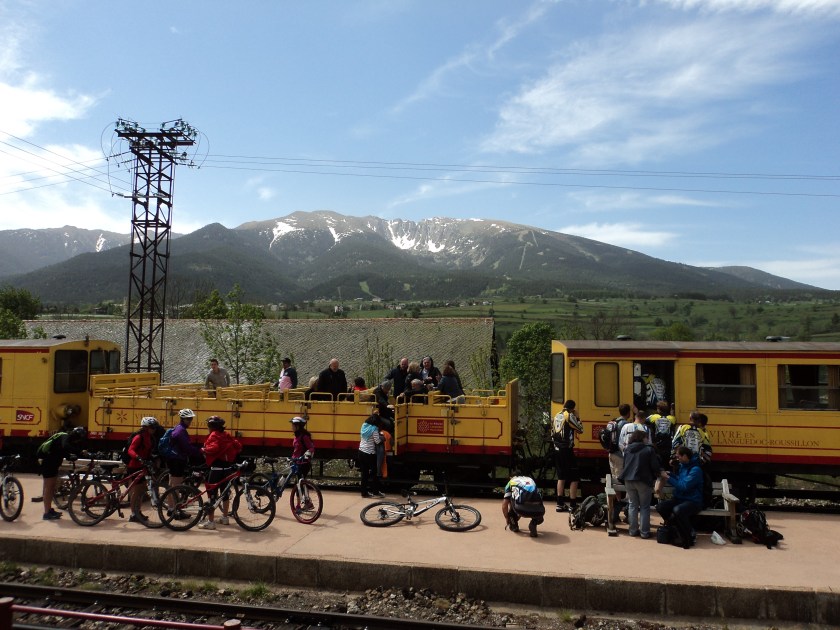
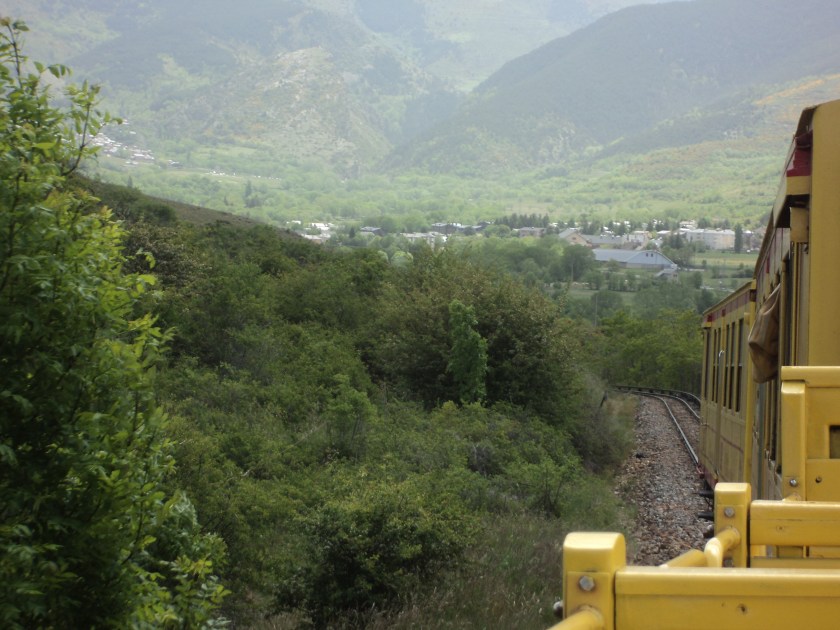
Going back down the mountains on the bus was actually more visually stunning than the morning’s train ride. I think it must be best to take the train through the gorges and ravines on the lower section of the line, but I guess that’s the section of track that’s still under repair.
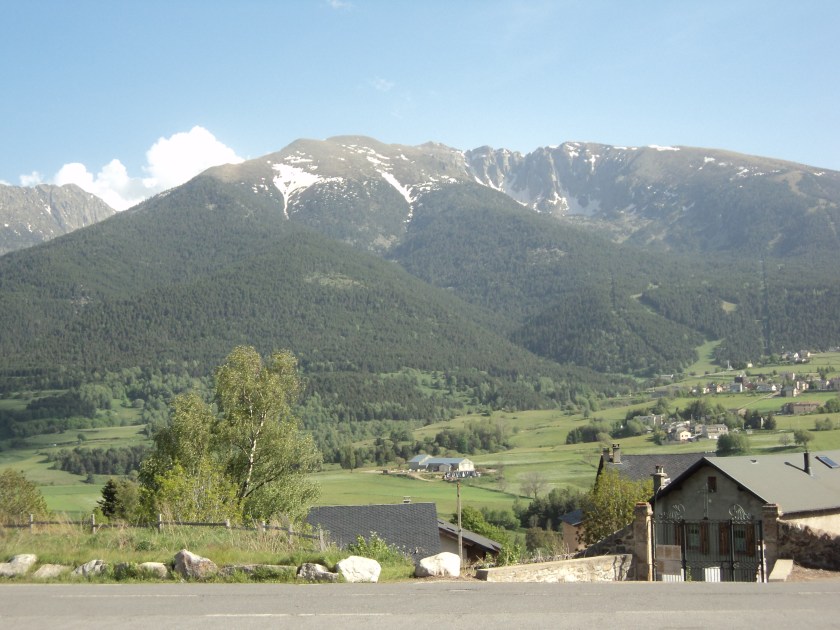
Still snow high in the mountains

The towns and villages in the high Pyrenees are obviously popular ski resorts. They all looked a bit sleepy in the summer sun, but I can imagine them turning on the charm -and the cash registers- as soon as the snow arrives.

It was fabulous to visit this region, but I’m still glad I’m living near Ceret and Reynes. Until it got really hot here towards the end of the week, we had a few days of sheer perfection ….warm and sunny and so peaceful in the garden. I took a book and a pillow down to the rock pools in the canyon one afternoon and lazed away a few hours in bliss. It doesn’t get dark until about 9.30pm either and the evenings are gorgeous.
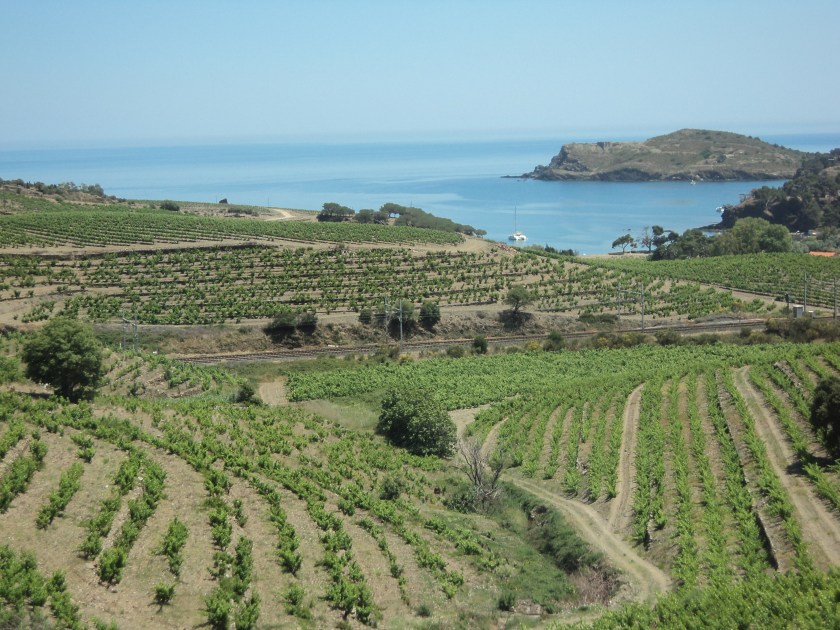
Sun, grape vines and the blue Mediterranean ….
life in the south of France

Major outings during the week have been a couple of bus trips. The local bus authority that operates the 1 euro buses also runs a program of very cheap half and full day trips to places of interest – even to Barcelona and Montserrat. On Wednesday I did a trip to Collioure again. The bus took a very scenic route along the coast, past miles of lovely beaches and hills covered with terraces and grape vines. There are wineries everywhere – a lot like the southern vales at home, only more mountainous. Then we had 3 hours in Collioure before the bus came back. I swam, took photos, and wandered through the pretty shops and little streets again. It’s quite touristy, but very relaxed and welcoming.

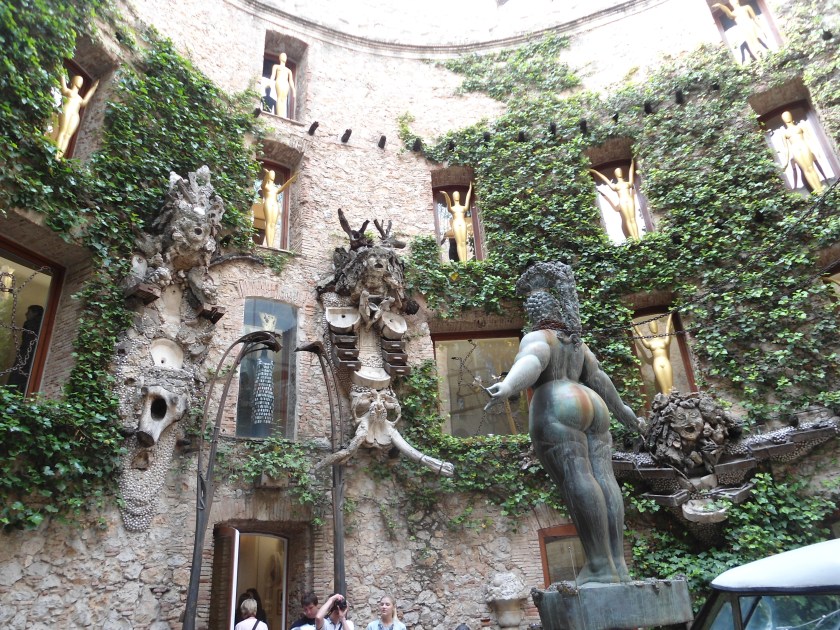
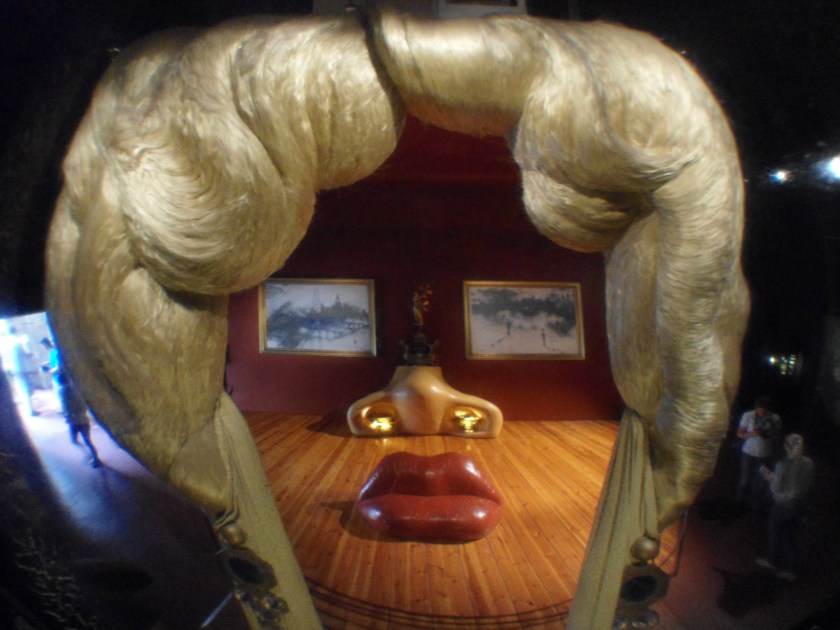
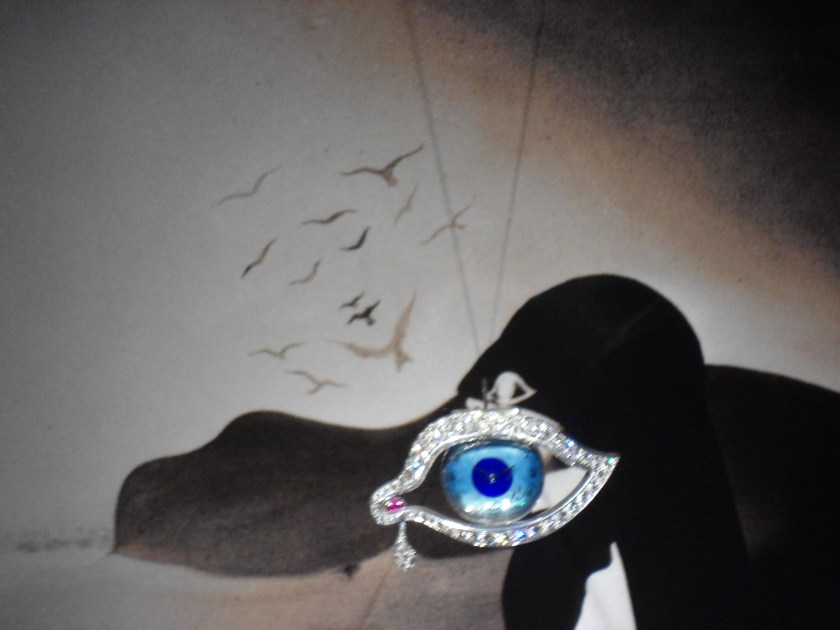
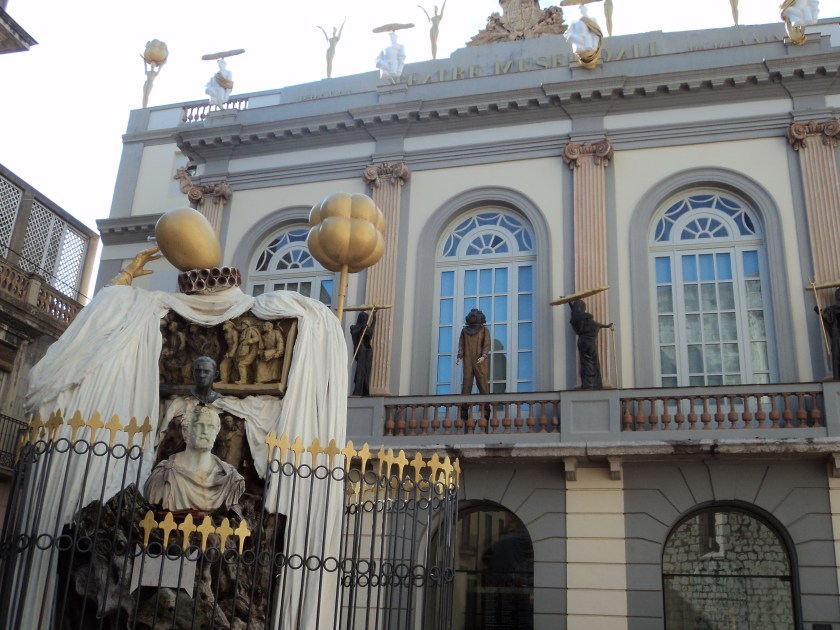
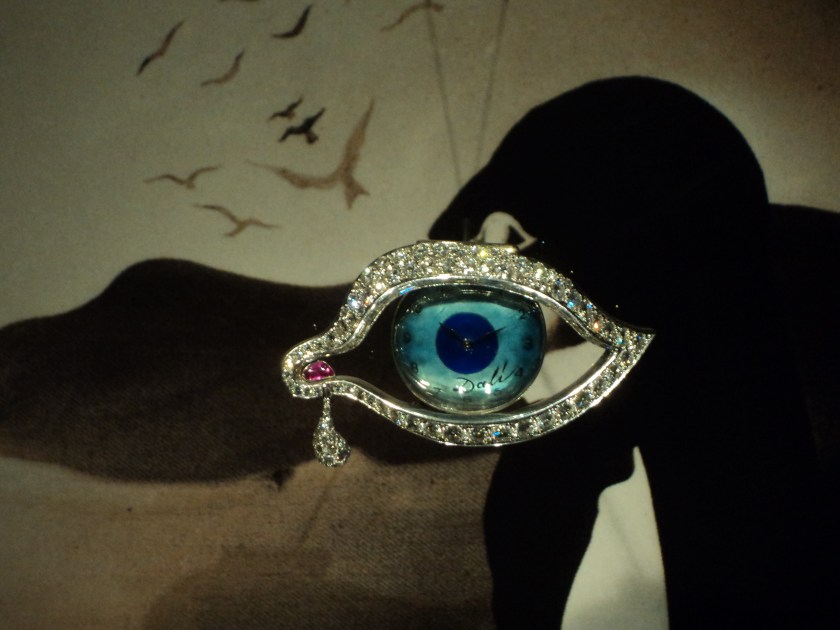
My second Escapade (what they call these bus trips) was to Empiabravura and Figueres in Spain, about an hour away. Ben (my son) and I enjoyed Figueres and the Salvador Dali museum when we were there 2 years ago. Wish he could have been here this time too. First stop, Empiabravura, is an amazing, over the top artificial kind of brash tourist place, with over 30 km of canals snaking their way between white wedding-cake type houses, and boats of all shapes, sizes and bank balances motoring around. If you think you’ve seen floating palaces anywhere, believe me, you ain’t seen nothing until you’ve seen Empiabravura…..though I wouldn’t recommend it to anyone. It was so good to get to Figueres which, despite hordes of camera clicking tourists, and souvenir shops with every Dali icon imaginable, is still rather a charming, quirky old city. And it has one of my most favourite museums in the world….the Dali Jewels. I loved this collection so much when I was here the first time I even bought the TV shirt. So it was wonderful to have another opportunity.. the sublimely beautiful diamond and sapphire ‘eye’ is still one of the most perfect things I’ve ever seen. Salvador Dali was truly a genius, whatever one thinks of his surrealist paintings, and his influence on the art in the streets of Figueres is evident everywhere. I’m very much looking to another bus Escapade in a week or so to Cadaques where he lived for most of his life.
Sunday morning 15th June
Must finish this today and wander over to Sue and Simon’s to send it off. It’s been so good to have access to their wifi close to home. Haven’t yet decided what to do with the rest of the day…the options are many.

Had a very enjoyable evening last night over dinner with Jocelyne, Nelson and good friends of hers. A strong mix of French and English spoken throughout the evening…. I’m finding I can understand a lot more now, and even join in conversations a bit. It really does require constant exposure, so I’ll probably lose it all again at home.

Enjoying a drink on my balcony with the people who drove me up the mountain

I’m still walking a lot. This week, during the heat, the old song about mad dogs and English men popped into my head often as I trudged along in the sun…but mostly I enjoy following the little paths through the woods where local farmers and others have probably trudged for centuries. Of course I still hitch-hike back up and have met some lovely people this way. 2 days ago a couple of French holidaymakers drove me all the home, then came in and shared a bottle of wine with me. I invited Jocelyne down to meet them and they discovered by an amazing coincidence that Patrice came from the same small town where Jocelyne grew up, over near the German border. It is indeed a small and wonderful world!

Friday 20th June

Enthusiasm for this journal is waning a bit, but of course there’s more to record so I can be sure to remember it all in future. And, naturally, there’s another episode of ‘Passion in the Pyrenees’ to relate. The tale of Jocelyne & John-Pierre has taken another turn. … now definitely a soap opera, with one of the main characters on his way to Africa…..and the other two…. well, you wouldn’t believe it in Mills & Boon.
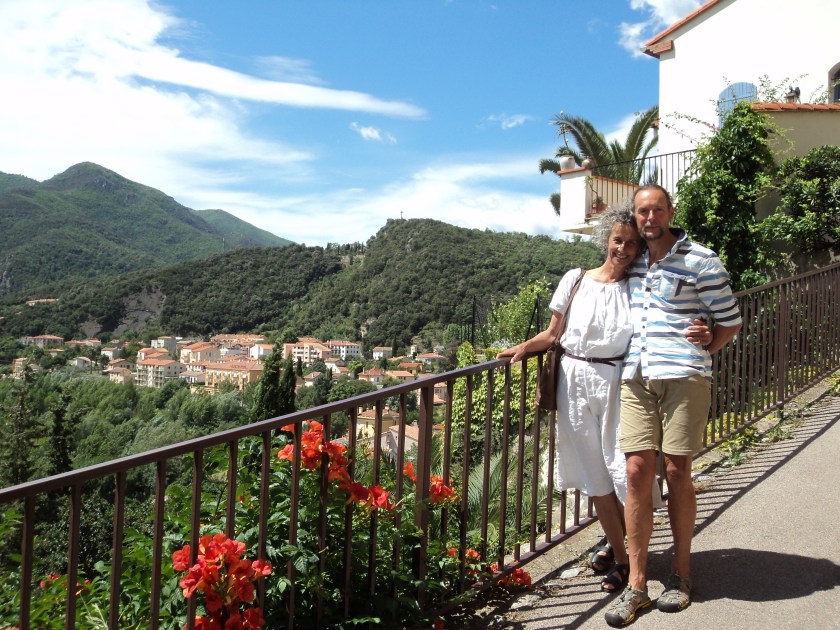
Jocelyne and Nelson at Palalda

The fact is that Jocelyne and Nelson have now hooked up together!! Within the past 10 days or so, they’ve become an item, with lots of coquettish giggling on her part, and gallant strongman stuff on his. It could be quite sickening except that in a funny way, it does seem genuine. I became aware of it about a week ago and couldn’t help wondering at the apparent craziness of it. Jean-Pierre has only been gone for a matter of weeks, and Nelson has only appeared on the scene since then. However, Jocelyne is certainly no longer the grieving, jilted lover – she’s enjoying more than just Nelson’s shoulder to cry on these days….

He’s set to go back to the UK next week, but they’re already talking about “the future”. Nelson actually shared the details with me over a beer last night. I’d been wondering how he was feeling about this very obvious turn of events but it hadn’t really been my business to ask, so I was pleased when he raised the subject. He said it happened quite suddenly – but it seems it didn’t take him long to think it was a good idea. He is a bloke after all, and she’s an attractive French woman….. and they are both sufficiently unconventional for it possibly to work. She’s a free spirit (or will be when the house gets sold) and he lives on a boat … so who knows? And it would make a fabulous TV soapie. Too bad I’ll probably never get to see the last episode. (Aha …. see the very end of this post for the outcome …. )

They’ve gone away for an overnighter somewhere today – and I’ve also been away for a couple of days during the week but I still feel included as part of the household, despite the changed dynamics. We had another lovely, relaxed dinner together last night with Carmen & Yves, friends of Jocelyne’s. Nelson and I still struggle along together when the conversation is all in French, and life on the mountain goes on very happily. I can’t help wondering though what all Jocelyne’s friends are thinking. Jean-Pierre must have been a big part of the house and the wider friendship group for a long time. But, c’est la vie, I guess.

While all this has been going on, I’ve continued my jaunts around the countryside making the most of the remainder of my time here. I traveled up to Quillan on Tuesday (2 buses, 3 hours total journey, all for the equivalent of $3). Met 2 extremely nice Perth women on one bus – kindred spirits, my age, also enjoying the benefits of the €1 bus system. Shared tips and hints about places to see, things to do. I stayed 2 nights in Quillan and did day trips out from there. It was only 1 hour from Carcassonne so I went up there again to take a boat ride on the Canal au Midi. A peaceful trip, through a couple of locks, but obviously not as much fun as it would be to hire a boat with friends and spend a week or more cruising through rural France. Saw plenty of pleasure craft doing exactly that.
Another side trip from Quillan included a couple of hours at Arlet- le-Bains, a beautiful medieval village with Roman remains, a 9th century abbey, 12th century merchant houses and even an ancient house where Nostradamus is said to have lived. There are so many of these old villages tucked away in the countryside, and each one has its own magic.
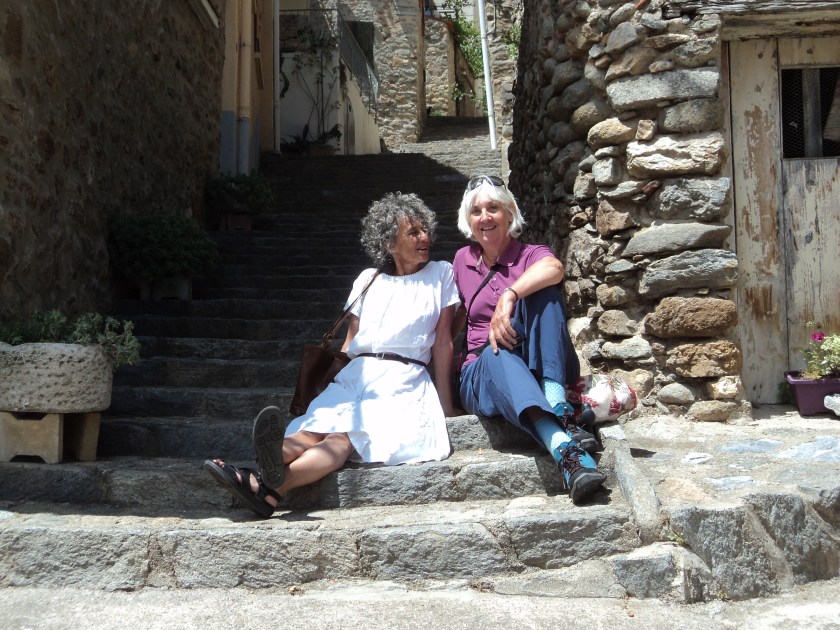
Jocelyne and me at Palalda

Just before this little trip, Jocelyne, Nelson and I visited Palalda, not very far from home…it’s exquisite, especially when the Sunday market is happening with little stalls set up in tiny squares and stairways. We also saw art and craft exhibitions, and a terrific permanent exhibition on the life and work of Charles Rennie Mackintosh who spent the last years of his life in this valley. He’s the Scottish architect and designer responsible for many of Glasgow’s fine buildings – and, like many other artists, he loved the life in France.
While in and around Quillan, I also visited a special perfumed garden near Limoux. What a heady mix of colour, design and scents it was. A lovely way to pass a couple of hours.

I headed back to Perpignan on Thursday morning – partly to give me time to explore more of this city, but also to ensure that I could actually get back. There’s been a train strike on for about 3 days which has also affected some of the bus services. Fortunately I had no trouble but I hope it’s resolved before I have to get to Barcelona for the flight home….
Perpignan is quite a big, spread out city and supposedly the most international city in France, with 25% of its residents being Catalan, another high proportion north African, along with a smattering of everything else. I found it very attractive, built on both sides of the little River Basse, with big parks, gardens and avenues of huge plane trees, Catalan architecture and a typical jumble of winding narrow streets in the historic sector. A great cathedral (of course) where an organist was pounding out some stirring music, and next door a very old cloistered cemetery….no graves in it any more, but some quite moving sculptures on the theme of peace and tolerance. I enjoyed seeing more of the city, having really only been acquainted with the big bus and train station until now.

Still Friday afternoon – a bit later
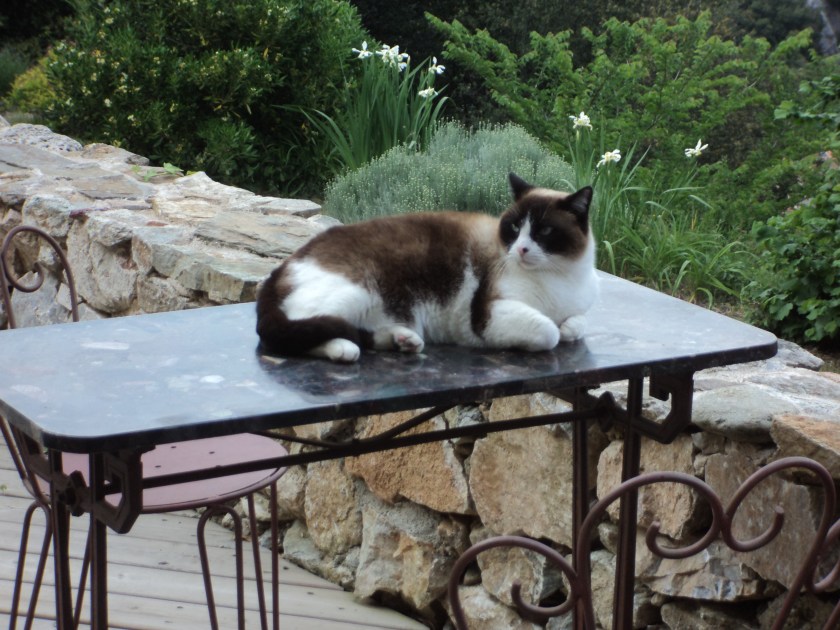
Took a break to wander round the garden. It’s quite relaxing having the whole place to myself while Jocelyne and Nelson are away. I have to feed the cat later. Just picked a bowl full of raspberries for dinner. I’m invited to pick whatever I want any time… there’s masses of stuff growing everywhere. And it’s been interesting to see how the seasons and crops change as time goes by. Even in the 7 weeks I’ve been here, I’ve seen the cherries and strawberries come and go, and now it’s time for apricots and raspberries. The fig tree outside my window was just a bunch of heavily pruned sticks when I arrived…..it’s now totally covered with big green leaves. Also all the snow that was capping the peaks on the biggest mountains nearby has now completely disappeared. May and June are lovely months to be in this part of the world.

With just over a week remaining here for me. I wonder how Jocelyne will be when Super Nelson leaves? Maybe there’s still another episode in the wings before I write the final pages of le Journal de Reynes.

Wednesday 25th June

Should have realised….just because it’s my last week, things don’t stop happening.   So here we go again…..

After one day of peace and solitude at home while Jocelyne & Nelson were away, I needed to get out on Saturday, so took the bus to Collioure again. A long trip, via Perpignan this time, but well worth it for the pleasure of getting to the beach and swimming in the Med again. J’adore Collioure…it’s such a relaxed, anything goes, sort of place with none of the pretentiousness of other Mediterranean resorts, but so, so pretty
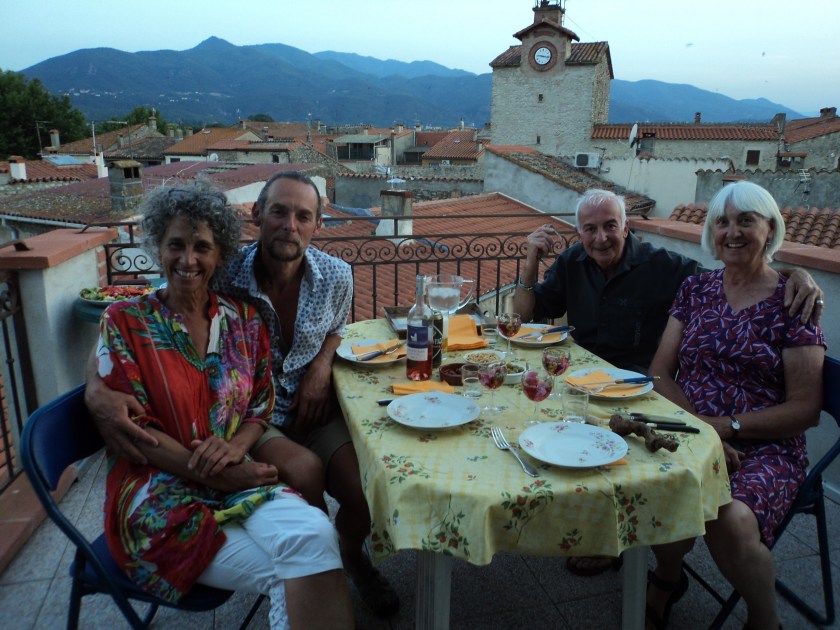
Dinner with Annie and Gerard

Arrived back at Pont de Reynes ( the local bus stop) at 8pm, all set for the walk up the mountain, only to find Jocelyne and Nelson waiting in the car for me to go to dinner at Annie and Gerard’s place.  Wasn’t aware I’d been invited, and looked quite disheveled with bathers still on under clothes etc,  but threw the towel and backpack in and went off with them to the nearby village of St Jean Pla de Cour. And what a treat the evening turned out to be!  Annie and Gerard are the loveliest couple, both artists -she’s a painter, he makes wooden furniture – and their house is like something out of a story book. A tiny village house in a corner of a little square, but the cosiest place inside, on 4 levels, with narrow stairs, great wooden beams, an absolute mass of paintings and bric-a-brac everywhere, and a roof-top terrace overlooking the village, the bell-tower and the surrounding mountains and valleys. We sat out over dinner on the terrace ’til midnight. There was music coming from somewhere all evening too, because it was the Festival of Music in all these villages this weekend.

On Monday I went up the valley to Prats de Mollo again…I’d enjoyed it the first time, and wanted to do some walking in the area. Actually took the bus to La Preste at the end of the line, beyond Prats, but found nothing much there except a couple of posh hotels with thermal baths and pretty mountain scenery. Treated myself to coffee and chocolate cake while waiting for the next bus down again. There was some sort of fête day in Prats (they have so many festivals and holidays over here…there’s always a village with something happening) but the market and festivities were happening a way out of town – too difficult to get to without a car. So I watched the men playing boule for a while (we call it petanque)… and then set off on a lovely walk through the forests. There’s something quite exciting and beautiful following little paths all alone in the mountains. I had a map, and the trails are fairly well way marked, so there wasn’t really much risk, though I wouldn’t have liked to sprain an ankle or meet a sanglier (wild boar) on the track. Speaking of these animals, there are apparently loads of them in the Pyrenees We saw some in the car headlights on the way home from Annie and Gerard’s place the other night….three fat, piggy bottoms scurrying along and down into the trees

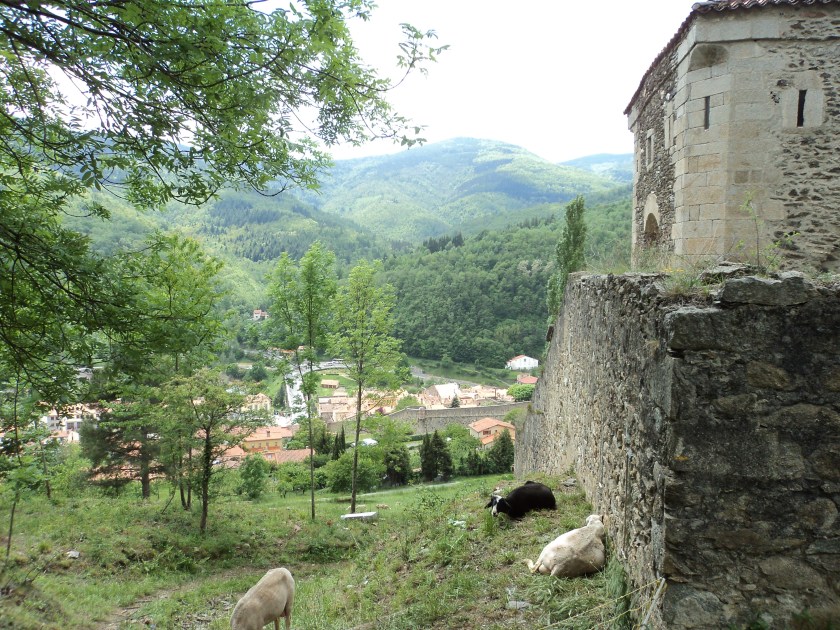
While I was waiting to leave Prats de Mollo, a huge thunderstorm struck. It had been threatening all day, but the skies opened with a crash just before the bus came along. It rained heavily all the way back down the valley (about an hour’s trip) and I was anticipating a long, wet hike back up the mountain when I got to Reynes. However, who should be at the bus stop again but Jocelyne and Nelson….he was catching the bus I’d been on to get into Perpignan to start his journey home to England. So after fond farewells and French kisses, Jocelyne and I waved him off and we drove home in comfort while the rain continued to pour!

It’s been a bit cooler since the storm, which is really quite pleasant. It’s .still definitely summer, but not the hot sun and high humidity. It was perfect for my outing yesterday. Went on another bus escapade to Cadaques in Spain, where Salvador Dali lived most of his life.
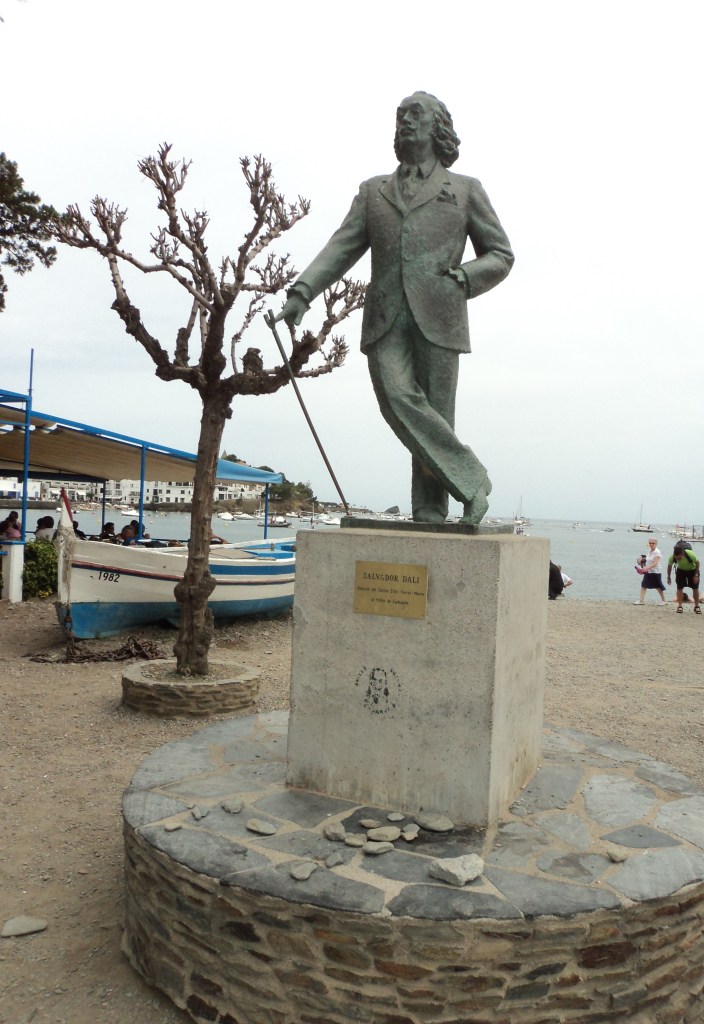
Salvador Dali at Cadaques

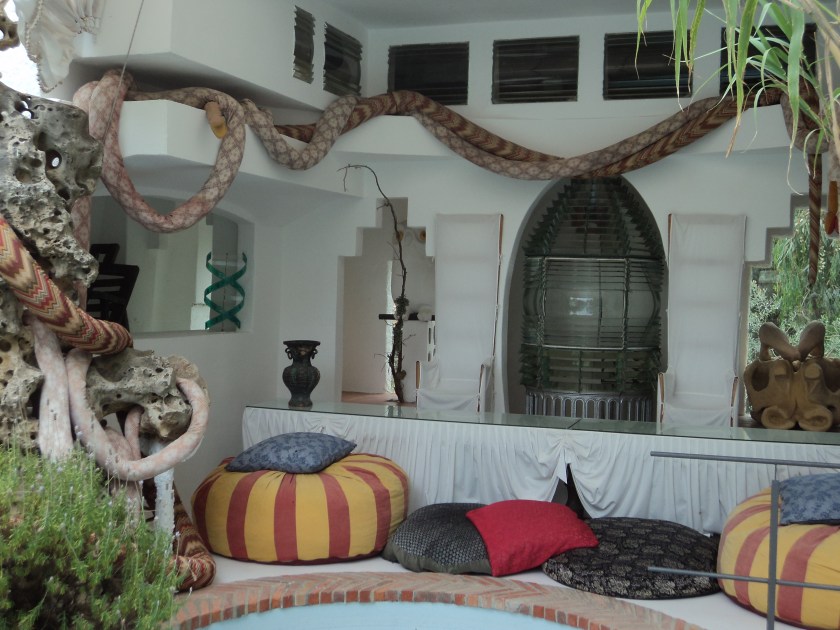
Back in 1930 when Dali discovered the little fishing bay of Portlligat about 1km from Cadaques, there were no roads, only mule tracks across the mountains. Today there’s a fairly tortuous winding mountain road into Cadaques, frequented by tourist buses and holidaymakers, because apart from the lure of the Dali house, Cadaques is a very attractive Spanish village with pebbly beaches, colorful fishing boats, boutiques, bars, restaurants and all the other essentials that tourists want. The Escapade bus was only there for 2 1/2 hours, so I had to move fast to find my way on foot to Casa Dali and have even a remote chance of actually getting a ticket to go inside.  You’re supposed to book way ahead to get a ticket, and I found when I got there that the next places wouldn’t be available until the evening. However, the woman at the ticket office said to come back in 10 minutes in case there were any cancelations for the 4pm visit. And, guess what, my lucky angel was working overtime again….I got in! You have to go with a guide, only 8 people at a time, because some of the rooms are quite small and there are little stairways and terraces poked into tiny corners. But I’m so happy to have seen it…it’s totally unconventional and beautiful with windows and mirrors designed to capture superbly framed views of the sea and the gardens outside, an amazing collection of decorative objects and furniture, a couple of original, unfinished paintings in the studio, a stunning phallic shaped swimming pool and courtyards, and one room full of photos of Dali and his wife Gala with other artists, actors and the rich and famous. They lived there until Gala died in 1982, at which time Dali stopped painting.
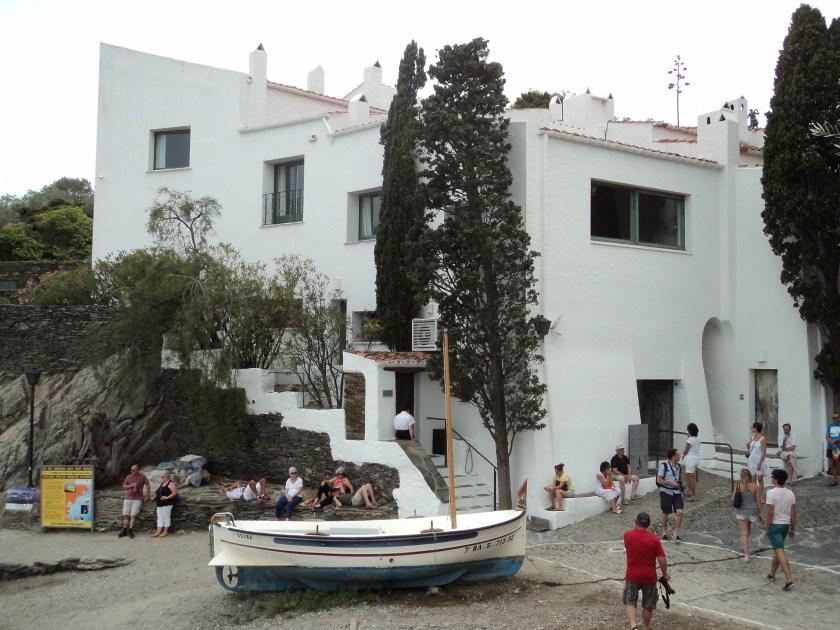
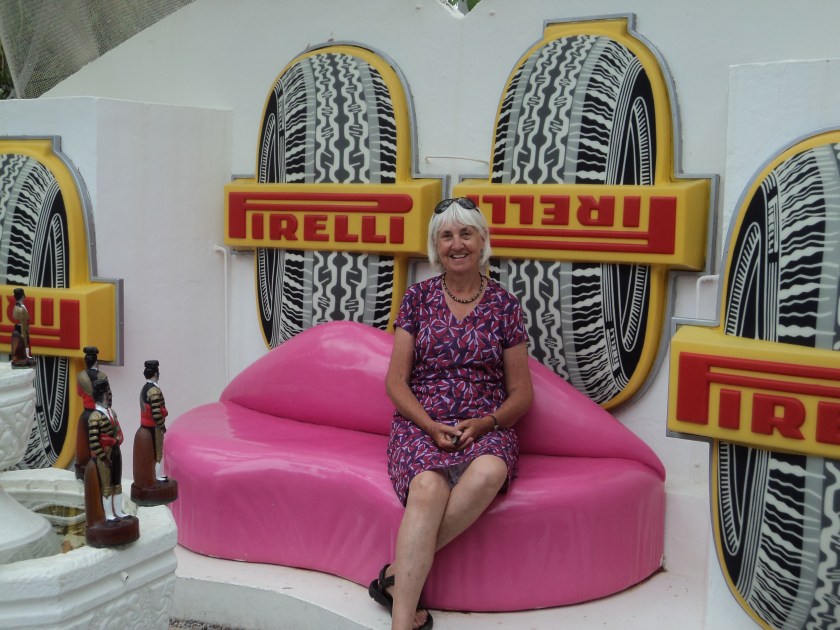
The house was created throughout the 40-50 years they lived there…a kind of labyrinth of beautiful spaces, cobbled together brilliantly as they added new rooms and terraces. In a way, it’s exactly what Jean-Pierre and Jocelyne have done here, and many other beautiful French and Spanish houses too. Curves, twists, up and down, nooks and crannies where you’d least expect them and fabulous Catalan wrought iron balconies and balustrades. What I’d give to have some Gaudi or Dali inspiration in the round building I live in…

Friday 27th

Had my last French lesson with Nathalie in Ceret yesterday. Sadly I don’t think I’ve improved much despite her best efforts and an hour of total French conversation each week. I still sound like a stuttering 4 year old most of the time. It’s quite depressing not being able to have a proper conversation with all these lovely people I’ve met. They all have enough English to get meaning across both ways.  Jocelyne’s shared more of her story of life with Jean-Pierre with me too. She’s still keen to talk about Nelson and possible options for the future. He certainly arrived at a special time for her, but I’m not sure if she’s more in love with the idea of having a lover, than in love with him. However it’s still a happening thing so will be interesting to see what develops.

This morning we went to the beach again – Jocelyne, her 80 year old friend Danielle, and me. Went early and had a glorious stretch of beach almost to ourselves. The sea was reasonably warm, and from the water you could see all the nearby mountains, including the Canigou still with a bit of snow on top. What an amazing place this whole region is…no wonder it’s such a popular holiday destination. Apparently from next week on, for all of July and August, it’s standing room only everywhere. Argeles-sur-mer is described as the camping capital of Europe. There are camping grounds all over the place and hundreds of big RUVs cruising around already. It could all be like a massive theme park when the masses move in, so it’s a perfect time for me to be saying Au revoir to the Mediterranean

Only 3 more days before I take the train down to Girona, then bus to Barcelona airport.

*************************************************************

YEARS LATER (2020) – here’s the end of the story of Jocelyne and Nelson ….
I kept in touch with both Jocelyne and Nelson for a while and even met up with Nelson a few times in subsequent years when I was in Europe. It turns out that it all became very difficult maintaining the relationship beyond the initial flourish. Jocelyne was distraught again and wrote to me for help in tracking him down.
I provided as much sympathy as I could but was NOT going to get involved any further. Nelson had made it clear that he wanted out. She later wrote and told me about the new man she’d met … a Parisian!
Devon and Cornwall, UK 2015

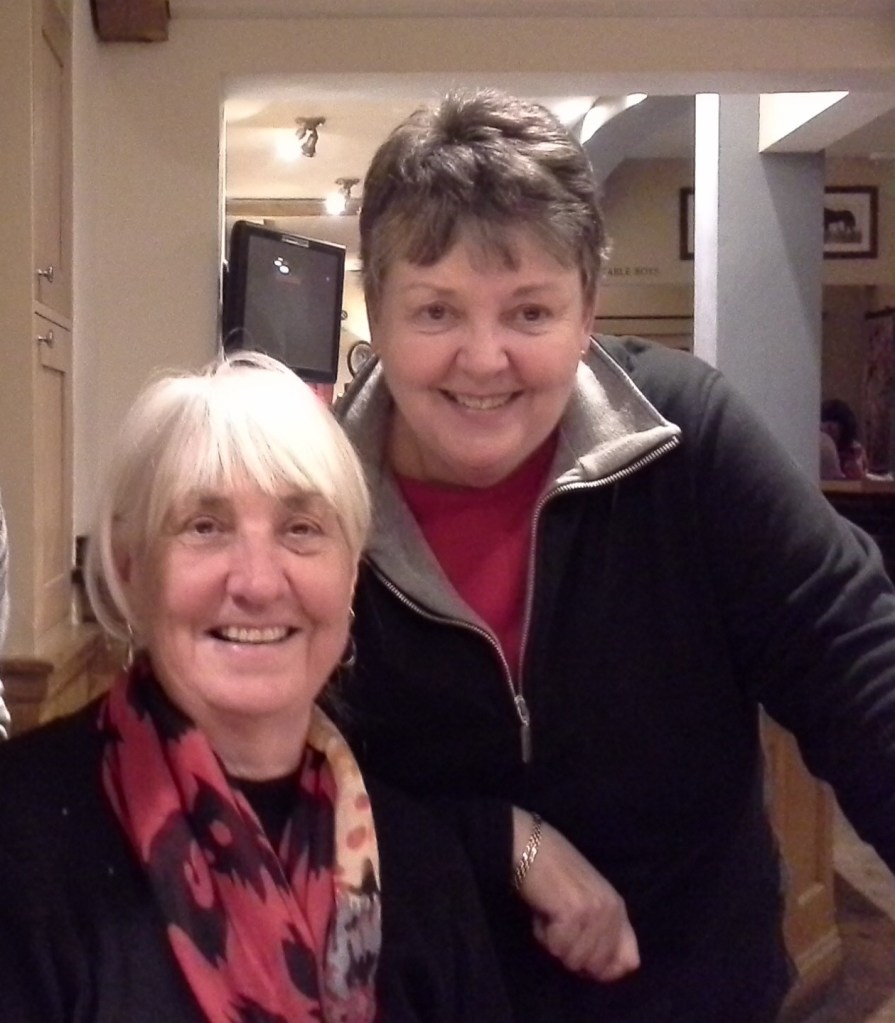
Sally & me on my birthday

From Berlin it was back to England for another home exchange – this time in Torquay. On the way, I stayed a few days with good friends Sally & Colin in Slough, near Heathrow. They met me from the train and we went straight to a lovely English pub to celebrate my 71st birthday. Always fun to be with Sally and Col! (Sally is the Blue Badge London guide I first met on a walking tour with Pauline in 2011)

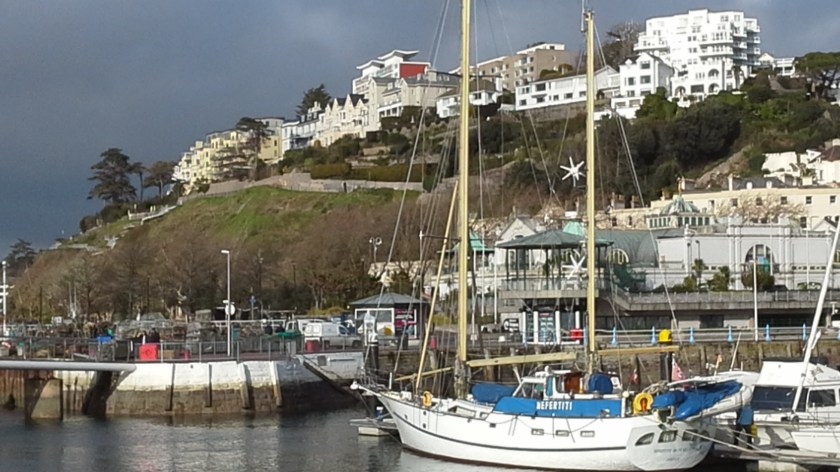
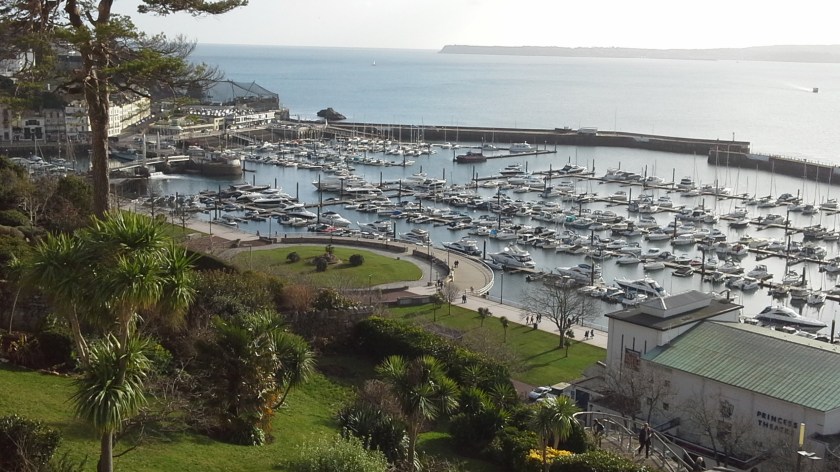
A couple of days later, I took another train down to Torquay in Devon, on the English Channel. This new home turned out to be rather glamorous … high on a cliff top overlooking the town, the harbour and the sea. Not exactly the French Cote d’Azur, Torquay and the surrounding beaches are still known as the English Riviera. No doubt beautiful (though crowded) in summer time, it still had lots of seaside resort charm … even in February. Especially after cold, grey Berlin.

My home exchangees were cycling enthusiasts so wanted to swap at this time of year for the Tour Down Under in Adelaide. Worked well for all of us. I enjoyed having time in the south of England, exploring Devon and Cornwall, and was able to catch up with Pauline (from Maidenhead) and Phil and Mary (friends from home who were living in Cornwall at the time.)

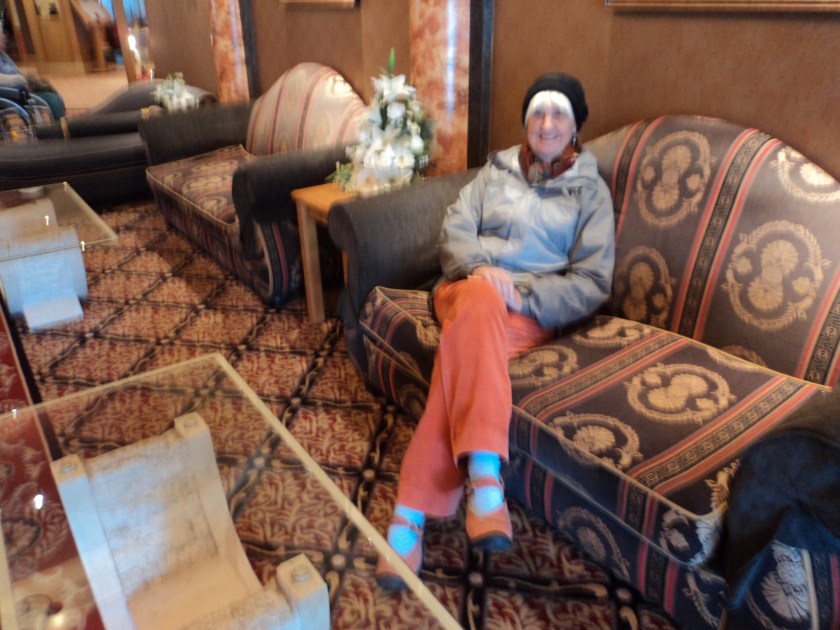
Imagining Agatha in the Grand Hotel, Torquay

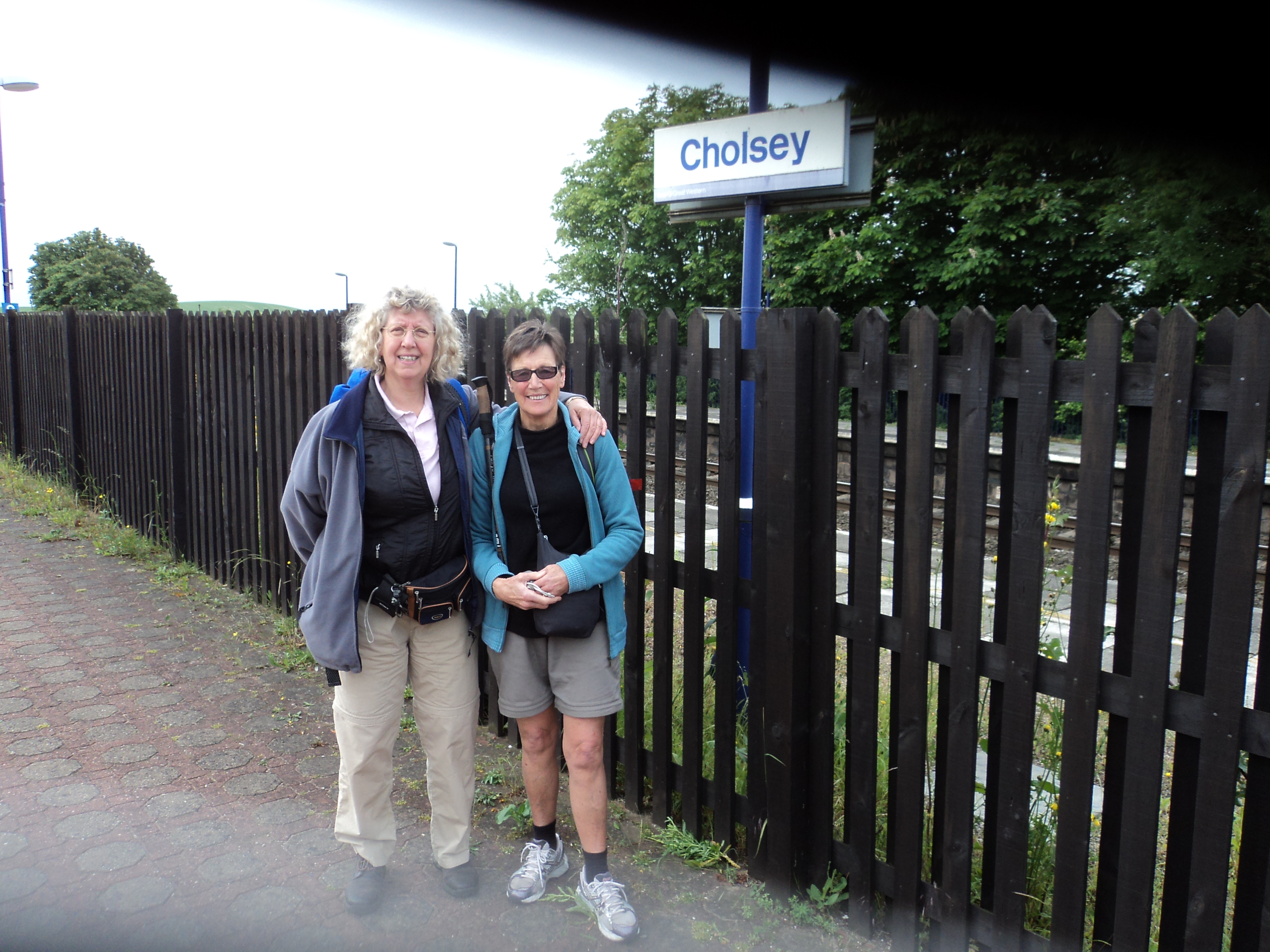
I also caught up with Agatha Christie again. She’s buried in Cholsey, where I stayed in 2011, but she lived for many years, and wrote many of her books, in Dartmouth just a bit further down the coast. The Grand Hotel in Torquay had an exhibition of her life and works. It’s also decorated in the art nouveau style of Christie’s era.

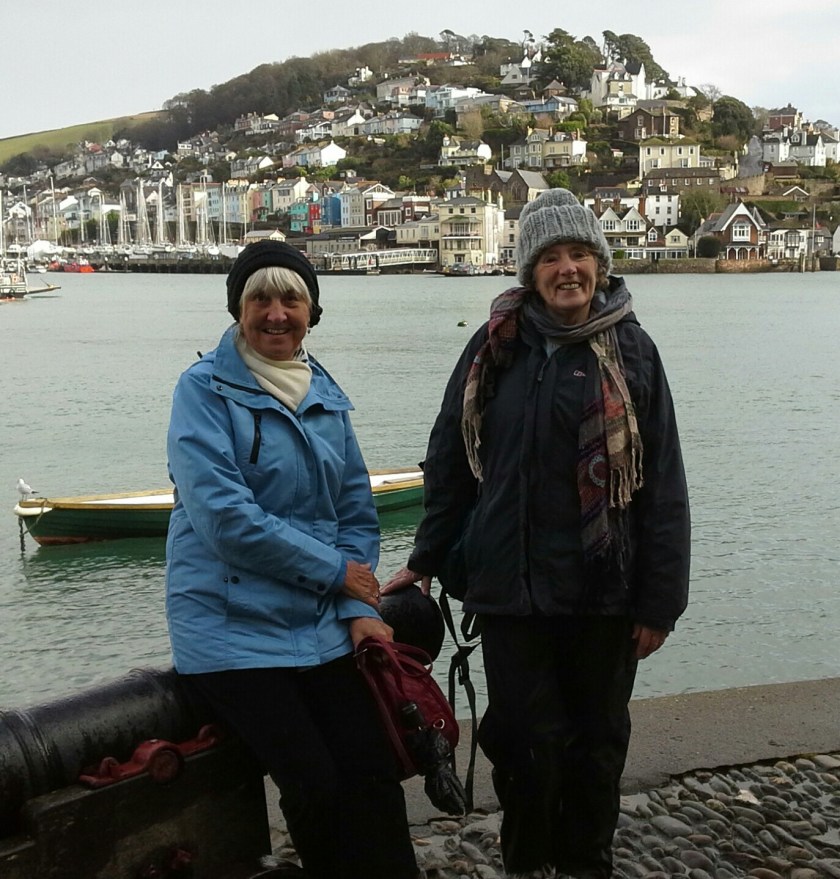
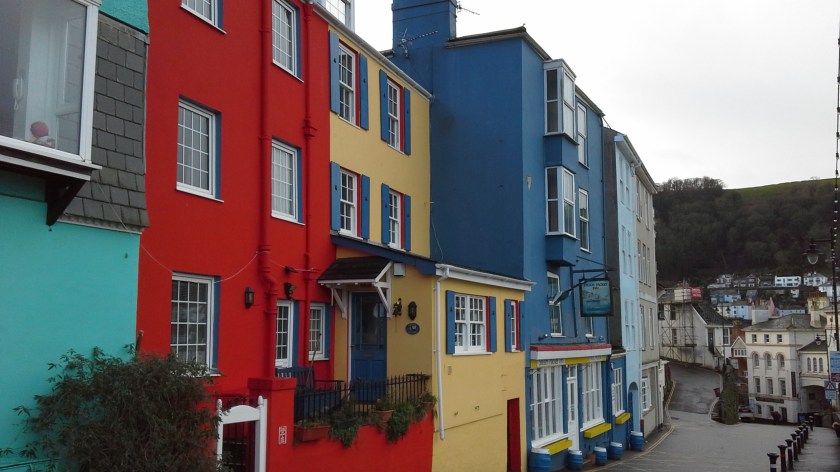
During Pauline’s visit, on a bitterly cold day, we made a trip down to Dartmouth and took a boat ride up the River Dart – past the Royal Naval College where Mal (my brother) visited a few times while he was at the Royal Naval Engineering College in Plymouth in the 1960s. The town appeared to be another lovely little place to spend some time, but with a feeling of snow in the air we were keen to find a bus and escape the cold. Stopped off at Brixham on the way home and enjoyed hot chips and hot chocolate in the Jolly Roger – or whatever it was called. (A kitschy tourist cafe decorated with skulls, crossbones etc. At least it was warm.)

Pauline and I also enjoyed a visit to Totnes, an interesting market town in Devon with a laid-back, hippy, new age vibe. Described as the “alternative capital of Britain”, Totnes residents are keen environmentalists, live in eco-friendly homes and enjoy arts, crafts and festivals. They even have their own money (the Totnes pound) for use in all the funky shops – though good old conservative sterling pounds are also accepted, of course. I loved it!

When Phil and Mary came up for the day, we visited the Torquay Living Coasts Zoo, then climbed back up the cliff to the house for a late lunch. The Zoo specialised in marine animals and birds … lots of seals, penguins and other sea birds. (* Later … sadly the Zoo didn’t survive Covid … it closed permanently in 2020)

Another good day was had when I took myself down to Cornwall. Took the train down to Penzance, then a bus to the village of Mount’s Bay so that I could visit St Michaels Mount – a tidal island in the bay, linked to the mainland by a granite causeway that can be crossed at low tide. When the tide comes in the crossing can only be navigated by boat or the special army duck vehicle they use for ferrying tourists across. The castle-like home on St Michaels Mount is privately owned and can only be visited at certain times … unfortunately not at the time that I was there.

Mounts Bay is also on the long-distance South West Walk that follows the coast through Cornwall and Devon. Apparently there are lots of cliffs along the way so I don’t think I’ll be tackling this one …..

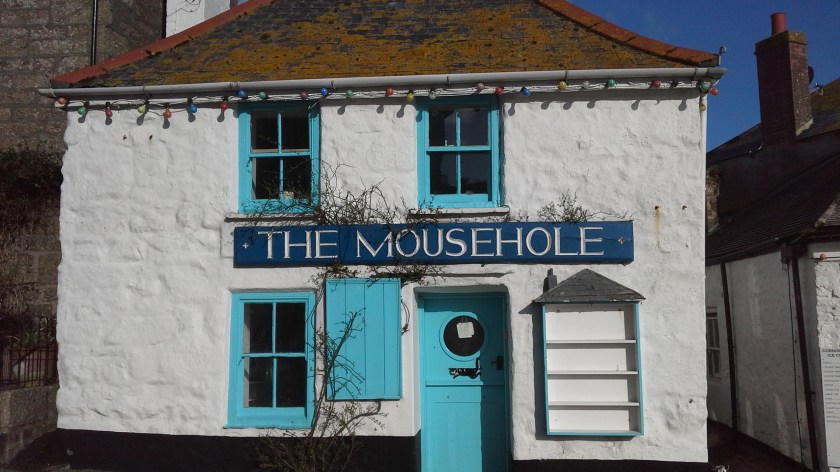
Cottage in cobble-stoned Mousehole, Cornwall

The last time I was in Cornwall was back in the mid-1960s when friends and I made the trip down from London to visit Lands End. I remember the tiny village of Mousehole (pronounced Mouzel) along the coast. Of course I had to revisit while I was so close, but in the middle of winter everything looked very closed and sleepy. I didn’t get as far as the Minack Theatre which is built into the cliff at Polperro, this time – but I do remember it well from long ago. It would be good to return to this part of England in warmer weather to enjoy the beaches, the colourful fishing villages and more of the countryside. Devon is designated another Area of Outstanding Natural Beauty with its stunning coastline and sweeping moors.

It was a happy couple of weeks in Torquay – short, a bit chilly, but fun to be back in England.

Berlin 2015: Middle of winter

Libby, Sergiu and Phillip in our Berlin apartment

The end of Week 1 in Berlin, so time now to record some of the activities of the past few days and reflect on them. I’m here with Libby (from SA) whose son Phillip lives here with his partner Sergiu. a Romanian ballet dancer and choreographer.

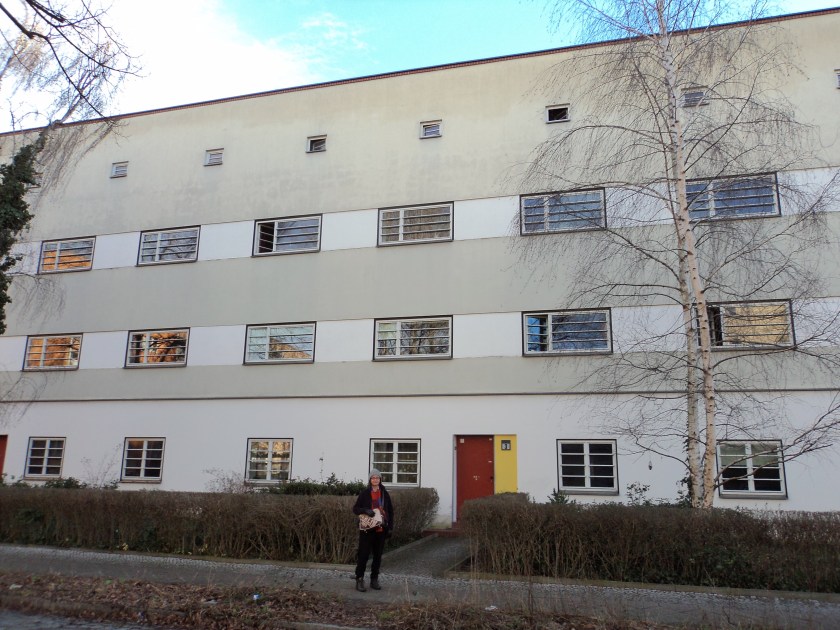
Our grey block building -very typical architecture

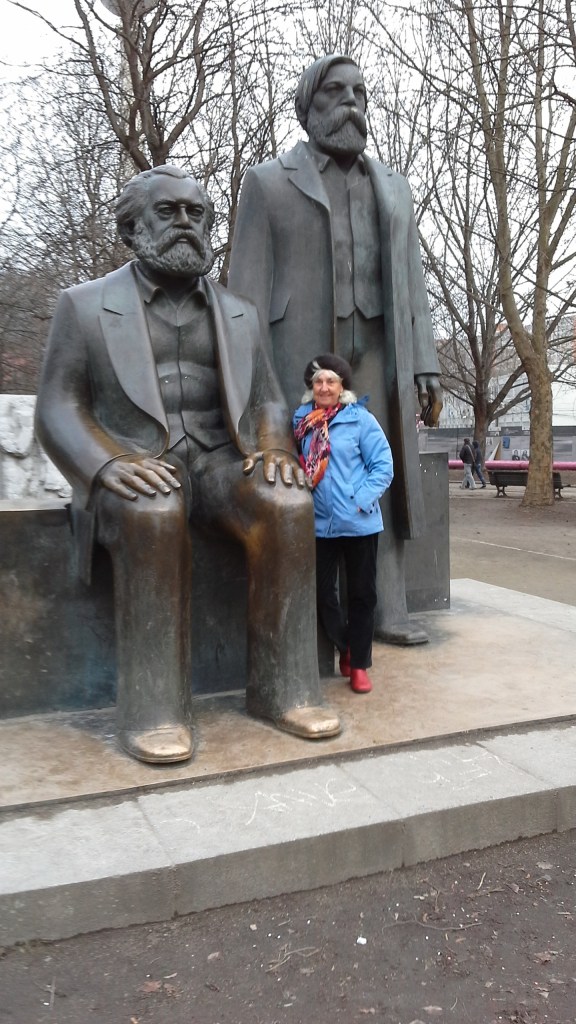
I’ve decided that this city is not for the faint-hearted, at least not in the middle of winter. It’s a grey, heavy city with reminders everywhere of a history that’s raw and brutal. There’s nothing soft, gentle or whimsical about Berlin….unlike Paris, Barcelona or Edinburgh. All the apartment buildings throughout the city (east and west) are similar…. square, solid, functional…not pretty. And the major historic buildings are huge and imposing.  Even sculptures and statues are big and strong with icons like warriors, eagles, Marx and Engels.  The streets are wide with very efficient trams, and there’s also a busy network of underground and overhead trains.  It’s a city that works, but one that’s highly aware of its history and fiercely determined to resist any threat to its freedom in future.

With Marx and Engels

So it’s a highly mixed city – street art and graffiti everywhere , presumably as symbols of freedom of expression – and probably to add colour to the otherwise starkness of the buildings. But as for the theatre,  music, nightlife and clubs that Berlin is noted for, Libby and I have hardly scratched the surface and I can’t say yet that I’ve felt the buzz of a wide-spread flourishing music and art scene.  However, we did experience an amazing musical performance a couple of nights ago, with free tickets , courtesy of a friend of Phillip and Sergiu.  All the audience were given thick woollen blankets and socks before entering the performance space, and then we all had to find an individual platform-type ‘bed’ covered with artificial grass on which to lie down with our blankets.  The lights were dimmed, then completely turned off and the whole concert continued in pitch blackness with the musicians making their way through the maze of ‘beds’.  The music was very contemporary – all stringed instruments – and quite surreal in the dark.  It was one of the strangest experiences I’ve had in a theatre,  but intensely sensual and rewarding.  We also have tickets for an a Capella singing festival next week.

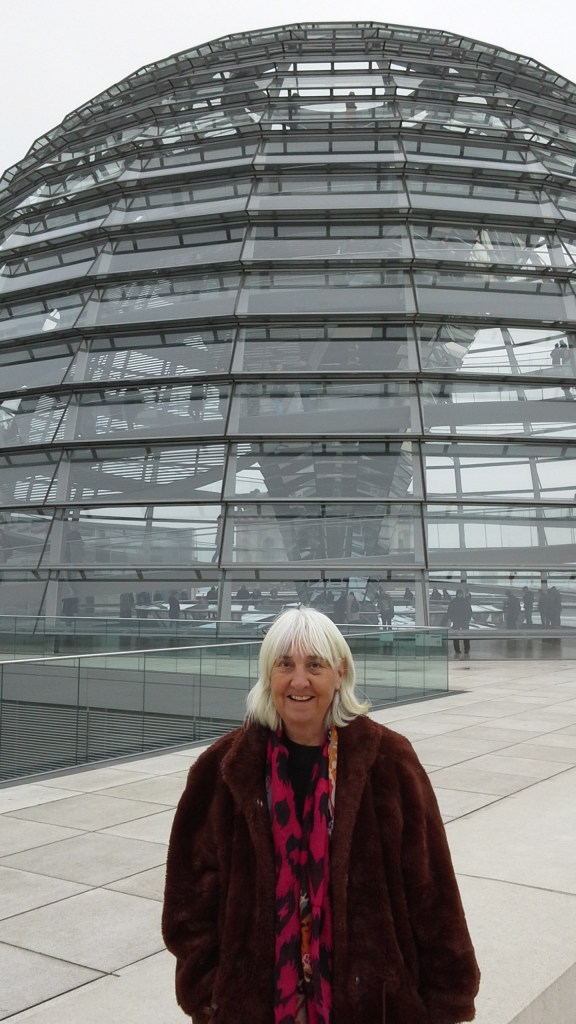
The Reichstag building

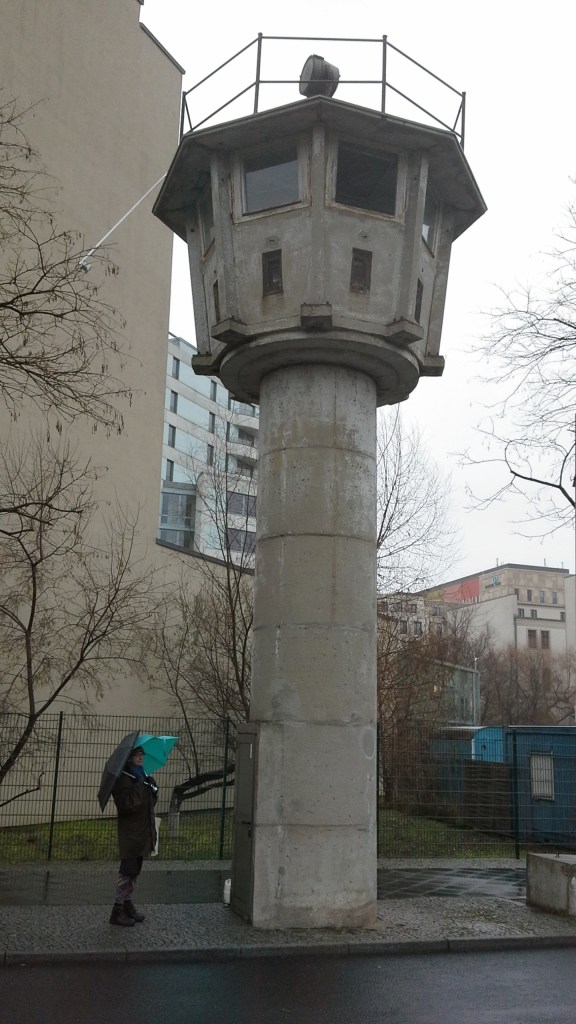
I think my current impression of Berlin as grey and foreboding is a reflection of the places we’ve visited and seen this week …. The Reichstag  (Parliament) building, two museums about life in the former Soviet East Germany, the Wall, the Jewish holocaust memorial, the last remaining Soviet watchtower and a modern art exhibition in an old concrete air raid bunker.  Also the Deutsches History Museum and the Cathedral.  Maybe next week we’ll seek out the bright lights and happier places.

Inside the Boros art gallery – an old bunker

The Boros collection in the bunker was well worth seeing, as much for the venue as for the art. In fact, apart from a few stand-out pieces by highly acclaimed artists (whom I’d never heard of), the art was not to my taste. But the bunker was something else.  A huge solid concrete construction with 3 metre thick walls and roof, massive steel doors, the remains of old signs on walls and mostly bare, raw, grey interior walls.  Since its construction in the early days of WW2 as a Nazi air raid shelter, it has had many uses – as a prison, a warehouse, a hard-core techno-punk music club, to name a few.  The millionaire, Boros, who now owns it had it converted for its current purpose as an art gallery, with a penthouse on top. It’s all concrete and steel with harsh bright lighting … not my idea of a cosy place to call home.

The Reichstag – modern part of the Parliament) building

The Reichstag warrants a better description than I can probably give. This is the home of the German Parliament (called the Bundestag), where Angela Merkel and other eminent politicians work.  Like all the government buildings, it’s huge.  It’s also a mix of old and new, having been bombed, burnt and rebuilt at various phases of Germany history.  Its massive glass dome stands out across the city, but the interior is a maze of corridors and closed doors, except for the reception areas and the actual great chamber where parliament sits under the wings of a huge eagle sculpture.  The architecture is decidedly minimalist, with almost no art works or colour on the walls – unlike Parliament House in Canberra.  But what it does have in a couple of sections are the graffitied names of Soviet soldiers who marched into the city and liberated it from the Fascists.  This, along with the war-damaged walls, is yet another stark reminder of the all-too-recent history.  I had to keep reminding myself that this all happened in my lifetime.

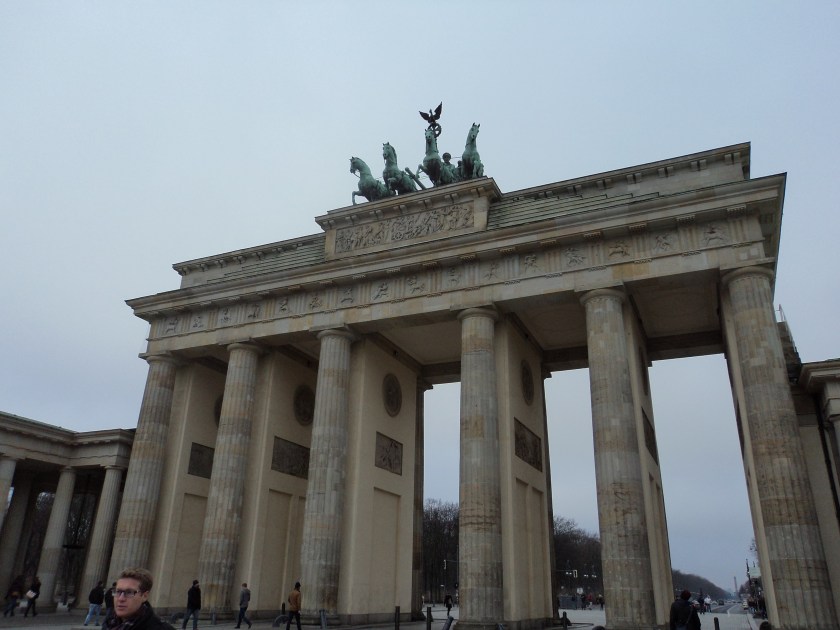
Brandenberg Gate

From the Reichstag, it’s a short walk to the monumental Brandenberg Gate and the wide Avenue,  Unter der  Linden, which leads from it, along which Napoleon marched with his troops a century or so before the Allied armies who liberated Berlin at the end of WW2.   The bunker where Hitler committed suicide is somewhere close by too.

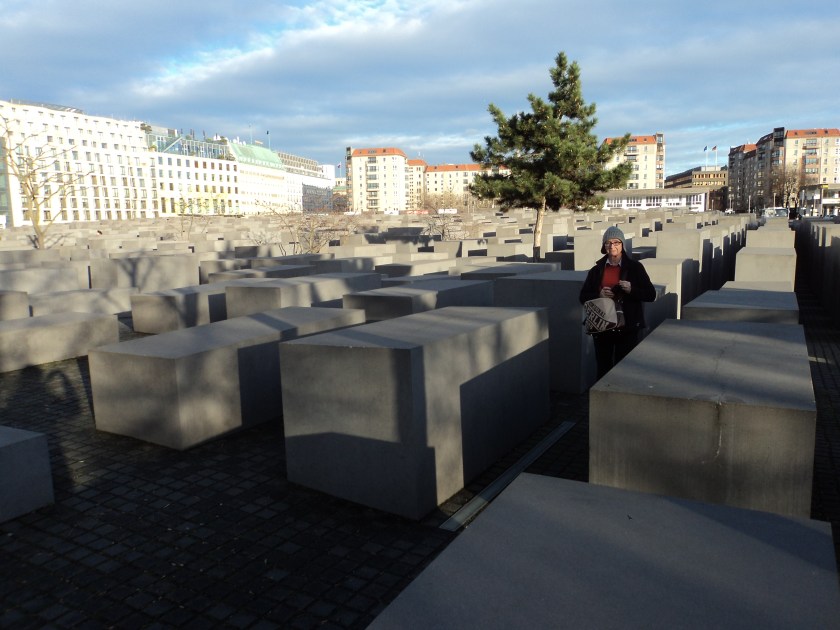
The Jewish holocaust memorial

The Jewish holocaust memorial is a particularly chilling place.  The museum is underground with photos and stories telling of the systematic, programmed way the Nazis went about rounding up millions of Jews, Roma and Sinti  (gypsies) and killing them in the streets and concentration camps.  Above this is a massive space filled with grey coffin-like concrete boxes stretching almost as far as you can see.  You can walk between them on narrow paths and get completely lost within. It’s an extremely solemn and moving memorial.

The big Deutsches History Museum was full of information and objects from medieval times through to WW1 and WW2.  Germany has certainly had more than its share of battles, uprisings and attempts at domination over the centuries.  Heavy stuff, but interesting

The Cathedral is much like every other big European cathedral inside, but outside looks more like a mosque. It’s all domes, not spires and steeples.  But the saints and angels all around are a Christian giveaway. 

Old watch tower – still plenty of reminders of the Wall

I know everything would lookand feel better in the spring time.  At present the trees are bare, the roads are wet and it’s very cold.  The 5 euro fur coat I found in the op shop is getting lots of use.  We’re going out somewhere every day, even if only to explore other districts like Pankow or Prenzlauerberg…. and we’re always coming upon interesting sights  We just stumbled upon the big old brewery complex that’s now been turned into a cultural arts Centre.  It looked a bit bleak in the wintry weather, but it would be full of life in summer, with several theatres, restaurants, bars, cinema and shops. Also one of the ‘Day in the Life’ type East German  museums

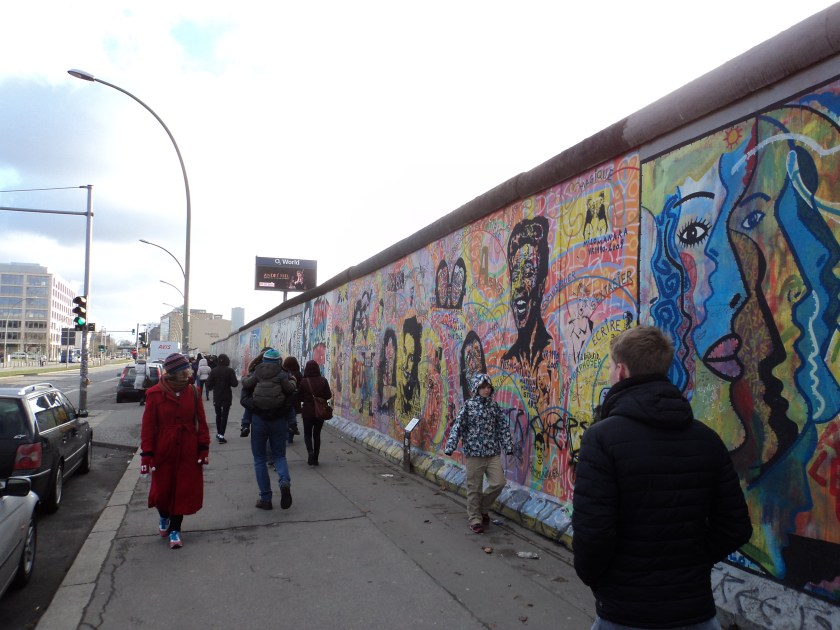
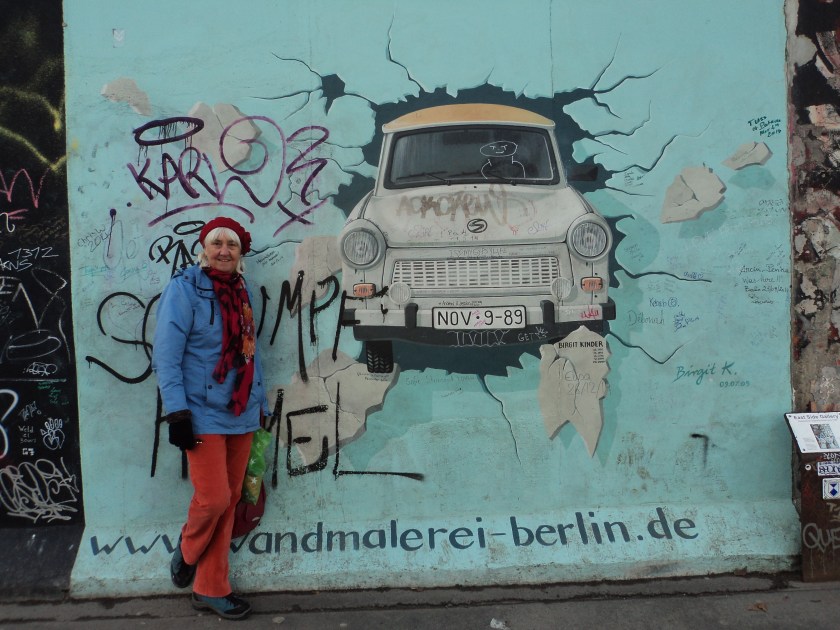
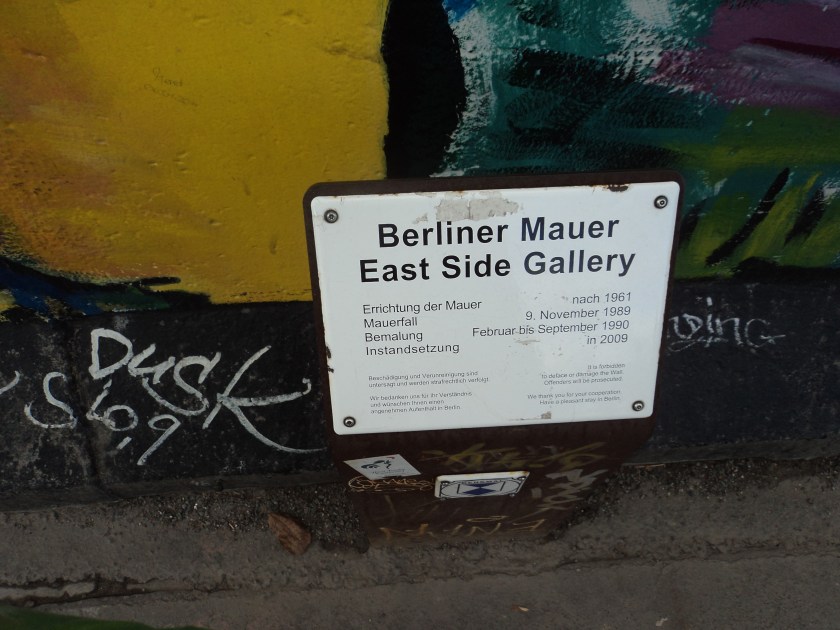
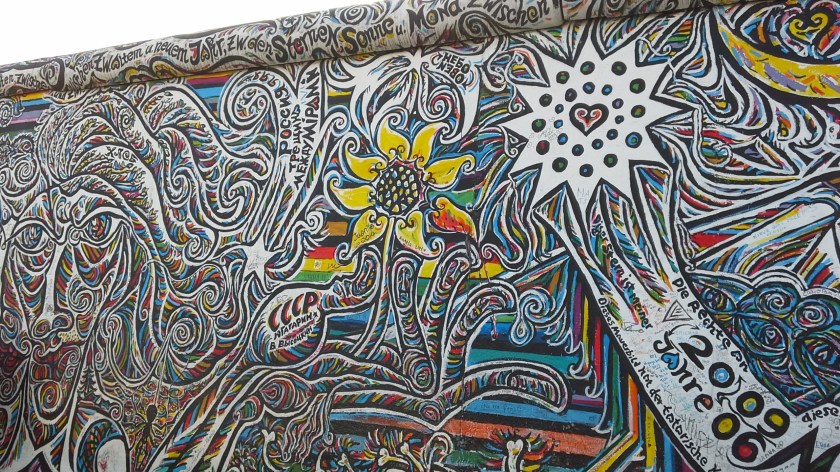
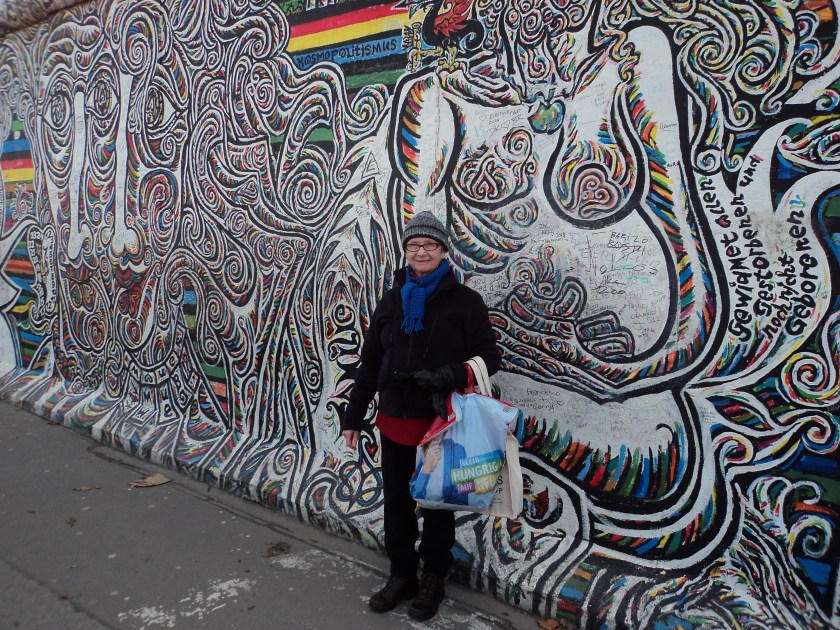
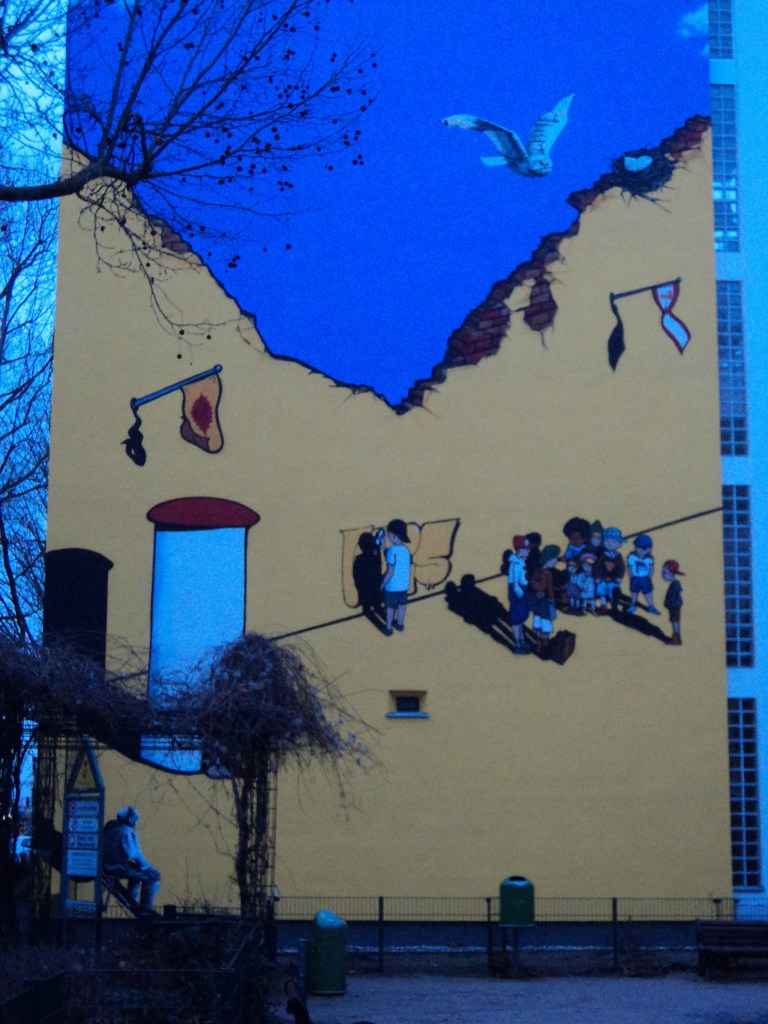
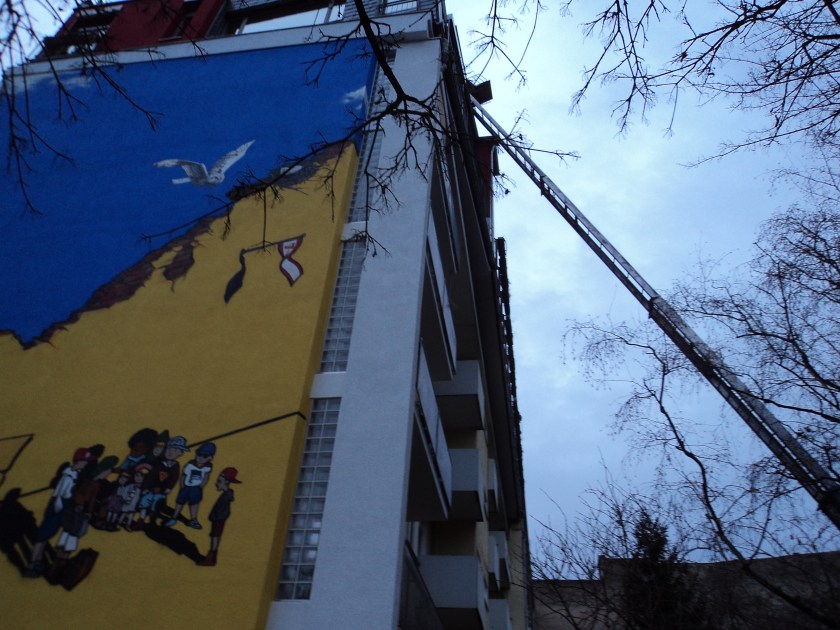
Early in the week we found the East Side Gallery which is a 1.5 kilometre open air art gallery with huge paintings all along the only remaining part of the Berlin Wall.  Originally facing the East Berlin side, artists started painting very soon after the Wall fell. Very colourful and impressive, though somewhat spoiled in my opinion by the extent of common and mindless graffiti scrawled over many of the paintings  This whole city seems to be an open canvas for graffiti artists.  There are some fantastic wall murals covering high walled buildings, but also lots of decidedly unartistic efforts on walls, stairways, doors etc.

Enough for now. There are still 2 more weeks of living in Berlin. And still lots more wonders to discover.  I’m looking forward to some fun stuff sometime!

Week 2:

What a difference sunshine and music make!  Berlin turned on both this week… milder weather, no wind and a pale yellow sun that made the city sparkle. It’s still chilly, but people aren’t as hidden away in their big coats and woollen beanies.  The children still look like little snowmen in bright parkas, boots, mittens and pompom hats … very cute.

Libby and I have enjoyed a week of art, music, museums and good food … starting with a lovely dinner on Monday evening at Philip and Sergiu’s apartment in Neukollin.   The boys have only been in it a couple of weeks and have lots of work ahead to bring it back to its old world graciousness – which they will.  They’re both talented and artistic young men. Sergiu’s a dancer and choreographer, working with contemporary dance companies here. He’s Romanian and well-travelled with his dancing.  After dinner we went to a modern dance performance… a solo dancer performing Stravinksy’s Rite of Spring. Quite strange. Even Sergiu seemed critical of the approach –  but it was certainly something different that I ‘ll be unlikely to see anywhere else.  It was also a great opportunity to see another part of old Berlin by night

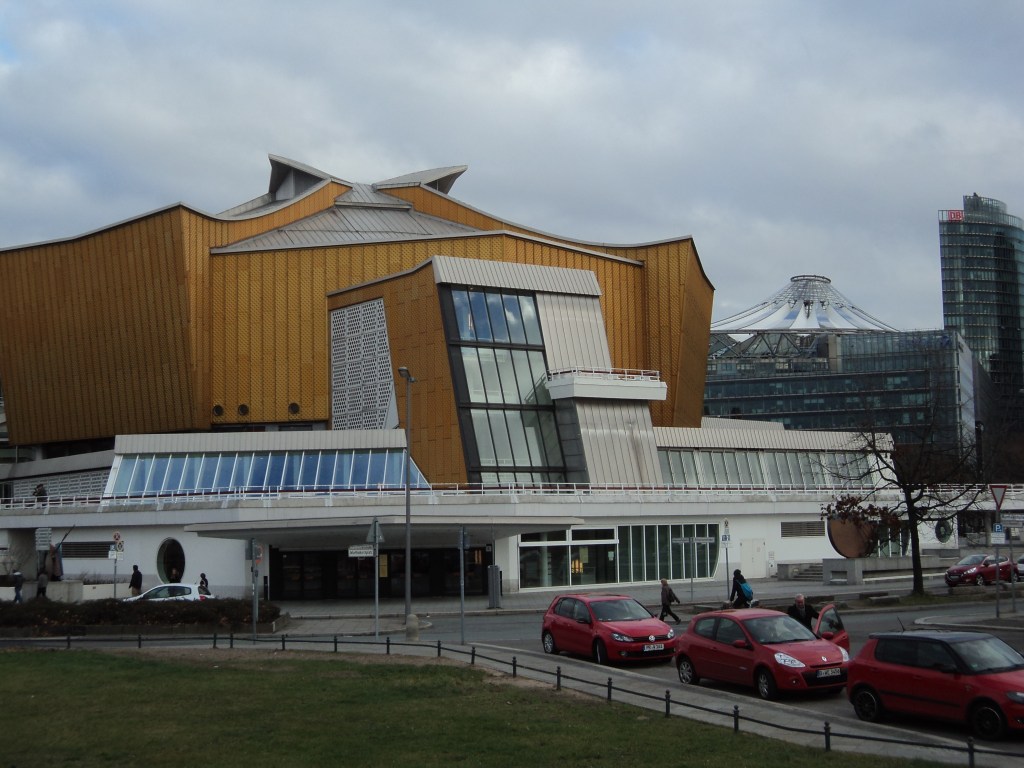
Berlin Philharmonic concert hall
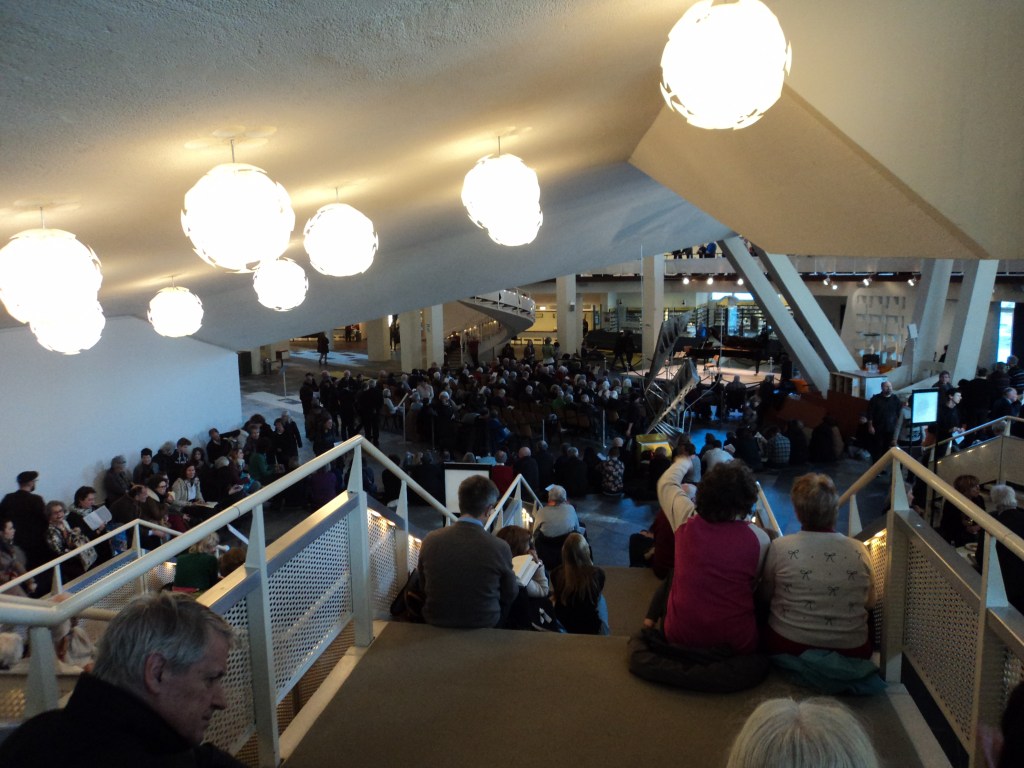
At the lunchtime concert

Tuesday brought more music …. a free lunchtime Schubert concert at the Berlin Philharmonic.  These weekly concerts seem to be extremely popular. There were hundreds there, with many having to stand.  We arrived in time to find a perch on one of the staircases and had an excellent view of the trio…a violin, cello and piano.  The concert was in the spacious entrance hall of the Centre. The whole building is a beautiful modern structure, all angles and arcs and yellow bricks. 

With so much of Berlin having been destroyed in the War, many of the major city buildings are relatively new.

Another spectacular state-of-the-art building not far from the Cultural forum (concert hall, art galleries etc) is the Sony Centre …. all glass and steel, a work of engineering art. Under its massive glass ceiling is a central courtyard with a fountain, restaurants, cinemas and space just to enjoy.  This area of the city, Potsdamer Platz was almost completely flattened, so it’s provided architects and designers an opportunity to go all-out in the long reconstruction process

Potsdamer Platz is also not far from the Jewish Holocaust Memorial, so after the concert ( & feeling uplifted!) I went back there for a while. Libby chose not to.  It’s such an incredibly significant place that I wanted to make sure I took in as much as I could, and remember it.  It’s impossible not to be moved by it, and appalled by the sheer horror of what happened. It should be completely inconceivable that anything like the Holocaust could happen again, but the world, it seems, is somehow always vulnerable. 

Checkpoint Charlie
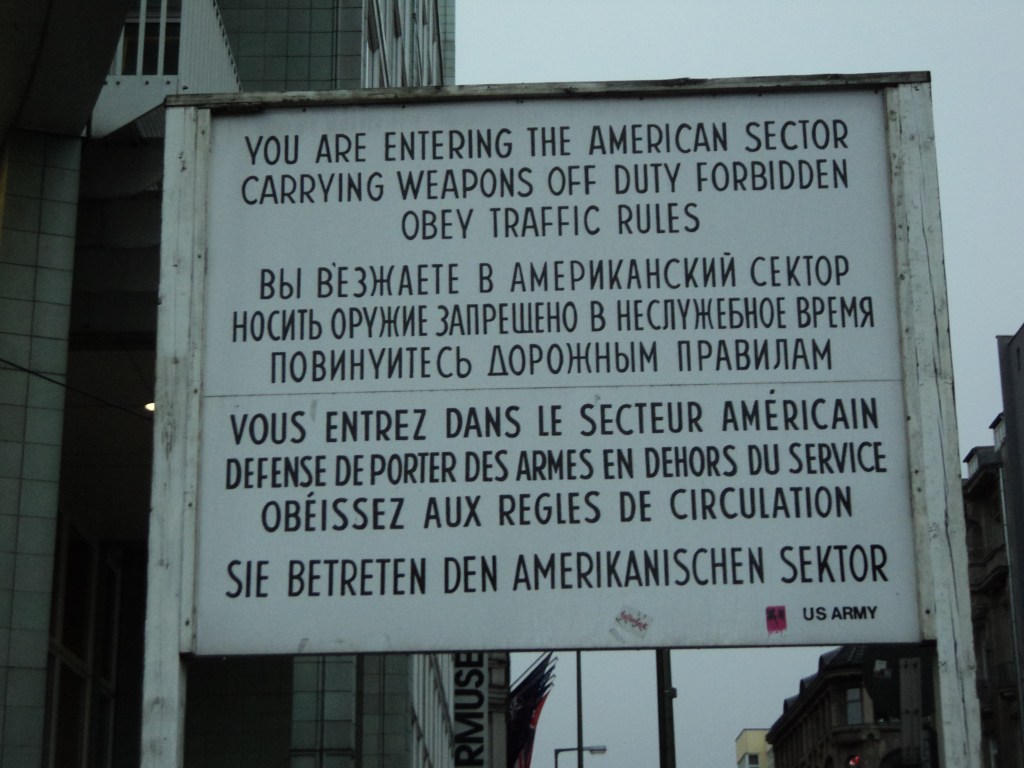
Reminder of the division of Berlin into 4 sectors after the War

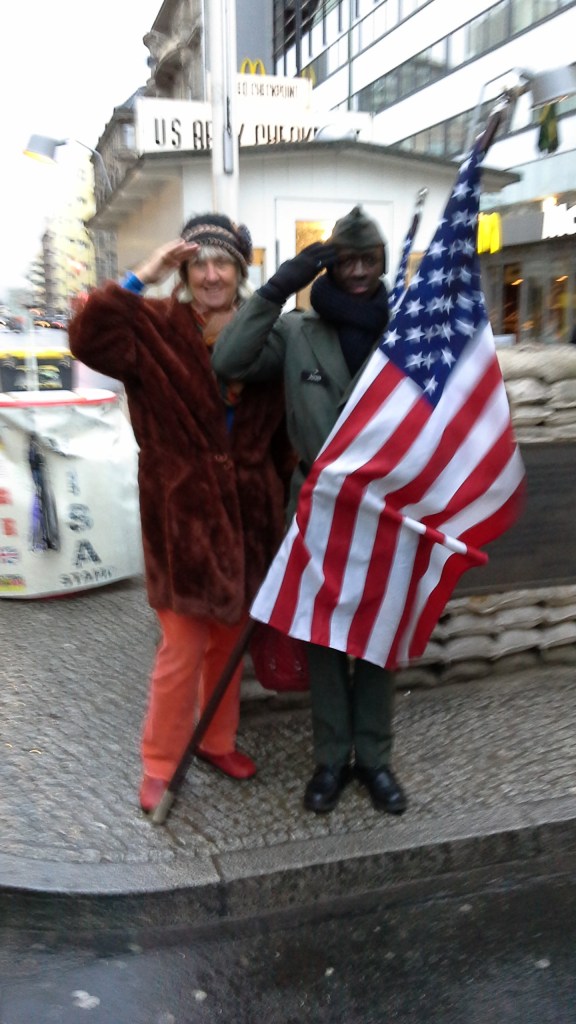
The international political situation since WW2 was emphasised for us by a visit to the interesting museum near Checkpoint Charlie.  (For anyone too young to remember when Berlin was a divided city, Checkpoint Charlie used to be the only crossing point into East Berlin for diplomats and foreigners when the Wall was standing. I remember going through back in the 60’s).   Now, the site of the old Checkpoint is a bit of a kitsch touristy place where a guy dressed like an American soldier poses for photos. But for old time’s sake, I got Libby to take one of me with him.  However, the Museum was good – with photos, films, old newspapers etc explaining the political background to the end of WW2, the division of the city into 4 sectors managed by the Allied victors, the creation of the Wall, the many escape attempts and the subsequent demolition just 25 years ago.  But most informatively, the museum put the events before and since into a whole world context. I learned more than ever before about the impact of the Cold War, the super powers, other wars that followed  (Korea, Vietnam, Afghanistan etc) and the current threat of terrorism.  It’s all linked through history, ideology and, in  my humble opinion, the sheer stupidity of men in charge

(Oops …. Feel as if I’m heading back down the depressing side of Berlin again right now … so will get back to the fun stuff that we’ve enjoyed this week…..)

On Wednesday, we spent early all day at the enormous, wonderful Gemaldergalerie, the huge art gallery that houses an outstanding collection of European Old Masters….. Rembrandt, Botticelli, Vermeer, Bruegel to name a few.  A complete walk all around the gallery is about 2 kilometers and it’s impossible to take it all in in one go. But to top it off, there are other galleries and special exhibitions under the same roof too.  We gave it our best shot and thoroughly enjoyed it all.  Interesting to note that most of this huge collection was taken away and hidden for safe keeping during the bombing blitzes of the war.

Then, as if we hadn’t had enough for the day, we sought out the nearby Weinhaus Huth, the only building in Potsdamer Platz to survive the bombing.  Apart from being a lovely little building (on the site where the Brothers Grimm were born), it houses a superb collection of modern art.  The current exhibition showcases Willie Baumeister, a highly esteemed German artist. It was absolutely fascinating, not only because his work was so great, but because his personal collection of paintings given to him by friends such as Chagall, Matisse, Miro and many others were also on display.  Such a wealth of fabulous stuff… and it was free!

It’s been good to have time to explore and compare many of the districts of Berlin. They all have their own special characteristics and sites of interest. For instance Neukolln, where Philip and Sergiu live, is now an up and coming district, described somewhere as “Berlin’s latest frontier of hippiness”. It has a high multicultural population, with Turkish markets, middle eastern restaurants, trendy shops and cafes and a even a well preserved village of cottages built by Czech refugees in the 1800’s. 

Schoneberg is similarly a mix of cultures and lifestyle – the original gay centre of Berlin still with rainbow flags and posters, plus some fairly way out hard core leather and rubber shops displaying interesting windows, but also lots of attractive, individual shops selling handmade jewellery,  quirky fashions, books, maps and so on.  A nice place to wander around for a couple of hours.

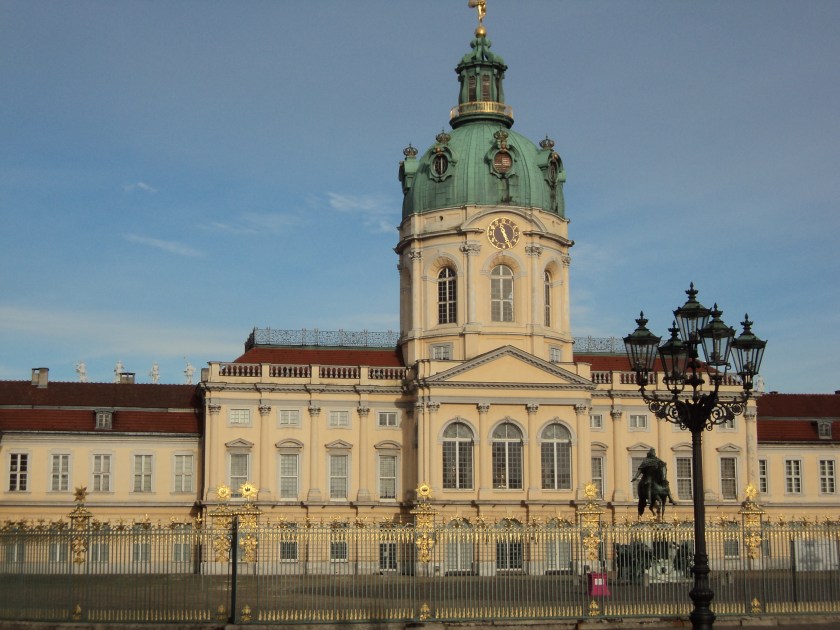
Charlottenberg Palace

Charlottenberg is very different again. Definitely the high class area of Berlin, it has beautiful apartment buildings, wide tree-lined boulevards and charming restaurants and bars. And Charlottenberg Palace, the summer residence of Queen Sophie-Charlotte in the early 1700’s.  It’s said to be the largest and most beautiful of Berlin’s remaining royal palaces, and retains much of its original grandeur, as well as lots that has been superbly reconstructed and crafted since .  Some entire rooms and sections of the palace were destroyed in 1945.  It’s completely over the top with its gold and mirrors, tapestries and porcelain, exquisite furniture and hundreds of grand paintings.  But we did it all and enjoyed the background stories provided on the audio-guide.. I can’t remember all the history now, but followed with interest the various King Friedrichs through the centuries while strolling through the ballrooms, bedchambers and boudoirs.  Queen Sophie-Charlotte seemed to have been a pretty special monarch too, devoting much time and support for music, art and science

Across the road from the grand palace courtyard were more museums. Berlin is full of them; over 600 I read somewhere.  We chose to visit the one with a collection of surrealist art… Dali, Max Ernst, Dubuffet etc. Libby appreciated this more than I did, but I found the adjacent exhibition quite fascinating.  It was a collection of paintings and sculptures created by people in a mental hospital at the beginning of the 1900s, the so-called ‘mad’ people.  Fortunately some enlightened collector recognized the beauty and significance of these works of art, and they’ve survived, and in the process, had a great impact on the development of the Surrealists.  Many of these same pictures were exhibited in the 1930s in a display of “Degenerate Art”, as a kind of propaganda exercise by the Nazi government.  I’m glad I got to see them.

The next district for another day out was Kurfurstendamm, the glitzy central shopping centre of the city. All the top name stores and brand names were here, as was half the population of Berlin, it seemed.  Clearly there’s money around and the Berliners enjoy spending it.  Not really my scene, but fun for a bit of window shopping.  However, the K’damm district had other things to offer as well.  The Katthe Kollwitz gallery is well worth a visit.  One of German’s leading female artists in the 20th century, Katthe Kollwitz recorded portraits and etchings of mothers and children,  poor working class families and the poverty and hardship that so many people had to endure before, during and after the two World Wars. She lost her son in the first World War and her grandson in the Second. Beautiful, heart-wrenching works in a gracious old gallery

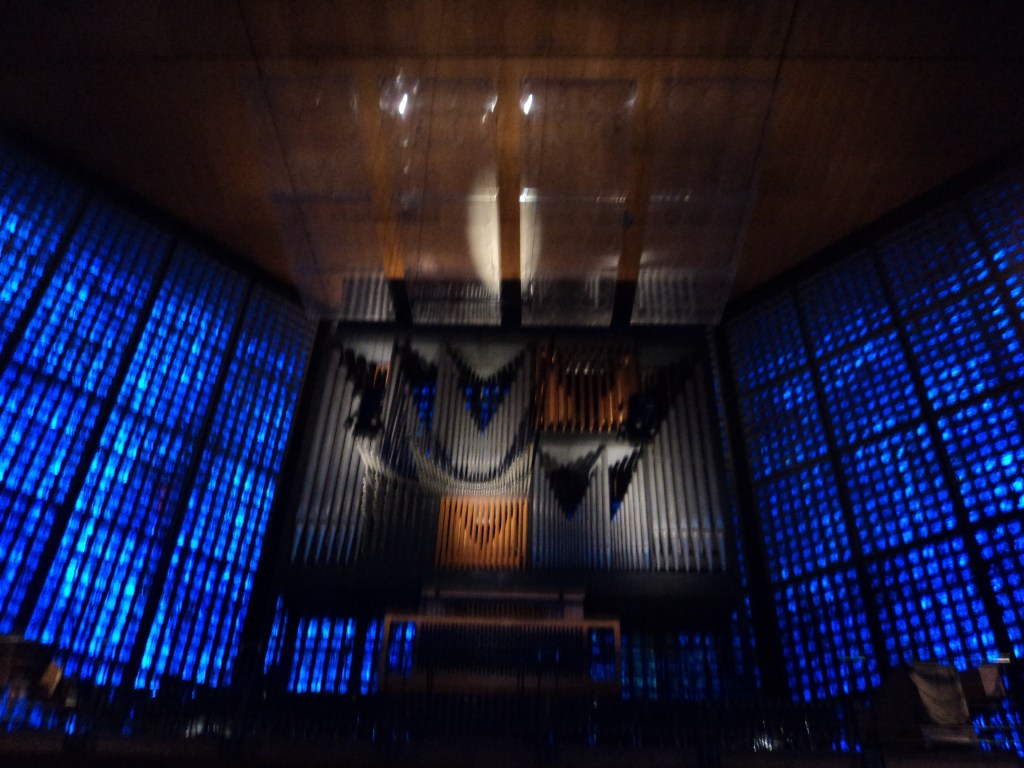
Kaiser Wilhelm church in central Berlin

The other major nearby site is the bombed ruin of the Kaiser Wilhelm church right in the middle of the busiest intersection.  The shell of its structure remains, with a series of photos inside to show what it once looked like…and right next to it has been built a beautiful modern church with thousands of small blue stained glass windows. Just as we entered and sat down to look around, a group of 5 men started singing in front of the altar.  How lucky were we!

And now to finish this week’s diary….

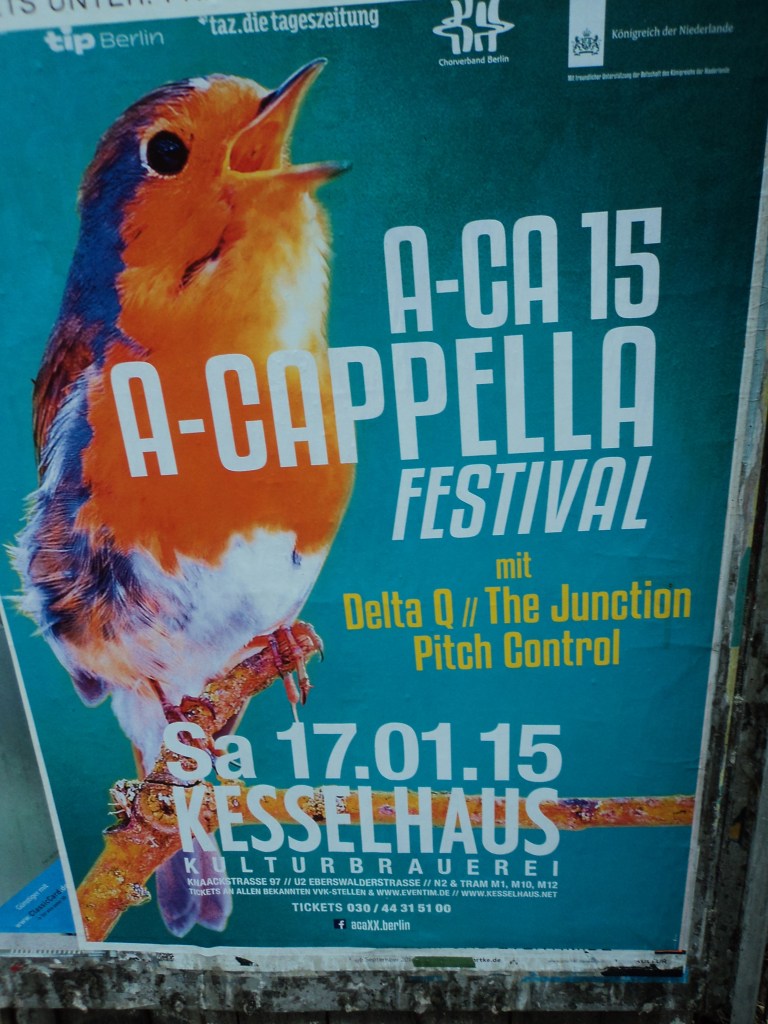
Fabulous night at this concert

One of the  absolute highlights of the whole time we’ve been here happened last night… a fantastic , amazing
A Cappella concert at the old Brewery (the one that’s been turned into a cultural centre). Three groups performed – two from Holland (Pitch Control ; The Junction) and one from Germany  (Delta Q ).  They were all BRILLIANT!! Superb harmony singing with choreography to match. This form of entertainment is apparently becoming very popular in Berlin…not hard to see why. To make it even better we had seats in the front row, next to some beautiful young German guys!  The one next to me translated some of the commentary, though most of the songs were in English.  Getting seats at all was a miracle because half the crowd had to stand. But Libby wandered around looking and found 2 free ones right in the middle of the front row.

It was a night of laughing, clapping and just sheer enjoyment.  Watch out for A Capella choirs in future!

Week 3

Berlin… Week 3

I’m sitting at Schonefeld airport waiting for my flight to Bristol, UK.  A bit of time to reflect on the past week’s activities in Berlin

Kopernick

The day after the A Cappella concert, Libby and I made a trip to the outskirts of the city…to the old medieval village of Kopernick.  It’s a popular day trip for Berliners. Probably more so in summer, though we obviously weren’t the only visitors enjoying the old streets and buildings and the pleasant walk along the Riverside.  Because it was Sunday, most of the shops were closed but we found coffee when needed and did some window shopping in the old part of town.  The most impressive building in Kopernick is the old Rathus  (Town Hall)… a solid red brick structure with a high, decorative clock tower.   All in all, it was a pleasant but uneventful way to while away a few lazy weekend hours

——————————————-

Well I didn’t get far with the diary –  now it’s two days later, and I’m in England.  Berlin already feels a long time ago. However, just for the record, I’ll try to recall the events of last week….

————————————————

 I remember Monday because that’s when the Black Eye happened.  I was running for the train and tripped on the top step. Went flying through the air and landed heavily on the platform, face first!    Over the next few days I looked increasingly like like a zombie with massive bruising and swelling, but fortunately it didn’t stop me from doing anything.  I got a few funny looks wearing big sunglasses in bleak and grey Berlin – but even more stares when I took them off!  (Now a week later, there’s still a bruise on my cheek bone, but the eye’s looking better).  The crazy thing is there was no need to dash for the train…they come every few minutes. But when the rest of the crowd hurries, you just go with it.

In our kitchen

We were going out that night for dinner with Philip and Sergiu,  so just caught the next train and got on with it. Went to a great little French place – super food and classy liqueurs by candlelight ….so no problem with the eye.

Other highlights of the week included a concert at the Berlin Philharmonie. This time (unlike the free lunchtime concert) it was in the main concert hall.  We had great seats with a fine view of the orchestra and soloist, Gil Shaham, an Israeli violinst whom Bronwen and I heard play in the Adelaide Town Hall a few years ago. He’s actually marred  to an Adelaide concert violinist.  His playing was sublime. The ovation went for at least 5 minutes.  The orchestra followed up with a Shostakovitch Symphony. ….very dramatic with lots of clashing cymbals and gongs. A fabulous evening

Took in another interesting art exhibition on Wednesday in yet another area liberally sprinkled with galleries. This one was a collection of works by all female international artists – paintings, sculpture, photography, video.  The weather had turned colder and drizzly by this time, so we enjoyed more good coffee in the comfort of the gallery café.  We made the most of lots of excellent cafes and bakeries throughout our time in Berlin …with apple strudel, cinnamon buns, cheese cakes, cherry torte and many more cakes that I don’t even know the names of.

One day Sergiu invited us to watch a rehearsal of the piece that he’s currently choreographing, in preparation for a performance towards the end of February.  It was just him and a beautiful female dancer on this occasion. The third member of their team had had to go to Sweden to sort out his visa. It’s truly a different world in this environment.  After watching Sergiu and Maria move effortlessly around each other for about half an hour, we went for a break with them to the café at the arts complex where they were working….a series of spaces and venues in an old tram station.  The café consisted of a couple of rooms and an old bus cobbled together, fitted out with rustic timber benches, old sofas and armchairs.  My black eye didn’t look at all out of place here.
All very cool….

On the day before packing, cleaning and moving out, we visited two great local markets. Didn’t need anything of course, but still managed to spend some money, and of course enjoyed our obligatory daily coffee fix

There’s probably more that I’ve forgotten, but my head’s now in UK mode and I’m looking forward to the next couple of weeks in my latest home exchange place. It’s a 5 star apartment overlooking Torquay Harbour and the sea.   What a life!

Portugal: July 2013

Immediately after our walk in the Cotswolds, Penny and I flew to Porto and stayed 2 nights in a 2-star hotel while we explored the city. We’d originally planned to do some more walking in the Portuguese national parks, but with temperatures high in the 30’s, and blazing summer sun, we settled for buses, trains and swimming pools instead.

The historic centre of Porto was designated a UNESCO World Heritage site in 1996 … not hard to see why with its stately bridges across the river, the multi-coloured buildings in the riverside district, narrow cobbled streets and palatial palace and cathedral. We explored the cathedral and enjoyed the famous port wine in the bodegas. However, Marvao and Castel de Vide were our main objectives and time was limited, so it was off to the countryside, near the border with Spain.

Rural Portugal is rocky and mountainous, with villages and towns hanging on the side of hills or hidden in valleys. Travelling north/south is easy – by train or bus – but trying to get across the country east/west is difficult without a car.

Our hotel in Marvao had a swimming pool … very welcome in the Portuguese heat! But we still managed to climb to the high points of the village to look out over Spain and the surrounding areas. Similarly in Castel der Vide, we rambled around the village, finding vantage points to see the views and soaking up the laid-back feel of the Portuguese summer.

Tomar hadn’t been planned but we were so glad we discovered it along the way. Described as one of Portugal’s ‘ historic jewels’ and site of a magnificent 12th Century Knights Templar castle and convent, it’s a must-see stopping point for anyone travelling through Portugal. There are other equally lovely old churches, a synagogue and a huge central plaza where we happened to see some kind of procession, dancing and singing after eating at one of the local bars around the plaza.

Where we stayed in Tomar

Penny and I parted ways in Tomar. She travelled south to meet her Scottish family for a beach holiday near Lisbon (and continued to enjoy the sights of Lisbon after they left.) I took the train up to Coimbra to meet Clive, who I’d stayed with after completing the Camino in 2012.

Coimbra is also superb with its medieval university, library and clock tower. It’s one of the oldest university cities in Europe. I was more than happy to visit it again. I love the winding pathway that snakes up the hill to the huge University square at the top … with little shops, stalls, cafes and bars lining the way. The ubiquitous Portuguese roosters (in every possible size) fill the shelves and doorways, along with T-shirts, shawls, dolls, bottles of wine and beautiful ceramic tiles – yet somehow it retains the charm of thousands of years of history and culture.

Clive’s villa and swimming pool was an oasis in the summer sun – particularly enjoyable for a spot of R&R after another long walk (Cotswolds Way) and then travelling around the Portuguese countryside. I stayed for a week before making my way back to Porto, then Heathrow and finally home to Oz again.

Walking the Cotswolds Way June 2013

After walking the Camino in 2012, I wanted to explore another long distance walk – this time in England. The Cotswolds are designated an Area of Outstanding Natural Beauty, so walking through this beautiful part of the country sounded perfect. The Way follows the Cotswold Escarpment from Chipping Norton to Bath – a distance of 102 miles or 163km – and it can be walked in either direction.

Penny (NZ) and Rose (Cholsey) joined me for 10 days of rambling through a mix of lovely market towns, pretty villages, hills and woodlands, and past stately homes and thatched cottages made of the honey-coloured stone from this area. There was also a magnificent tower folly built in Victorian times, fascinating churches and gravestones and even a Neolithic burial mound (Belas Knap).

We stayed in BnB’s, farmhouses, an old mill, country pubs and a Youth Hostel. Here’s our itinerary:

Train from Oxford to Moreton-in-Marsh Dep: 9.04am.  Arr: 9.58 Then bus to Chipping Campden Dep: 10.43    Arr: 1.12pm    Walk from Chipping Campden to Broadway (9.5 km; 6 miles)   Bus 21/22 to Moreton-on-Marsh (dep 5.37pm; arr 6pm)  then Bus 801 to Stow-on-the-Wold (dep 6.10pm; arr 18.25pm)
Bus or taxi back to Broadway Broadway to Winchcombe (19.5km; 12 miles)
Winchcombe to Dowdeswell (17.5km; 11 miles)
Dowdeswell to Birdlip (16.5km; 10.5 miles)
Birdlip to Randwick (21.5 km; 13.5 miles)
Randwick to Dursley (17km; 10.5 miles)
Dursley to Wotton-under-Edge (11.5km; 7 miles)
Wotton-under-Edge to Old Sodbury (20.5 km; 13.5 miles)
Old Sodbury to Cold Ashton (13.5 km; 8.5 miles) 
Cold Ashton to Bath   (16km; 10 miles) – then train home to Cholsey (via Oxford)

The photo gallery can tell the story ……

Edinburgh in winter 2012

2012 was a great year – Spain, Portugal and the Camino de Santiago. And spending Christmas, Hogmanay and the rest of winter in Edinburgh was the icing on the cake. Scotland is now right up there with all my other favourite places. The diary entries for this trip are long, but there was just so much to see, do and enjoy. I LOVED this home exchange ….

EDINBURGH 1:  11th December 2012

It’s early morning in Edinburgh on Day 1. 7.30am and still pitch dark outside.   The house is warm and I’m settling in.   Temperature outside is zero and there’s an icy frost on the back lawn and over the road.  

First impressions: Edinburgh at night

I got in to Waverley Station (Edinburgh) yesterday around 6.15pm after a speedy 4-hour train ride up from London. Amazingly efficient these British trains.   First impressions of Edinburgh from the taxi last night were fleeting but it looks a very grand old city with imposing Gothic buildings, winding streets and sparkling Christmas lights.   The night was crisp and clear and it felt like driving through a beautiful film set. 

81 Grange Loan

81 Grange Loan (my house) isn’t far from the city centre.  Feels like home already and I’m looking forward to the next couple of months.  But I’d better note down the details of the first few days in England… 

The Cathay Pacific flight was OK though a longer-than-scheduled stopover in Hong Kong was frustrating.   It landed at Heathrow over an hour late, and then there was an interminable queue to get through immigration.  But when the passport finally got stamped, I was back in the UK where I always feel I belong.   Sally and Colin – wonderful friends – met me, took me back to their place for breakfast, and then on to Pauline’s at Maidenhead.      

Pauline had other house guests for the first night – former neighbours David and Judy (from Wales) whom I’ve met before.  We all went down to the local Carvery for an excellent all-you-can-eat dinner before I zonked into bed around 9pm.    This was Thursday.   On Friday, Pauline and I went into Maidenhead town to wander the shops and visit the local Heritage Centre.   Strangely, in all my previous times in Maidenhead I’d never actually been there.   Among other exhibits and stories of olden times in the Maidenhead district, there’s a permanent exhibition about the Air Transport Auxiliary, the people who supported the RAF in WW2 by delivering new planes to all the airfields in the country.   Many were young women.   There’s an old Spitfire plane body in the exhibit with a flight simulator, so visitors can actually ‘fly’ it.   It’s very realistic and a bit scary – but with a bit of guidance from the guy working the computer, I ‘flew’ over the English countryside and even did some rolls and loop-the-loops. All without crashing.   I wasn’t brave enough to attempt a landing but thanks to technology, I could leave the plane in mid-air while I extracted myself from the cockpit.   I now have a certificate to prove my flying prowess….

We went to Nordern Farm twice on Saturday – to the Christmas craft fair in the morning and a Cabaret show at night.  The cabaret star was Rosemary Ashe, who I’d not heard of, but she’s apparently well-known on the West End stage.  She did an hour of Ethel Merman… suitably brash and brassy, but not exactly my cup of tea. 

And then Sunday was the best!!  We downloaded a walking guide from the web and spent all day in London wandering around the Bloomsbury district.   Spotted many blue plaques on houses where great writers, artists, architects, lawyers and other intellectuals once lived, and strolled through little parks and squares and in and out of pubs, grand hotels and museums.   Especially interesting was the Foundling Museum at Coram Fields.  This was the site of the first shelter for abandoned children in England, established in 1739 by a retired sea captain and philanthropist, Thomas Coram, who was strongly supported by William Hogarth, the artist, and Handel, the musician.  As orphanages go, the Foundling Hospital seemed to have been quite a safe and caring place if the personal stories and photos on display tell the whole story.  It continued to provide a home for abandoned children into the 1950’s and 60’s.    Today it’s a museum, art gallery and concert venue which continues to raise funds for the Coram Children’s Foundation and houses a permanent exhibition of Hogarth’s paintings and the world’s largest collection of Handel manuscripts and music scores.   Nearby Coram Fields is a large park and playground which adults can only enter if accompanied by a child.  

To get back to Paddington station, we took a double-decker London bus so got to see all the Christmas lights in Oxford Street.   Quite strange being so dark at 4pm, but even on a Sunday evening the shops were buzzing and hordes of people were still out there doing their bit for the economy. 

Monday was the day I travelled up to Scotland.  Left Maidenhead at mid-day and was in Edinburgh by 6pm.   It’s a different world up here in Auld Reekie but one I’ve already started to explore – and love.  Since beginning this diary entry this morning, I’ve walked for miles around the local area and into the city.   A full description will have to wait ‘til next time.

EDINBURGH 2:   Wednesday 12th December

Edinburgh continues to delight.   Tonight I had an encounter with a lovely young 21-year-old woman from the Barossa Valley.   We were sharing a mirror to try on hats at the Christmas market in Princes Street when we recognized fellow-Australian accents… then discovered we were both from SA.   Gaby is young, gorgeous and idealistic, travelling the world before she decides what to do with her life.  She’s currently working in Edinburgh and living with a Scottish family.   Neither of us found what we wanted in the market, so Gaby led me through the streets of the Old Town to a vintage shop where she’d bought the lovely fur coat she was wearing. When we got there, sadly it was closed, so we ended up having a drink in a cosy pub in Grassmarket, sharing travel tales and dreams (my tales, her dreams).   It was one of those serendipitous meetings that make this travelling life so happy.

I’d spent several hours at the National Museum of Scotland before wandering down to the market.  What an amazing place it is!  There’s so much to see and discover that it will take many visits to do it justice.  This time I settled for an exhibition on the history of Scotland – and also one of the current special exhibitions about Dr David Livingstone, the Scottish national hero who explored Africa, ‘discovered’ the Victoria Falls and made his mark on ending the African slave trade.  Quite an impressive chap, it seems. I learned a lot. 

The cricket club – opposite my house

Today and yesterday I’ve also explored some of my local area. This part is called The Grange. It’s very near Marchmont and Morningside for anyone who knows Edinburgh.  It’s about a 20-minute walk into the city centre from my house.  Most of the houses in the nearby streets are huge Gothic mansions, and almost directly across the road is the local Cricket Club, walled around with a high stone fence.  A little lane alongside the Cricket Club provides a short cut through to the Meadows, a vast expanse of open parkland bordering the University and the Old Town precincts.   It’s been covered with sparkling white frost when I’ve walked across.

The skating rink below the Castle

The High Street (or Royal Mile) is lined with Scottish shops selling cashmere and tartan, shortbread and postcards, while Princes Street a bit further down has all the fashion stores, bookshops, coffee shops etc.   In between, are the National Gallery, churches, gardens, statues and, at this time of year, the German Christmas markets and the ice-skating rink.   There’s a happy atmosphere with everyone rugged up against the cold, enjoying mulled wine and hot dogs, browsing stalls selling everything from Christmas decorations to hand-knitted baby clothes.   All extremely tempting, but all I’ve bought so far is a woolly hat and matching scarf.  

Thursday 13th December 

I’ve been sleeping better here than I have in years … something about the long, cold, dark nights I guess.  Also possibly the many miles I’ve walked each day, and the glass or two of duty-free port before bed-time.   There’s no live TV here in the house – only a TV set in the cold front room for watching DVDs. But I’m enjoying lots of reading and listening to the radio.   There are hundreds of books in the house and the table is now littered with all my Scottish tourist information, so plenty to keep me occupied.

Greyfriars Bobby pub – opposite the National Museum
Greyfriars Bobby’s grave

Today’s outing was back into the city, along the lane and across the Meadows.  Wandered into Greyfriars Churchyard where many famous sons of Edinburgh are buried. But probably the most well-known is Greyfriars Bobby, the little Skye terrier who sat by his master’s grave for 14 years.   There’s a little monument for him right in front of the church.   And next door to the church is a pub named after him.  Even apart from Bobby, the churchyard is a fascinating place of old, old graves, including some that have iron grilles built over them to protect them from the ghoulish gravediggers who used to dig up bodies to sell for medical research.   It’s a place full of ghosts, I’m sure.

The lovely little Writers’ Museum

From here it was on through the Grassmarket (where the vintage shop was now open, though I didn’t buy anything) and up steep flights of winding stairs to the Royal Mile again.  I then visited the Writers Museum which honours Robbie Burns, Sir Walter Scott and Robert Louis Stevenson.  Lots of little nooks and crannies in this tall, thin house and lots of memorabilia describing the lives of these esteemed poets and writers.   

Then yet another museum on the way down the hill, the Museum on the Mound.  This one turned out to be about the history of the Bank of Scotland, the current building of which stands next door.  Probably of great interest to money-buffs but I preferred the Writers’ stories.

Friday 14th:   Very, very cold with 40 Shades of Grey in the skies today.  Even a few soft flakes of snow.  I rugged up during the afternoon and explored the other end of Grange Loan – down to Morningside Rd with more shops, cinema and restaurants.

Holyrood Palace

Saturday 15th December:   A big day of touristy sightseeing.  Walked into the city and headed down the Royal Mile to Holyrood Palace, with stops along the way at St Giles Cathedral, The People’s Museum, Knox House, the Scottish Parliament and finally the Palace.  

St Giles has all you’d expect of an old cathedral – lovely windows, vaults, chapels and tombs.  But the gem is the little Chapel of the Order of the Thistle which was built onto the side of the Cathedral about 100 years ago.  It looks medieval with beautiful wood and stone carving but is actually quite new.   It’s where the Knights of the Order of the Thistle are proclaimed (invested?) by the Queen.  This is the highest honour in Scotland and not an hereditary title … the Queen herself selects them.   Princess Anne and Prince William are both Royal Kinghts of the Thistle. I saw their seats, also the one that Sir Robert Gordon Menzies sat in.   He’s the only Australian amongst this esteemed group, I think. 

It was midday when I left the Thistle heraldry, and a concert was about to begin in the main part of the Cathedral. None other than the Forth Accordion Band!  Yes, a whole troupe of young piano accordionists in Santa hats playing Scottish folk songs and Christmas carols.   Slightly bizarre but pleasant enough to while away about 20 minutes.  

Knox House is thought to be the oldest surviving house in the city.  Dating from the 1400’s, it has massive metre thick walls, stone staircases and huge tiled fireplaces, oak floorboards and painted ceilings.   It’s famous because of two of its inhabitants back in the 1500s – John Mossman, the royal jeweler and supporter of Mary Queen of Scots, and after him, John Knox the religious reformer who was one of the main figures behind Mary’s abdication.  Mary was a Catholic, but powerful preacher Knox believed that a Presbyterian would be a better ruler for Scotland.   This was a time of huge religious and political upheaval in Scotland and I learned (or re-learned) some of the story of Mary Queen of Scots and the turbulence between England and Scotland. and Catholicism and Protestantism, during those years. 

The very modern Scottish Parliament

From here it was a quick visit to the People’s Museum further along the Mile. But with too much to take in and desperate for coffee and a sit-down, I wandered on down to the new Parliament Building for lunch.   Much controversy surrounds this building – ultra-modern architecture in the midst of all the great, old buildings of the Royal Mile.  It was designed by a Spanish follower of Gaudi and has some similar features to the Sagrada Familia in Barcelona.   Quite beautiful in a futuristic kind of way. I also read up a bit about Scottish Parliament and Scottish Government, and the Act of Union between Scotland and England. As usual, I can’t remember the details, but it was interesting at the time.   My little guidebook says that it was on September 11, 1997. that 74.3% of those who voted in the referendum supported the re-establishment of the Scottish Parliament. And 2 years later both the Scottish Government and Scottish Parliament were established.   Obviously this still isn’t the same as completely independent home rule because that referendum is still coming up next year – and from what I can gather, opinion is very divided about the benefit of breaking away from England again.   Watch with interest! (LATER: As we know now, the NO vote won. But there’s talk of another referendum, post-Brexit)

Holyrood Palace

Holyrood Palace, across the road from the Parliament building, and beneath the craggy cliffs of Arthurs Seat, is the Queen’s official residence in Scotland.   It’s used for official visits, garden parties and ceremonies when HRH is around.   Along with all the usual Great Halls, Morning Rooms, tapestries, bedchambers etc., the visit included Mary Queen of Scots chambers where many dramatic events occurred.  It must have been a bleak old place in those days.   The Palace is built on the site of the Holyrood Abbey, a Francisan abbey dating back to very early Christian days.   The ruins of the Abbey still stand in the Palace Gardens.  

By now I was pretty exhausted, but made my way back into the New Town and enjoyed the Saturday night atmosphere in the city while continuing to soak up the sight of the magnificent buildings on the Mound silhouetted against the night sky.   It’s a fabulous city. I just have to keep reminding myself I still have a couple of months to enjoy it all.

Sunday 16th:  

The sun shone brightly and the temperature climbed to about 8 degrees.  A really great day to be outside,. and plenty of people were doing just that.   I decided to take the local bus across town and go for a walk around Stockbridge.   There was a Sunday Farmers market in full swing when I got there – could have bought goodies such as pheasant, salmon, delicious pastries and home-made chocolates, but settled for a simple lentil and veg pie for dinner.    I walked in and out around the streets, along the Waters of Leith canal and up the hill to one of the poshest parts of the city.  Ann Street is supposedly one of the ‘best’ addresses in Edinburgh. It’s a whole street of Georgian houses designed by Sir Henry Raeburn and named after his wife.   Much as I wouldn’t mind living there, it actually looked a bit grey and heavy in the winter. Probably prettier in spring time.

Caught the bus back into the city in time for a 6pm concert at St Giles Cathedral where the Rudsambee Choir were presenting Christmas songs from around the world.   Definitely more professional than the Accordion Band yesterday, and I enjoyed it very much. 

EDINBURGH 3:   17-23 December

The past week has been a mix of Scottish history, ruined abbeys and country walks in the Tweed Valley, also galleries, museums and shopping in Edinburgh…   

Some days when I can’t decide what to do. When it looks particularly grey and damp outside, I end up sleeping in, having a cup of tea, a long read and a late breakfast, then doing some home chores, emailing etc.  But even on these days I’ve always gone out for a walk somewhere – to the local shops or the cinema.  Morningside, at the end of Grange Loan, has a good collection of shops for browsing so it’s not difficult to fill in a few hours just wandering.   I’m also still a bit spellbound by the size and shape of some of the houses around here too. They’re like mini-castles with towers, turrets and high windows.  I wouldn’t be in the least surprised to see Harry Potter or a wizard come out the front doors.   Most of the houses have sparkling Christmas trees in the windows right now, so it’s quite pretty walking along the streets after dark, which happens around 4pm.  

At the beginning of the week I visited the National Library of Scotland.   The library houses a vast collection of books but I actually went to see the exhibitions – and they’re fantastic.   Firstly there’s the story of the Bartholomew dynasty of map and atlas makers.  The earliest maps were all hand-drawn in the finest detail, but technology has obviously changed all that over the past 300 years, with the latest maps being electronically generated in 3-D.   Bartholomews eventually sold to Readers Digest, but they still produce high quality maps and atlases. 

The second exhibition contains treasures relating to many of the famous authors whose books were published by John Murray, a famous Scottish publishing house – people such as Charles Darwin, Conan Doyle, Byron, Walter Scott, Livingstone and others.  The first edition of ‘Origin of Species’ is there, along with many manuscripts, letters, items of clothing and interesting side notes about these famous people.  The whole collection has to be kept in a very low light to preserve the treasures, so it feels extra special to tiptoe from one glass case to the next.  

The Library is just up the road from the National Museum so I also wandered back in there.  This time I found the famous Lewis Chess Men.  These intricate little chess pieces were carved from walrus tusks in the 12th or 13th centuries, and discovered on the island of Lewis in 1831.   The Museum shows Scotland’s story from its earliest geological times, through the course of all the different tribes or cultures that have inhabited this land… Picts, Vikings, Angles and others.  I wish I could remember everything I read, but there’s just so much to take in.  

Another fascinating exhibit in the Museum is Dolly the Sheep, the first successfully cloned animal in the world. This happened in Scotland.  Dolly’s dead now, but she lived a few years and gave scientists and ethicists something to think about.   I was actually surprised to learn how many other animals have been cloned since Dolly, though not many lived a full and healthy life.   Also on display is one of the lunar modules, and a huge rocket that was fired in the desert of Australia in the 1950s. Probably Maralinga or Woomera?   The Museum covers 5 Levels so I don’t think I’ve even seen half of it yet….    

One of the ruined Abbeys in the Borders

Thursday and Friday (20-21 Dec) were the days I spent in the Borders, about 2 hours south of Edinburgh in the Tweed Valley.  I caught the Edinburgh-Melrose bus (a double-decker, no less) and met Penny (my NZ friend who’s visiting her family) when she hopped on in Peebles, as previously arranged by phone.   Melrose is famous for its beautiful ruined abbey – as are Jedburgh and Dryburgh, other nearby towns in the Borders.   Over the two days, we managed to see all three – in between showers of rain and short daylight hours – via a combination of local buses and walks along country lanes.   It would have been lovely to be there in sunshine, but ruined abbeys have a certain magic in the mist, and with no other tourists around, we could wander at will through the ancient pillars, stone walls and graveyards.   The 11th-15th centuries must have been a very busy time in the Tweed Valley with abbots, monks, earls and other nobles all having a part to play in the life of the abbeys. As well as hundreds of stonemasons and other craftsmen who provided the labour to build and maintain these amazing buildings.   There were Cistercian, Augustine and Premonstratensian (yes!) religious orders in one or other of the abbeys.  Their lives were supposed to be devoted to prayer and obedience, with some taking a vow of silence. But they also seemed to have become involved in the life of the surrounding towns and even amassed great wealth.  Hard to imagine what their life must have been like at the times when the abbeys were pillaged, burned, rebuilt and/or eventually destroyed during the Scottish reformation in the 1500’s.  

The Cistercian Abbey in Melrose

Melrose Abbey (Cistercian) is particularly interesting for its detailed carvings of saints, dragons and gargoyles … there’s even a bagpipe-playing pig on one of the pillars.   Jedburgh (Augustine) is the biggest, with much of the nave, walls and vaulted ceiling still intact.  But our favourite was probably Dryburgh (Premonstratensian).  To get to this one, we had to get off the bus at a roadside stop and walk about 20 minutes along a country lane, past a donkey sanctuary, across a suspension bridge over the swollen and turbulent Tweed River and up another little road past an old hotel until we found the abbey hidden in the trees.

On the Thursday night we stayed in a very comfortable B&B in Melrose and enjoyed a good meal by the fire in one of the local pubs.  Caught the bus back to Peebles – then Edinburgh – at 3.30pm on Friday afternoon in pitch darkness!  It was Dec 21st; the shortest day of the year… and it actually felt like midnight when I arrived home around 6pm.  

Today (Sunday 23rd) I walked into the city again to visit the National Gallery.  Another feast of great works of art here – Scottish artists, Old Masters, Impressionists and others – a pleasant way to spend a rainy afternoon.   Yesterday I took myself to the movies.  Saw “The Master” which proved to be a waste of time and money.    

Another big week coming up with Penny, Hazel & Chris all visiting – and then Hogmanay!  

EDINBURGH 4   (December 29th Christmas and Hogmanay

At last December 25 is over.  Crazy to think I could escape it by coming to Scotland.  Maybe next year I’ll try Mongolia or Tibet….

Edinburgh has Giant Pandas – like Adelaide

I spent the day (25th) at Edinburgh Zoo.  It seemed to be the only place open.  Perhaps not surprisingly there were a lot of people there.  But at least the animals didn’t know it was supposed to be any jollier or merrier than usual, and they carried on regardless – especially the funny little monkeys and meerkats.   I also got to see a Giant Panda at last. Haven’t seen them in Adelaide Zoo yet, but travelled all the way to Edinburgh for the pleasure of visiting the only pair in the UK.  Tian Tian, the female, was sound asleep at first but she eventually stirred, yawned, sat up, then curled herself into a cuddly panda shape and went back to sleep.   The male one didn’t even appear. 

The koalas seemed popular with the visitors, but I thought they looked a bit sad sitting in make-believe gum trees in their very well-heated ‘house’.   The best sightings of the day were the magnificent leopard and the silky black jaguar in adjacent enclosures.   Both were behind glass…just as well… because they came up so close you could see every powerful muscle in their great shining bodies.   Overall, it was a good day – the sun even shone for most of it.   It certainly wasn’t a White Christmas here.     

On Xmas Eve, I took the local bus to the other end of the line to have a look at Craigmillar Castle … ruined but still in pretty good shape for a medieval castle.   It involved a short walk from the Royal Infirmary where the bus finished, and once away from this very big hospital I didn’t see another soul anywhere.  I’ve lost count of the castles I’ve explored in travels to these old countries, but I still can’t hold back from climbing up every tower and down every dungeon.   Creeping carefully up stone stair-cases and edging along turrets of this one, you get a great view of the city in the distance.   With only crows and pigeons for company it was a bit spooky, but somehow easier to imagine lords and ladies, servants and guards doing whatever they did in their great halls and chambers.   I still marvel at how these places were built without the benefit of cranes and computers though.

With time to fill after seeing the Castle I took a different bus all the way back into town, then jostled through the last-minute Christmas shoppers in Princes Street before popping into the Museum again – now one of my favourite places.  Very glad I did, because there was a tour about to start with a volunteer guide to explain some of the Scottish history exhibits.   Only 3 of us in the group – a Canadian, a Kiwi and me – so a great chance to see more and hear so much history put into context.    I’m becoming more and more proud of my Scottish ancestry every day. The Scots were (are) amazing people!   

The best night of the week, without doubt, had to be the Scottish Fiddle Orchestra’s Hogmanay Celebration at Usher Hall on Thursday 27th.  I’d booked late but got a cheap seat in the upper gallery with a fabulous view of the stage and the whole concert hall.  And what a night!!  There were pipes a-piping, drums a-drumming, wee lassies dancing and about 80 fiddlers fiddling.  Everything whirled and skirled and the conductor jigged along with the music.  The crowd clapped, tapped and sang along to all the old Scottish traditional favourites.   Especially amazing was the finale when the whole concert hall, filled to capacity, stood, joined hands and sang a rousing Auld Lang Syne.  Even after the concert, people were still singing and jigging their way out to the bus-stops.   Lots of fun and a great start to the spirit of Hogmanay.  

It was interesting seeing a left-handed violinist in the orchestra … first time I’ve ever seen that… but they were all in fine form, possibly because they were all off to China the next day for a whirlwind tour.  Wonder what the Chinese will make of the bagpipes?  

The weather’s been a bit up and down. Very windy yesterday, but bright and clear today.   Rain is forecast for NYE but I’ve found that the forecast has been wrong nearly every day, so here’s hoping for a braw, bricht, moonlicht nicht for the Hogmanay parties!

EDINBURGH 5:   HOGMANAY 2013

I’m sure I read it somewhere…. no-one knows how to party better than the Scots!   Think whisky, kilts and ceilidhs and you’ll have some idea of how to have a good time. 

Edinburgh’s just drawn breath again after 3 fabulous days of festivities to welcome in the New Year.  The whole city was alive, the sun shone, and thousands of people from all over the world shared the traditional Hogmanay celebrations.   

The action started here at my place with Chris and Hazel’s arrival on Saturday 29th . They drove up from Huntingdon arriving here about 4pm.  Food and wine that evening (plenty of both) got us into the party spirit – and that’s how we continued. 

Next day (Sunday 30) we were all invited up to Dundee to visit sailing friends from Greece.  David and Lyn are Scottish – their boat’s in the same boat-yard as Chris & Hazel’s during the winter non-sailing season.  I hadn’t met them before but enjoyed all the talk about the Ionian Sea and the islands where I sailed with C & H in 2009 and 2010.   They’ve recently renovated an old house, so we had a great lunch and wonderful view from their very modern sitting room overlooking the Firth of Tay.  David also took us for a quick drive up to Dundee Law, the highest point of the city, to see the city spread out below – and across the Firth to St Andrews.   It was bitterly cold with a wind blowing straight from the North Sea (felt like the North Pole) but was a great opportunity to see another part of Scotland.

Torch procession on NYE

Penny arrived in Edinburgh late afternoon that day (Sunday) and the four of us walked across the Meadows to join the Torchlight Procession in the early evening.   This is a huge event that involves many thousands of people walking through the streets carrying long wax candles blazing with light.  The procession looked like a ribbon of fire as it wound its way up to the top of Calton Hill.  And we were part of it!  At the beginning, we were accompanied by enormous floating fish-shaped balloons – and a pipe band.  And up on the hill at the end there were fireworks and a Sound and Light display. A phenomenal start to a 3-day party.

Chris and Hazel didn’t do the final bit of the walk up the hill, so we parted ways to make our way home, after calling in to one of the many bars on the way for a quick drink or two.  

On Monday 31st, we went back into the city so that Hazel and Chris could get a feel for some of the sights in daylight. Princes Street, the Castle, St Giles, Grassmarket and Greyfriars, as well as many of the other magnificent buildings and little back lanes and closes of the Old Town.   Penny had to baby-sit back in Peebles that night, so she caught her bus around 2pm and we went back to Grange Loan for a rest before hitting the streets again around 9pm.   We’d had a choice of: (i) the Street Party with 5 stages and big-name bands, and thousands of young revelers the length and breadth of Princes Street or (ii) the Ceilidh with Scottish music and dancing, so we’d planned ahead and booked for the Ceilidh.  Had to fight our way through the crowds to get into the special ceilidh area but were really glad we’d made this choice when we got there.  It was huge fun and a great way to keep warm, jumping and jigging along with the music.  It was a night when having a full-time partner would have been handy so I could have danced all the reels and jigs, but I managed a barn dance with a young German girl, and joined in lots of others when numbers didn’t strictly seem to matter.  The whole spirit of a ceilidh is so inclusive … it doesn’t matter who you are or whether you know how to do it. Everyone is welcome! 

Music, dancing, fireworks, people … Hogmanay in Scotland

At midnight came the big Countdown …. over 70,000 people shouting 10, 9, 8 … then on the stroke of zero, the fireworks lit the sky above the Castle.   After hugs and kisses all around, everyone joined hands for a rousing Auld Lang Syne to welcome in 2013.  

The music and partying probably continued all night long, but we decided midnight was time for us to wend our way home and open the bubbly.  We finally called it a night around 2am because Chris and Hazel had to leave early the next morning for the 6-hour drive home to England.   Their next Australian home exchangees were arriving the following day – and then they were flying out to Melbourne the day after –  so they had a few things to do!   It was great that they could make it up here for Hogmanay.  

But even though my guests had all gone by Janurary 1st, Edinburgh was still celebrating. And I was keen to continue to enjoy it.   There were many events on offer all day, including the Loony Dook where people throw themselves into the icy Firth for a morning swim, or the New Years Triathalon, or the Edinburgh Dogmanay with sled dog races in Holyrood Park.   But I chose to join the ‘Your Lucky Day’ event, which started at the National Museum.   All participants (many thousands of us) got to throw 2 dice, then depending on the number you threw, you were given a card with a venue corresponding with that number.  You had to make your way to that venue where something would be happening.   At the end of the performance or entertainment, you’d throw your dice again and be issued with the next card and off you’d go again.   During the afternoon I managed to find my way across the city to 5 different venues and enjoyed every single one. First there was a folk quartet at the old Tron Church, then a ceilidh at Greyfriars Kirk, an amusing afternoon tea at the City Art Centre and a jazz guitar duo at a little jazz club.   I also caught the final bars of a chamber orchestra at the Hub.  The fun of all of this was that no-one knew what to expect anywhere. It was like a giant treasure hunt with people all across the city walking around with little numbered cards and maps.   At the Art Centre, those of us who happened to arrive at the same time were ushered up to the 5th floor to find a big room with lots of round tables and a wacky bunch of kilted comedians serving cups of tea and little cakes to everyone.  You just sat anywhere and talked to the people at your table….so Scottish, and so good. 

The Big Bang Finale came at 6pm in Buccleuch Place, near Edinburgh University.   Once again, no-one had a clue what was going to happen, but a huge crowd assembled and waited. It turned out to be a UK premiere of a Street Theatre Spectacular performed by a French group called Plasticiens Volants.   It’s extremely difficult to describe, but it consisted of more of the absolutely gigantic, enormous balloon-type sculptures that had heralded the start of the Torchlight Procession.  The theme was the creation of the universe billions of years ago, so the ‘balloons’ were shaped like grotesque animal forms, planets, sea monsters, wheels and other shapes, including a huge eyeball.  These were manoeuvred by performers who wove their way through the crowds holding the giant shapes aloft – all done with a soundtrack of voice, music, smoke and coloured lights.   The backdrop setting was something of a paradox … old 5-storey high stone buildings on both sides of the street.  

Needless to say I was completely zonked at the end of the day and still had a half-hour walk home.  But I don’t know if I’ll ever get to have so much entertainment packed into 3 days again.   It’s certainly been a fabulous start to a new year.  Thank you Edinburgh! 

EDINBURGH 6:

It’s not even quite a week since New Years Day, but it feels like a month.  Every day has been busy and enjoyable, mostly spent finding new (to me) places to explore. 

I’ve also got stuck into family history research this week, starting with half a day at New Register House where the Scottish archives and genealogical records are kept.   My research was made relatively easy by already having more than the bare bones of the Ferguson Family Tree, compiled in recent years by other family members (2nd & 3rd cousins in Australia), but I’ve already discovered more information and feel surprisingly close to these Scottish forebears.  I don’t know why I should feel so proud and happy to have Scottish blood when my maternal grandfather, Alexander Ferguson, actually deserted my grandmother after WW1 and left her to bring up my mother on her own.  My dearly-loved grandmother would be thrashing her heavenly harp if she knew that I was becoming so interested in the Ferguson story.  However, having only ‘discovered’ this grandfather in the last few years (he lived until 1964 but I didn’t know him), and finding that I have a huge family of Ferguson relations, mostly in the south-east of South Australia, I’ve been extremely keen to trace the story back to my great-grandfather, William Ferguson, who was born in Kirriemuir, Scotland.   William migrated to Australia in 1866 with his brother, John, and went on to own a successful sheep farm called Gowan Brae, near Lucindale.   My grandfather, Alexander, was the youngest of his 11 children, all born in Australia.    I’ve now found much of the story of the Ferguson family in Kirriemuir, and have decided to travel up there later this week to walk in the footsteps of my great-grandparents and their elders.  

Looking over Edinburgh from Blackford Hill

Other outings this week have included a lovely walk up Blackford Hill, and a bus trip to Cramond.  The peak of Blackford Hill is visible from my back window and it had been calling to me for days.  With map in hand, it was easy to find how to get there and I spent over an hour hiking up its paths and across the top, marveling at the fabulous views of Edinburgh on all sides.  It’s obviously a popular place for families, dog walkers and casual ramblers because there were quite a few people up there enjoying the relatively mild weather and bursts of sunshine.   There’s a direction-finder thing at the top pointing to the various surrounding hills and sights in the city … and I suddenly found myself looking across the valley to Craiglockart Hill where Siegfried Sassoon and Wilfred Owen met during the 1st World War – I’d just been reading a book about the poets of the Great War and couldn’t help wondering if the grand old building over on the hill might be (or have been?) the hospital where they met?    (* The book is “Strange Meetings”; the author, Harry Ricketts, is coming to Adelaide Writers Week in March).      

It’s strange how these kinds of coincidences keep happening. For example, you read about something in one book, and it crops up again in the next.   It happened again when I went to Cramond yesterday.  The number 41 bus from very near my place goes all the way to Cramond, a village on the Firth of Forth. It takes about an hour, and gives a great opportunity to see more of the city and surrounds.  (I still like sitting in the front seat at the top of double-decker buses and just watching the world roll by.)   Anyway, Cramond proved to be a little gem.   There’s an island there that is cut off at high tide, but when the tide is out you can walk across to it.   I could have, but didn’t … might go back and do it another time.  There’s a very old church in the village built on the ruins of an old Roman fort, dating back to around 140 AD.   But the coincidence that happened was finding an information board telling me that one of the most significant archaeological treasures to be discovered in Scotland had been pulled out of the river inlet at that very spot as recently as the 1990s.  The find was a large Roman funeral statue of a lioness devouring a man, dating from the time of the Roman occupation.  It is now displayed in the National Museum, and was one of the special exhibits that I’d been shown when I did a short guided tour.  It fascinated me at the time, so much so that I revisited it next time I was there.   I knew it had been found in a river somewhere, but didn’t know (or remember) that it was at Cramond.   Maybe I’m odd (!) but I get excited when things link together like this.   

In between these outings I’ve walked around more of the city centre, through streets and arcades that I’d not found before.   The city is larger than it first appears with lots of very attractive shops, especially now with all the post-Xmas sales on.   I also took myself to the movies at the local cinema again – this time to see “Quartet”.  An absolute delight! 

Today (Monday 7) is a bit damp and overcast but I feel very lucky to have had mostly good weather over the past few days.   Will keep fingers crossed for more in coming days.

EDINBURGH 7:  7-14 January

Highlight of the past week was my trip to Kirriemuir, and surrounding towns, to continue the search for the Ferguson family history.  And I’ve since spent another day in New Register House (Scottish archives) in Edinburgh to confirm my findings.   But more of all that later ….. I’ll try to sketch in the rest of the week first. 

On Tuesday 7th, I took the train to Glasgow to meet Victoria, who I’d first met on the Camino in Spain last year.  She was volunteering then at a hostel run by an English confraternity in the village of Rabanal.   Victoria’s now living in Glasgow doing a Masters degree, and currently studying creative writing.   Irish by birth, she lived in France for the past 20 years and is fluent in at least 4 languages.   It was so good to catch up and get to know her better. We walked all day through the University, Botanic Gardens, an art gallery, and up and down countless streets.  But mostly we just talked, so I can’t say I really got to know Glasgow at all.  However, the faint (and probably unfair) impression I got is that it’s rather down-at-heel compared with Edinburgh with lots of boarded-up and peeling old buildings.  I know it was once a grand and prosperous city so I’ll try to get back there again before I fly home.  

Now jumping ahead to Sunday 13th and to a concert at Usher Hall … this time it was the Johann Strauss Orchestra and dancers performing “A Night in Vienna”.  It had sounded promising, but turned out to be quite forgettable – on a par with elevator music.   One review I’d read had raved about it, calling it a “Mum-treat”!  Not for this Mum, I’m afraid, though I think some of the older Mums (and Dads) in the Hall were swaying along with memories of waltzing together once upon a time…..  

Snow in the garden – back of my home in Grange Loan

Snow has fallen twice this week.   It looks so pretty floating past the window – and the old houses and bare trees always look like something out of a picture book when they’re dusted in white.  On Sunday morning, Blackford Hill looked like a giant Christmas pudding with icing on top for a few hours.  

Other hours/days during the week have been spent on all the usual day-to-day stuff of life … supermarket shopping, washing, vacuuming, emailing, going to the library etc – but Wednesday & Thursday (8th-9th) were the Kirriemuir days.

Firth of Forth road bridge – view from the train

I took the train to Dundee on Wednesday morning.  It was a superb winter’s day, with brilliant sunshine, so there were fabulous views on both sides when the train crossed the railway bridge over the Firth of Forth.  This is an amazing bridge, opened in 1890, 2.5km long, and said to be the world’s first major steel bridge.   Most of the way further north, the railway line ran right along the coast, and the sea (technically the Firth?) was sparkling blue with not a ripple in sight.  I needed sunglasses!   From Dundee station it was a short walk to the bus stop where I caught the local bus to Forfar, and then another on to Kirriemuir.  So about an hour later I was in the small country market-town where my great-grandfather was born in 1849. 

Kirriemuir – birthplace of my Great Grandfather.

Kirriemuir is still a relatively small town, known affectionately as “The Wee Red Toon” on account of the red-coloured stone used to build most of the cottages and local buildings.  It’s also known as the Gateway to the Glens because it’s in the middle of spectacular scenery – hills, mountains, glens and braes.  The old town centre is still a maze of little cobbled lanes and closes, little cottages and a church or two .. and, if you ignore the cars, it’s not difficult to imagine yourself back in the mid 19th-century.   Kirriemuir, like many of the nearby towns, was a centre for the weaving trade.  Most of the population worked in the weaving mills or on hand-looms in their own homes.  It’s hard to imagine now, but jute-weaving was the main industry and brought huge wealth to Dundee and surrounding districts… think of all those potato and sugar sacks needed to transport goods to the colonies.  

The childhood home of my great-grandfather in the mid-1800s

I spent most of my time in Kirriemuir, and nearby Forfar, going through records in the local libraries, and also walking around the streets just to get a feel for where my great-great-grandmother and her children must have walked, talked, shopped and played.  I found the small lanes in both towns where the census records show that the family lived in 1841 and 1851.  Ann (great-great-grandfather William’s wife) was listed as a yarn winder by occupation.   The men in the family were all agricultural labourers. Indeed my great-grandfather (also called William) became a successful farmer during his lifetime in Australia.  He emigrated from Scotland in 1866 with his brother John. 

I guess I have to acknowledge that Kirriemuir lays claim to people more famous than my Ferguson forebears.   J.M.Barrie, author of Peter Pan was born here (and is buried in the town cemetery), also Charles Lyell, one of the fathers of geology and friend of my hero, Charles Darwin.   Also Bon Scott, of AC/DC fame was born in Kirriemuir.    Bon migrated to Australia with his family when he was 6 years old (!), but they still have a whole glass case in the museum dedicated to his achievements as a rock legend.   At least my great-grandfather lived there for 25 years.   

If I’d had a car – and a travelling companion – I probably would have explored the Glens.  But travelling where I could on the local buses was fun and provided great views of the local countryside.  The little bus from Kirriemuir back to Forfar (about 9km) was a bit like something out of “Heartbeat” … the bus was probably new in 1950.  The journey took me through the village of Glamis with glimpses of Glamis Castle through the trees. This was the childhood home of the Queen Mother and a real fairy-tale castle seen from a distance. 

“Discovery” in Dundee: Scott of the Antarctic exhibition

Back in Dundee, before catching the train back to Edinburgh, I wound my way down to the harbour to view the “Discovery”, the ship that took Capt Robert Scott to the Antarctic.  It was built in Dundee and now forms the centre-piece of an excellent museum about Antarctic exploration.  Having seen and heard a lot about the Antarctic when I was married (my ex-husband spent 2 years down there in the 60’s), I did have an interest in the story of the British exploration and scientific discovery.  I have to confess that I’ve changed my mind about Scott now to. I’d always thought he was a bit of a loser, having come second to Amundsen in the quest for the South Pole, but in fact he seems to have been a great sea captain, and highly regarded by all his men on the first “Discovery” voyage.   It’s a very good museum and needs at least a couple of hours to explore.

It was quite dark by the time I left … about 5pm… so I called it a day and headed back to the station.   British trains are so efficient (warm, comfortable and on-time) so I was home in Edinburgh about an hour later.  

There’s another busy week coming up – I’m playing mahjong with the Edinburgh U3A club on Thursday, then Pauline arrives on Friday.    Among other things we’re heading up to Aberdeen for a couple of days, also celebrating Burns Night back in Edinburgh.   But that will all be in the next diary.

EDINBURGH 8:   16-26 January 

Poor old diary … it’s been at least 10 days since I’ve had a chance to sit and reflect, and I’ve probably forgotten half of what I’ve done.    Pauline (friend from England) has been staying with me and the days have been very full.  

Last time I wrote I was setting off to mahjong with the U3A group.  That turned out to be extremely pleasant. Very nice people, and only a 5-minute walk from my place.   They played with slightly different rules, but it wasn’t hard to adapt and I learned some new hands that might be of interest at home.  

The following day (Friday 18th) brought Pauline up from London – along with some very cold weather.  There’s been a lot of snow over the past week, particularly in the countryside.   Edinburgh streets were dark and icy, but day-to-day life still carried on… the traffic flowed, buses ran, and everything stayed open.  Not so in some places in the UK… schools closed, roads were blocked and presumably people stayed indoors.  

On Saturday 19th we walked through a wintry, white world into the city, up and down the Royal Mile spending time at St Giles, Holyrood Palace (for Pauline) and the Queen’s Gallery (for me).   There’s an exhibition on at present in the Queen’s Gallery – 60 photos of Her and the Family – to mark the 60 years she’s been on the throne.  I think I’m becoming more of a monarchist with each passing year (though will still vote for a Republic if ever we get another chance). I loved all the photos and the stories behind them, especially the ones of HRH with her horses and the corgis.  The thing about this exhibition is that it kind of followed the years of my own life – the fashions, events, royal births and, of course, the gradual ageing of the faces – it all resonated with me.  

That same night we went to a preview performance of “A Taste of Honey” at the lovely little Lyceum Theatre with its magnificent chandelier. Preview nights only cost £8, with no reserved seating.  It’s first in, best seats.   I remember reading the book back in the 60’s … the story of a young woman, with a single alcoholic mother, who gets pregnant to a black sailor. Sadly it seems much of the same poverty, dysfunction and discrimination still exist. So even though the play is now somewhat dated, its themes remain relevant.  It was quite good and appropriately gloomy. 

On Sunday Pauline chose to do a bus trip. So off we went to Cramond.  Because I’d been there recently, I led the way around the village and along the river walk.  I think part of the pleasure of this particular outing is the chance to see more of Edinburgh’s houses, buildings and other districts along the bus route.  Back in town it was getting too cold to walk more outdoors, so we spent an hour in the Museum before heading home.

In the grounds of Roslyn Chapel

Monday was another full day out … this time in even heavier snow.   We trod carefully on icy footpaths all the way to Morningside Road to catch the bus to Rosslyn Chapel, about ½ hour out of the city.  Despite its up-and-down existence as a beautiful little chapel since the 1500s, with a very colourful true history, it gained world-wide fame with the advent of ‘The Da Vinci Code” – the book and the movie.   Visitor numbers apparently went from a mere few thousand annually to 300,000 after the book came out.   Thank goodness things have quietened down now. And in a blizzard on Monday there were only half a dozen people like us who were braving the elements to see the very elaborate and ornate stone carvings, and hear the stories of how they have been interpreted over the centuries by different waves of Catholic and Protestant worshippers, aristocrats, Masonic Knights and ordinary visitors.   It’s quite a lovely little place and well worth the bus ride through the snow.  

The bus brought us back to Morningside – right near the local cinema – so we decided to sit in the warm, comfy Gold Class seats to see “Les Miserables”.   Thoroughly enjoyed it ( despite Russell Crowe’s lack of singing ability).

Tuesday and Wednesday were by far the best days of the past week.  We travelled up to Aberdeen on the train to stay with friends of Pauline’s in Banchory – about an hour out from Aberdeen in the Dee Valley.   I’d become quite accustomed to seeing nothing but white all around, but the train trip up (approx 2 ½ hours) was still very picturesque as we whizzed through fields of snow and along the rugged coast.  It all felt quite familiar travelling through Dundee again.

John met us at the train station and there was time for a quick visit to the Maritime Museum before catching the bus to Banchory.   The Museum is under redevelopment, so with a background accompaniment of drills and hammers, we learned something of the rich history of Aberdeen as a major sea-port and a hub of the ship-building industry.  Its wealth in more recent years has come from the massive oil rigs off its coast, out in the North Sea.   It’s a grand old city, built of grey granite.  Didn’t have time to see much of it, but gained an impression from the bus.

Staying in Banchory was absolutely wonderful.   John and Jean are retired teachers/academics who spent a few years as tour leaders for HF International, a company that takes walking tours to interesting parts of the world.  Pauline met them on one such trip to the Grand Canyon and other national parks in the US.  They’ve made many trips to New Zealand, also Nepal, and are long-time walkers in the highlands and lowlands of Scotland.   

Banchory is about 40 miles from Balmoral in the Royal Deeside valley.  The Royal Family are regular visitors and supporters of activities in the district, so the locals get to see them often.  Jean has met Camilla through her patronage of the Art Group – and finds her charming.  Being in this beautiful part of Scotland brought back memories of travelling up to the Braemar Games in the mid-60s in a Mini-minor with two former room-mates from Teachers College! 

Deeside is Castle country. There are dozens of them scattered around, which makes the whole area very attractive for tourists.  Fortunately, things are quiet in the middle of winter, particularly with a foot of snow covering everything.  It was stunningly beautiful.  I felt as if I were in a movie …. everything was snowy white, with a sparkling postcard view out of every window.  Walking through the town was like being in an alpine village. And people were clearing paths and driveways just like you see on TV.        

On Wednesday, the snow had stopped falling so we were able to take the bus to the stop nearest to Crathes Castle.   (John can’t get the car out of the garage until he clears mountains of snow.) 

After coffee at a nearby stone cottage complex of little shops, art gallery and old mill wheel, we walked through paths in the woods up to the Castle.   It’s not open at this time of year, but it looked quite magnificent in its snowy setting, particularly when the sun came out and made everything shine.  We had the place the park and woods to ourselves ..not even a deer, fox or rabbit appeared.

 Pauline and I took John and Jean to dinner at the local Douglas Arms on Wednesday evening. Sat in a nook by a big log fire.   Then on Thursday it was back to Aberdeen and the train home to Edinburgh.  We had to get back for a Burns Supper and performance we’d booked at the Scottish story-telling centre in John Knox House.    Robert Burns (the famous Scottish poet of the 1700s) was born on January 25, so Burns Night is a time to celebrate in Scotland.  Traditionally it’s a time for haggis, bagpipes and poetry … and we joined in over the next two days. 

Cutting up the haggis

On the Thursday night performance (24th), a group of actors told the story of Robbie Burns’ life and times (quite a dashing young lover with the lassies, it seems) and we enjoyed music, songs, poems and a 4-course traditional dinner of cock-a-leekie soup, haggis, neeps & tatties (turnips & potatoes), cranachie, then shortbread and black buns with coffee.   In the intimate setting of the story-telling centre, it was a really lovely evening.   

The next day (Friday 25th) was also a full-on day.   It started with attendance at a BBC radio program called ‘The Big Debate’ being broadcast live from Greyfriars Kirk.   I’d booked free audience tickets after a tip from Charles (my current exchangee).   It’s a radio program, a bit like “Q & A” on Australian TV.  The theme of this particular session was “What does it mean to be Scottish?” . So the questions, comments and panel responses addressed everything from politics to history, geography, art, culture, language and more.   Absolutely fascinating and very entertaining.   Needless to say, I didn’t ask any questions or offer any comments, but there was a lot of lively audience participation.   

Pauline & me at Greyfriars Bobby pub

This was followed by a wander around Greyfriars churchyard (for Pauline), lunch and exhibitions at the National Library, and another stroll down the Royal Mile to the Museum of Edinburgh and the People’s Story Museum, both of which recount the story of life in this city through the ages.  It was rather surprising (and shocking) to see the level of hardship and poverty that still existed in the Old City tenements right through to the 1960s – when I was a carefree young backpacker visiting the Edinburgh Tattoo, and driving a hired mini-minor around the lochs and the castles.    Of course things have changed massively, but there’s a magic to the place that keeps the history alive.    I could live here very happily, and have in fact met 3 women-of-a-similar-age since I’ve been here (at bus-stops and library events) who have recently come from other parts of the world and chosen to make Edinburgh their home.    Not really a choice I’ll ever have to make though. The British Government is just as rigid as our own when it comes to letting foreigners in to stay. 

So, after all this sight-seeing, there was still another treat in store.  The National Library had a Poetry Grand Slam event happening in honour of Robbie Burns.  This free event had been fully booked but I thought it was worth waiting at the door in case people didn’t turn up – and sure enough we got in.  It was a competition amongst local Scottish poets, with a judging panel and cheering audience, to find the 2013 winner.   The standard of writing and presentation was incredibly high. It seems that talented and creative people still abound in Scotland.   And it was great to see the interest in poetry, both amongst performers and audience.   After preliminary rounds, the final round was won by a woman whose name I can’t remember.

It had been a long day, but we still had to eat, so called in at a corner pub on the way home to have yet another Burns supper … haggis and more tatties.     

So now it’s Saturday 26th and Australians will be celebrating Australia Day in the sunshine.  I packed Pauline off to explore by herself today, armed with maps, phone numbers and directions for getting home.    I wonder if she’ll make it?     (She did….) 

EDINBURGH 9:  January 28 – February 4

It’s been crazy weather all day today.  Snow flurries this morning and now bright blue sky and sunshine. And everything else in between.  I’m keeping fingers crossed that it will stay OK for the next few days for Rose’s visit (my former home exchangee from Cholsey, England).    

Up on the Crags above Holyrood Palace

The past week has been another busy one.  Since Pauline left, I’ve relished having time to explore more of Edinburgh on my own and to discover more delights.  Early in the week, I decided to walk from home towards Arthurs Seat.  This big old volcanic mound can be seen from nearly everywhere in the city but I’d never been quite sure how to get there…. so I just headed towards it in the hope I’d find a path somewhere.   Sure enough, after wandering along several new (to me) streets, I came out on the busy road near the Royal Commonwealth Pool and a sign pointing to Holyrood Park.   This Park is huge, has roads for cars, and many paths for walkers. And Arthurs Seat and Salisbury Crags were directly ahead.  I had a great walk but it was far too windy to get right to the top (I can well believe a friend’s anecdote about the man who had his glasses blown off his face!).   It would be a fabulous place for my Friday Walking Group on a sunny day – wonderful views in all directions, high paths and low paths, and not far from Holyrood Palace and the Royal Mile. 

Just behind the Royal Commonwealth Pool, I passed the Pollock Halls of Residence, a complex of boxy-style student accommodation.  But in the midst of all the 1960s buildings sits the most magnificent castle-like, baronial mansion, with a signpost declaring it to be St Leonard’s Hall, a conference centre.   Of course I simply had to go in and have a closer look and investigate its history… and guess what!!… amongst several other incarnations since the 18th century, it was the former St Trinians Girls’ School.   Apparently Ronald Searle, the cartoonist, had a niece at the school and it was his visits there that gave him the inspiration for the St Trinians cartoons.   It was also used as a military hospital during wartime.

In between walks and other activities, I’ve been enjoying lots of books – including several of the authors who’ll be coming to Writers Week in Adelaide and at least 4 Ian Rankin crime novels, plus a general assortment of others.   I’ve become a regular visitor to the Central Library and the local library branch in the next street, and on Saturday morning I joined a Book Lovers’ Walking Tour.  The man who led it, Allan Foster, is the author of “The Literary Traveller in Edinburgh, a Book Lover’s Guide to the World’s First City of Literature” so he should know his stuff.  There were only 3 in the little walking group and we heard tales of Robert Burns, Sir Walter Scott, Robert Louis Stevenson, Arthur Conan Doyle, J.M. Barrie, Alexander McCall Smith, Ian Rankin, J.K. Rowling and others – i.e. just a handful of Scotland’s well-known writers.   It’s been great reading the Rankin books here in Edinburgh and recognising all the haunts of DI Rebus, but now I also know where Harry Potter really started, where Sir Arthur Conan Doyle gained his medical knowledge, where Robert Louis Stevenson drank with friends etc.  This city really is quite astounding for the wealth of writers and literature it’s produced … is there something in the water here??  

I’ve become fascinated with Robbie Burns since learning more about him during Burns Night events.  Have managed to read some of his poems too, or at least get the gist of them, written as they are in the old Scots language.   The other night I found a really good TV documentary on the computer about his life and times. He’s truly a national hero and his works are treasured. 

 On Saturday night I went to the Edinburgh Playhouse (just another of Edinburgh’s many theatres and concert halls) to see a Las Vegas-style performance of the Rat Pack … Frank Sinatra, Dean Martin, Sammy Davis Jr. along with showgirls, orchestra etc.  Good fun and great old songs. They did it well.     

Something I forgot in last week’s diary….among the many activities that Pauline and I crammed into the week was a tour of Edinburgh’s underground.   There are a number of tour companies here who trade in the dark side of Edinburgh’s history – ghosts, ghouls, squalor and disease – and some of this tour was fairly predictable.  But it did take us way down below some of the Old City buildings and into the tenements and closes where people used to live hundreds of years ago in horrendous conditions.  These old rabbit warrens and dark hovels were built over in the 18th & 19th centuries when Edinburgh became increasingly wealthy.  They were then were largely forgotten for many years.  But some have been re-opened more recently, so it’s possible to get some idea of how the poor lived and died before modern sanitation, education, medicine and welfare came into being.   Rats, open sewers, plagues, drunkenness, violence … it would have been a very different world back in the dark times.  

On a much brighter and more beautiful note, yesterday I walked along the Water of Leith from Dean Village to Canonmills.   The walk actually goes from the centre of the city down to Leith (about 11 miles), but the prettiest part is the middle bit around Dean, Stockbridge and the Botanic Gardens which is the section I did.  And it is gorgeous!!  Dean Village is a mix of cottages, big old stone houses, cobbled lanes and bridges.  It’s nestled in a kind of gorge through which the little river flows, so the houses are built steeply up on the rises on both sides. And there’s a great arched bridge which crosses above way up high.  The walk curves along, following the river, to the village of Stockbridge and beyond.  A short detour leads up to the Royal Edinburgh Botanic Gardens which I visited briefly but will need more time to explore in full.  I walked back through Inverleith Park – more wonderful views of the whole city from here – and a popular spot on a Sunday afternoon.   I can’t get over how lovely this city is.   I feel truly happy living here.  

The village of Dean and the Water of Leith

Choosing what to show Rose in just 4 days is going to be difficult, but we’ll make the most of it.   After she leaves, I’m heading up to Inverness by train, with a plan to spend 3-4 days making my way back down the west coast on local buses to get more of a taste of the highlands and the lochs.  I’ll probably also catch up with Victoria in Glasgow again.  And after that, there’ll just be a few last days to pack and tidy up and start the homeward-bound journey, so I guess I’d better start getting used to the idea…. 

Entrance to the Castle

EDINBURGH 10:    February 5-10

Sunday 10th:   I’ve just come home after visiting Edinburgh Castle.  This towering, majestic Castle is built high on the rocks of an extinct volcano and absolutely dominates the city.  It’s the most spectacular Edinburgh landmark and probably visited by every tourist who comes to Scotland.   It dates back thousands of years, has defended the nation in many battles and been occupied by many kings and queens.  Its powerful walls protect the battlements, towers, royal apartments, Scotland’s crown jewels and St Margaret’s Chapel – as well as many military museums and the National War Memorial housed within.  You could easily spend all day inside, visiting all the exhibitions and viewing the treasures, but I saw as much as I could reasonably take in during two hours.  I especially loved the little Chapel of St Margaret, the oldest building in the whole Castle, built to commemorate Queen Margaret, mother of David the First.   (Margaret was married to King Malcolm … perhaps Mum connected to her Scottish roots when she named my brother and me??)  

Rose was here for 4 days this week … she left yesterday.  She was a perfect guest and we shared some good times.  The sun shone throughout, and Edinburgh looked its best.

When she arrived on the airport bus on Tuesday, we took advantage of the good weather straight away to enjoy some of the sights of the Royal Mile, then a coffee in the crypt under St Giles Cathedral, before walking home across the Meadows.   And after dinner that evening, we set off to Summerhall (near the University) to go to a ceilidh to really get into the Scottish spirit.   However it was booked out by the time we got there – but we learned about another exhibition that’s showing there in the daytime, so put that on the list for another day.  

While waiting to meet Rose, I’d walked some more around the city, and this time I discovered the Oxford Bar where Detective Inspector Rebus (from the Rankin books) hangs out.  It’s an inconspicuous little place down a side street, but my guess is that it’s probably one of the most photographed pubs in Edinburgh.  The word is that the real publican hates the whole tourist fiasco that surrounds the popularity of the books – but I bet he still enjoys the income it brings in.

Rose and friend (one of Henry Moore’s sculptures)

The next day (Wednesday) turned out to be one of the best weather days since I arrived, so we set off for Dean Village and the Water of Leith again.  This time I wanted to explore a bit more upstream, and it proved quite easy to find the Dean Cemetery and the two Modern Art Museums nearby.  (There’s a free bus that normally runs between the National Gallery in the city and the Modern Art galleries – but it’s not running just now).   The Modern Art galleries are housed in magnificent old buildings set in landscaped parks, with sculptures by Henry Moore and others. I can’t say I was particularly inspired by much of the art work inside, but it was good to visit. And Rose and I later enjoyed a discussion of what we liked (or didn’t) over lunch in the bright, airy gallery café.     

The ceiling at St Johns

We then continued along the river to Stockbridge, explored all the more up-market charity shops in this part of the city, and eventually walked all the way back to Princes Street through the elegant Georgian streets and terraces of the New Town.   St Johns Church was open for a change, so we popped in there to admire the very beautiful ornate ceiling and windows.   Quite different from St Giles, which I think is rather more sombre.  

Across the road from St Johns is the grand old Caledonian Hotel.   Rose is even more assertive than I am when it comes to walking into places, so she just smiled at the top-hatted doorman and strolled  through to the gracious central courtyard where High Tea was in progress.  I followed ….and we learned that the hotel had actually been built over the old railway station where the Caledonian steam train used to come into Edinburgh.   The architects somehow joined the three buildings around the station on this busy corner, and turned the original garden into a covered terrace for drinks and teas. Lovely!   On the way back out, we chatted to the doorman who then escorted us halfway across Princes Street to show us the little steam engine which is incorporated into the great stone carving above the front door.  

Food, wine, Scrabble, reading and lots of chat filled all the evenings.  I still haven’t missed TV once.

Next day (Thursday 7th) also turned out sunny and (almost) warm – probably around 6 degrees.  Exactly as it should have done for my birthday!   It was another full day, beginning with a guided walk around the National Museum in the morning, then coffee and cake on the Museum balcony inside the Great Hall, followed by mahjong for me and Holyrood Palace and other sights for Rose.  Rose is so capable I didn’t worry for a minute about her finding her way around. We met back at home, then walked out again in the evening to enjoy a birthday dinner at the Old Bell pub on Causewayside.   Great food and atmosphere – an excellent start to my next year. 

On Friday we managed to see the exhibition of stage design we’d heard about at the Hope Gallery at Summerhall.  This proved to be well worth visiting, with sketchbooks, models, costumes and light and sound effects from many productions of plays, opera and ballets staged in various theatres in the UK.  
I don’t know much about stage design – or designers – but it was fascinating to see how they plan and build sets to create the effects for a particular production. 

Rose on the Salisbury Crags

From there we walked on to Holyrood Park and the Salisbury Crags.  Being quite a mild day, with no wind, it was relatively easy to walk and climb around these massive crags which overlook the whole city at the opposite end of the Royal Mile from the Castle.   We didn’t tackle Arthur’s Seat … I’m sure it will still be there whenever I get back to Edinburgh.  We ended up walking all the way home, past the Palace and new parliament building, up the Royal Mile, Nicholson Street and into the Grange.   I’m back to feeling as fit as I was on the Camino. Must try to keep it up.

I think I forgot to describe the National Portrait Gallery which I visited between Pauline’s and Rose’s visits.   The Portrait Galleries in London and Canberra are among my favourite exhibitions, so I was pleased to discover that the Scottish gallery measures up equally well.   It’s such a great way to see and read so much history and get a feel for the lives of the people who’ve shaped their country.  Of course I don’t remember all of it, but impressions remain, and the people and events of history often turn up later in books and films.  

For Rose’s last morning yesterday, we went for a shorter walk – up Blackford Hill not far from here.  She left mid-afternoon to get the plane home.  So I was back to solo status again. Hence my visit to the Castle.    Only 10 more days for me in bonnie Scotland – and I plan to make the most of them. 

EDINBURGH 11::  Trip to the Highlands  February 11-16

It’s hard to know where to start.  Wandering around the Scottish Highlands is a dream.  During the past five days I found myself surrounded by some of the most beautiful scenery I could wish for anywhere – a mix of Switzerland, Canada and the South Island of NZ, though still totally and utterly Scottish.   The beautiful soft light on the sunny days seemed to highlight the colours of the mountains and lochs, and the mist and clouds on the grey days simply added to the atmosphere.   I was lucky and scored more sunshine than rain, so I think I saw the snow-capped mountains, rolling hills and glens, rushing waterfalls and stunning great lochs at their winter-time best.  Icing on the cake would have been purple heather on the hills, but that will have to wait for another time, another season.    

Inverness Castle

I took the train up to Inverness on Monday.  Arrived at 2.30pm on a superb, sunny day so spent the afternoon just walking around soaking up the beauty of the River Ness, the Castle above the town, and the elegant houses and hotels all along the river front.   I even struck it lucky on the train up … got chatting to a woman and her daughter who were visiting her sister who happens to own a B&B.   Although she (the sister) wasn’t taking guests at this time of the year, she lives in the street where most of the B&B’s are clustered, so she drove me from the station and phoned the place across the road, and within 10 minutes of arriving, I was settled in with Margaret and Angus. Ended up staying 2 nights with them. 

Had one slightly bizarre experience while strolling along the riverbank in Inverness…. my mobile rang, and it was the Australian Embassy in Hungary on the line!  This was the result of a brief work email exchange late last week.  The Embassy is supporting a school for disadvantaged children in Hungary, and they’re seeking support from an Australian organisation experienced in working with children with autism.  I had a good chat to Gabor in Budapest, found out what I needed to know, then adjourned to an internet café to email NDS colleagues back in Melbourne and Canberra who would have found the information when they woke up next morning. What an amazing world.  

However … back to Scotland.  After a lovely day, and a gourmet dinner at a restaurant by the river in the evening, I was quite enamoured with Inverness and decided to stay another day.  This gave me the chance to do a superb train trip across the mountains to the Kyle of Lochalsh on the coast, just over the sea from the Isle of Skye.  The guide book I’d borrowed from the library describes this trip as one of the most scenic in Scotland – and I’m sure that must be right.  It takes 4 hours each way but the time passes quickly as you dash from one side of the train to the other to try to take photos of the snow, the mountains, the lochs and the coastal inlets.  Photos can’t possibly do justice to this landscape (particularly when taken from a moving train), but it was good to see it with my own eyes rather than through the lens of a camera anyway.   It must be an artist’s paradise up in this part of the world. There were some very attractive paintings of the area in a little gallery in the village of Kyle of Lochalsh.

Kyle of Lochalsh with Skye in the background

Skye is just across the water from Kyle. There’s now even a road-bridge just out of town that links the island to the mainland.  But all these coastal towns and islands still rely heavily on the ferries and there were lots of boats bobbing on the water. Also some beached high and dry on the inlets where the tide-marks appear to be very high up on the rocks and shingly beaches.   I didn’t have time to get over to Skye and back in time for the train, but it was good to see it up so close.    The village of Kyle of Lochalsh is tiny and felt a bit like a film set – not surprising really, because I heard someone say that it was where the TV series “Hamish McBeth” was filmed.   Lots of seagulls, boats and a sailors’ pub or two.   (Found out later that it was actually the next village, Plockton, where it was filmed, but no doubt they look similar.)

Back in Inverness, I woke next morning to light snow flurries and misty rain.   After two days of bright sunshine this wasn’t what I really wanted for the bus trip down to Fort William during the day.  However, it’s Scotland in February, so anything can happen, and fortunately it didn’t rain all day.  

One of the lochs … possibly Loch Ness? They’re all beautiful.

The bus travelled down the length of Loch Ness with more beautiful mountain scenery most of the way.  No sign of Nessie the Monster today – though she’s obviously good for business, with lots of hotels, shops and cafes along the way offering boat trips and souvenirs of this legendary beast.   I don’t recall much of my last visit to these parts in 1966, but I’m sure tourism must have exploded since that time long ago.  From the number of B&B’s and hotels, the place must be heaving with tourists in the summer time.   But it was all very laid back and peaceful in the winter. 

Fort William

Fort William, on the banks of Loch Linnie, is at the base of Ben Nevis, the highest mountain in Britain.  Thousands of people apparently climb this peak every year, but it was shrouded in mist when I was there.  The town clearly exists for walkers and mountain-climbers with every third shop selling boots, jackets and other outdoor gear.   There were sales on everywhere and fantastic prices, but much to my regret I couldn’t carry any of these treasures home.   I did buy a pair of walking sandals for half the price I’d pay in Adelaide.  I’d love to get back to the Highlands in spring or autumn and do some walking in the lower hills and fells. 

Oban

Another bus ride from Fort William down to Oban next day coasted along the lochs and inlets again.    Coming from dry, old South Australia, it’s phenomenal to see so much water everywhere.   You can’t tell what’s loch and what’s sea.  It’s also hard to get your head around the fact that the people who live here wake up to these spectacular views of mountain and water every day of their lives. 

The whole stretch of connecting waters from Inverness to Fort William makes up the Caledonian Canal which links the west and east coasts of Scotland.  Much of the total distance comprises Loch Lochy, Loch Oich and Loch Ness, though engineers did have to build lock-gates, aqueducts and bridges to open the waterway to boat transport.  The Great Glen Way, one of the many long-distance walking trails in Scotland, apparently follows the line of the Canal.  

Fitting my journey in with bus and train timetables gave me most of a whole afternoon and next morning in Oban.  At this time of year, buses and trains are less frequent, but Oban proved to be a very pleasant place to hang out for a while.   It’s built on hills overlooking a pretty harbour and the nearby islands of Mull, Kerrara and Lismore.  Lots of other smaller islands are also visible, and Islay, Kintyre and Arran aren’t far away.  I’m sure it would be possible to ferry-hop from one to the next if time and weather permitted.     

Oban – with McHaig’s Tower above the town

After settling into a cheap room at the Hotel Royal in the middle of town, I spent the time walking, browsing in shops full of tartan and cashmere, and climbing the hundreds of steps up to McHaig’s Tower, a strange Victorian folly built in the 19th century to provide work for the unemployed.  The views over the harbour and town made the climb worth the effort. 

At mid-day, I caught the train from Oban back to Edinburgh, with a stop-off in Glasgow to catch up with Victoria for coffee.   She laughed when she saw me … said I looked like a peregrino again….   I probably did too- same backpack, same walking shoes, plus the same feeling of freedom and happiness.     

Last leg of the journey was the regular train from Glasgow to Edinburgh – about a 1-hour trip.   And now I really have to start accepting that this whole great Scottish experience is nearly all over….

PS…  Forgot to write about Culloden …

At Culloden – freezing day and very bleak

On the snowy morning in Inverness, I took the local bus out to Culloden Battlefield, about 4 miles out of the city.   This was the site of the famous battle where Bonnie Prince Charlie was defeated by the English Government troops in 1746.   The battle lasted little more than an hour and resulted in nearly 2000 deaths, mostly on the Jacobite rebels side.   Charlie (Prince Charles Edward Stuart) had returned from exile in France, determined to defeat the English and reclaim the Scottish crown for his father, James (the something?).   He’d gathered an army of wild and rugged highlanders and marched south with some success. But at Culloden he was soundly defeated.   He fled to safety ‘over the sea to Skye’ and Scotland has been ruled by English Kings and Queens ever since.  

It’s a great story, one of the most important landmarks in Scottish history.  The Visitors’ Centre at Culloden displays it brilliantly, from both the Government and the Jacobite sides.   It’s also possible to walk out onto the bleak and lonely field where the battle actually took place, though was too cold to venture far on the day I visited.  But I did brave the snow and wind for a while to see some of the memorial stones and markers showing where the bodies fell and the blood ran free.  Worth a visit.

*************************************************************

Time to go home. Very sad to leave Scotland.

Camino de Santiago 2012

The Camino Frances is an ancient medieval pilgrimage path across Spain. Starting at St Jean Pied de Port in France, this route extends for 800km to Santiago de Compostela in Spain.

I began walking in Pamplona in May 2012, after leaving Odena where I’d had a home exchange. I arrived in Santiago 6 weeks later on 1 July, after walking approximately 7o0km.

I wish I’d kept a detailed diary of my Camino, but after walking up to 20km a day, then washing clothes, sharing a pilgrim dinner or just catching up with others in the albergues – I was just plain spent.

There are countless books and websites about the Camino, including all the many paths to Santiago, so anyone wanting to learn more about this wonderful, unforgettable experience should have no trouble finding out about the highs, the lows, the fun, the challenges, and most especially the camaraderie and the beautiful landscape of Spain along the way.

I set out alone, but met up with others along the way … people from many different countries, with many different reasons for making this pilgrimage.
I wasn’t sure why I was doing it – and still not sure many years later. But I know it was one of the most rewarding, challenging, memorable experiences of my life. Meeting Bob in Sahagun, and then Nicole in Hospital del Obeiro, made the last three weeks so much fun. We walked together sharing everything – food, accommodation, stories of our lives, and a great celebration when we walked into Santiago together. We’ve stayed in touch ever since – and had a great reunion in North Carolina in 2017.

The last night with Bob and Nicole in Santiago de Compostela

Spain and Morocco 2012

2012 was a big year. It started in April with a home exchange in a village called Odena, about an hour west of Barcelona – with Ben. During this time we explored much of Catalonia, fell in love with Barcelona and made a quick trip across to Morocco for a fabulous few days in Marrakesh, through the Atlas Mountains and down to the Sahara.

In mid-May, Ben flew home and I took the train up to Pamplona to begin to walk the Camino de Santiago, which I finished in Santiago de Compostela 6 weeks later. Then, for some much-needed R&R, I bussed down to Coimbra in Portugal and spent a relaxing week in the sun with new friend Clive in his lovely villa. [2012 finished in Edinburgh …. but Portugal and Scotland will all be covered in separate posts ….. ]

SPAIN 1:  Settling in…..

Not the best start…. but it´s now Day 3 and things are improving all the time. 
A 24-hour journey, a ferocious head cold (me) and general unwellness (Ben) made the first couple of days a challenge.  

However it´s amazing what a couple of nights of sleep and a warmed-up house will do.  The house was freezing when we arrived and weather outside quite windy and cool.   But the sun’s now been shining most of the time, and the area all around is stunningly beautiful, with great views from the house.   We´re both already being beguiled by the charms of Catalonia, this region of Spain.  

Odena, near Iguelada, about an hour from Barcelona

Odena, where we´re living, is further from Barcelona than I´d originally thought – way out in the middle of Catalonia.   To get here we had to take a local bus from the airport to Sant Boi about 20 minutes from Barcelona airport, then change to the Iguelada train for another 1 ½ hours, then find a taxi for the last 5km on to the small town of Odena.    Despite both feeling totally wrecked, we made it – to be met by Justo, our very friendly Spanish neighbour, at the front gate.   With fixed smiles, we scrambled together our miniscule Spanish vocabulary so we could converse with him while he gave us the keys and showed us around.    

The flight over had seemed impossibly long and wasn´t helped by having to sit on the tarmac in Milan for an hour while 90% of passengers disembarked.   The rest of us weren´t allowed to leave the plane, but at least it meant we had room to stretch out for the remainder of the journey to Barcelona.   And we had the most superb views of the French Alps as we flew across. 

I think we´ve achieved as much as we could have so far, all things considered.  Yesterday was fantastic. We explored the nearby mountains and villages by car.  With a map but no plan, we just followed little roads that wound through hills and valleys, past crumbling old Spanish farm-houses, village churches and ruined castles on craggy mountain tops, with fantastic panoramic views on all sides.   At one point we could see the snow-capped Pyrenees in the distance, and the world-heritage listed Montserrat mountain only a stones-throw away.  
We´d already been stunned by the view of Montserrat from the train on the way to Iguelada… hard to believe it´s real, a great rocky mass rising up from the plains and forests.   Can´t wait to visit it and explore the huge monastery on top…. and we´re already planning to walk the Way of St Jaume from Montserrat back to Odena…. about 25 kilometres. 

Montserrat

Our route yesterday took us through places such as Castellfollit de Boix, Castellar and Calaf.   Each had features of interest – a very strange tree like a living sculpture with amazing wooden and metal decorations, a quaint little bar where we had coffee and a Coke, a cemetery where local families have their own vault, many stacked 3 or 4 high and decorated with photos, flowers and family treasures, and many, many old churches, village squares with decorative drinking fountains, forts and castles.   

Today we drove into the city centre of Iguelada. Even though we´d allowed for the midday siesta time, we were still too early.  Everything closes between 12 and about 5pm – and then stays open until 10 or more at night.   But we still enjoyed wandering the winding streets and gazing at the amazing architecture. Images of Gaudi came to mind when we saw little turrets and sculptured balconies, though we know we´re in for a real treat when we go into Barcelona and see the real Gaudi works of art.   Already I´m feeling that this country is one great big work of art – natural and man-made.   There´s a rich and simple beauty, colour, pride and passion in the houses, the churches, the little shops and the beautiful mountains all around.   

Ruins of the old Odena castle – destroyed during the Spanish Civil War in the 1930s

I´ve explored more of Odena than Ben has yet. And I´ve made friends with the local shopkeeper who sells top quality meat, bread, fruit and veg and basic groceries.  We´re getting on pretty well with his few words of English and my smattering of Spanish.   Though it´s all a bit more difficult here because most of the locals actually speak Catalan, the local dialect. All the signs are in Catalan too.   Ben and Justo next door are getting on famously now too – and Ben´s been invited in to watch the big Barcelona v Madrid soccer game live on Justo´s TV tomorrow night.  

So despite the bad start, this is turning out to be a fabulous experience and I´m enjoying it much, much more than Italy.  3 months already seems too short!  

SPAIN 2:     27th April 2012

I´ve been finding it hard to write a diary this trip because days have rolled into one and both Ben and I have been knocked around by the head cold I thought I had. I think now that it was actually a nastier little virus that took its toll.   We had 2 whole days when we couldn´t do anything but sleep (or try to).   But we didn´t let it stop us completely and we´re now well on the road to recovery and have had some absolutely fantastic days enjoying this part of the world.  

Ben at Camp Nou – soccer heaven
Ben and Justo ready to watch the big game on TV

Very hard to know where to start, so won’t even try to keep things in sequence.  We´ve immersed ourselves in history, culture, scenic beauty, religion and football (soccer) – so I might as well start with the football.   Ben´s in soccer heaven here in the heartland of the Barcelona Football Club.  He´s bought the Barca team shirt and hat and we´ve both watched 3 games of Champion League football on TV during the week.   We also have tickets to the Barcelona-Malaga match at Camp Nou (Barcelona´s famous soccer stadium) next week.   Our neighbours, Justo and Maria, invited us in to watch the Barcelona v Madrid game a few nights ago… you could only see it on pay-TV, and apparently everyone in Catalonia was glued to a set somewhere.  Sadly Barca lost, but it was a great experience watching the game in a Spanish home with total football fanatics! 

Beautiful scenery in Anoia

One day (can´t remember which one) we went for another superb drive around the region of Anoia, all around Iguelada.  This is a land of vineyards and farms, all set in the most picturesque valleys and hillsides.   Castles and churches abound and you can stop at any little village bar for a coffee or Coke (sadly we haven´t felt up to wine-tasting yet…).   Amongst all the exceptional scenery, the highlight today was La Tossa de Montbui, a pre-romanesque chapel built on what must be the best vantage point for viewing the whole Odena/Iguelada/Anoia area.   It´s described as a cultural site of national interest.  The views were out of this world and we had it all to ourselves.      

We´ve also become much more familiar with the layout of Iguelada over the past week and now know how to find the train and bus stations, supermarket, city centre – and then find our way home again to Odena, our village.  It´s tricky, with lots of one-way streets, narrow lanes and roundabouts… while all the time remembering to drive on the right side of the road.    However, there´s a kind of calm in this little city. The people are patient and friendly and the traffic isn´t too bad.   I like Spain a lot.

La Rambla

Yesterday we took the very comfortable long-distance bus into Barcelona – a one hour ride.  What a magical, beautiful city!   We mostly just walked around, soaking up the atmosphere and sunshine.   La Rambla is the main wide avenue that´s filled with market stalls, buskers, cafes, bars and tourists – a happy street with other little lanes and thoroughfares branching off to beautiful plazas, fountains, statues, churches and some of the most attractive little shops you could wish for.   This visit was the first of what will hopefully be many and we now have a feel for how to get around on buses and underground Metro and where to go to see all the treasures that await.   Ben was still struggling with the last effects of the virus so he tired out before me and decided to just sit in the sun in a lovely little square while I went off to explore the Cathedral nearby.  
It´s a magnificent Gothic structure with the glory that all the great European cathedrals have – gold, marble, candles, statues etc – as well as a lift up to the roof!   Of course I went up and revelled in the superb view all over the city. Even spotted Gaudi´s Sagrada Familia not far away, but haven´t actually been to it yet. 

Ben´s still not 100% and my head´s still a bit stuffed up, but between us we´ve got enough good eyes and ears to appreciate the scenery and the culture, and things are improving all the time.   Like today… we visited Montserrat.   We can see this spectacular mountain from our front verandah. It´s only about 25km from here, so we took the car instead of public transport.   This meant braving the main A2 freeway that goes to Barcelona, but it was really quite easy.   And the road up the mountain was an engineering wonder, with panoramic views at every turn.  

Monstserrat

It´s very difficult to describe Montserrat so I´ll quote a bit from Lonely Planet… 

“ the mountain of Montserrat, with its strangely shaped crags of rocks, its monastery and ruined hermitage caves….is one of the most spectacular of all Spain´s natural sights, a sawtoothed outcrop left exposed to erosion when the inland sea that covered this area around 25 million years ago was drained by progressive uplifts of the earth´s crust. Legends hang easily upon it.” 

The Monastery at Montserrat

The Benedictine Monastery of Montserrat is cradled amongst the rocks and is one of Spain´s most important shrines.   Legend has it that St Peter came here only fifty years after the birth of Christ – it´s also claimed to be the site of the Holy Grail.  But whatever the truth is, it is a very surreal and beautiful place where pilgrims come to venerate the Black Madonna, a 12th Century statue of Mary and Jesus which has been kept in the great Basilica for centuries.

Unbelievably, and quite coincidentally, we happened to visit on one of the two main pilgrimage days of the year, April 27, when crowds flock to see the Black Madonna.   We didn´t realise this until we got there – but it didn´t matter.  The place is so magical and there´s plenty of space to walk around.   The best part was that entry to the magnificent Museum was free today!  The monastery has an extensive art collection and beautiful icons and antiquities.  

At 1pm every day the Montserrat choir boys sing in the Basilica.  I couldn´t miss this, though Ben preferred to avoid the crowds inside and just enjoy the spirituality of the outdoors.  

We´ll definitely make another visit, and when we´re fully fit again we´re planning to walk the Camino path down the mountain all the way back to Iguelada. We saw the trail markers leading down and also saw plenty of people kitted up for mountain hiking.     This Camino (The Catalan Camino) begins in Barcelona and links with the Camino Frances – the one that I´ll be doing in a few weeks.  
(Ben´s gone out for a few beers tonight with Jaume, our friendly neighbour across the road. While an early night would have probably been healthier, he couldn´t pass up an invitation to experience some night-life in Iguelada with Jaume and his amigos.)

SPAIN 3:  3rd May 2012

I have to keep checking the calendar to believe that we’ve only been in Spain for 2 weeks.   Seems much, much longer.   We feel quite at home in Odena and Igualada.  Even Barcelona has become quite familiar.   We´re still picking up a few more words of Spanish and Catalan, and Ben´s getting good now at conversations with the neighbours, people in bars and even the barber he went to today to get his hair cut.  On the other hand, I now have much more sympathy for the elderly Spanish women (& Italian, Vietnamese, Chinese etc.) who land in Australia with their families and never manage to learn a word of English.  

Barca v Malaga

Overall, life continues to be one big adventure.   Since last journal entry,
we´ve been back to Barcelona a couple of times and enjoyed a good fix of Gaudi architecture and other sights – also a fantastic night at the Spanish League soccer last night at Barcelona Football Club.  We saw Barça beat Malaga 4-1, with the icing on the cake being Messi (one of the top players in the world) kicking 3 goals and breaking a record for most goals kicked in a season.   It’s true … I´ve been on a steep football learning curve over the past couple of weeks, and I´m getting hooked.   Barcelona is probably the top club in the world, having won many, many championships over the years, and their stadium is said to be the biggest in Europe.  It holds 100,000 people, and most seats were full last night.   We had a great view and enjoyed every minute of the total experience.   There were burgundy and blue scarves and jerseys everywhere, lots of singing, chanting, cheering and flag-waving.   A fabulous spectacle.  

Ben had been on a tour of the Club earlier in the week, through the museum etc and saw all the trophies and history of Barcelona FC.   I opted out of this one, and whiled my time away happily back in the main part of the city.  Strolled down La Rambla again, stopping off for a visit to the grand old Liceu Theatre, Barcelona´s Opera House.   It´s very beautiful inside, reminding me of La Scala in Milan.  Described as one of the most noble opera houses of 19th century Europe, it´s one of the largest in the world seating 2,300 people in its red velvet chairs.  It was destroyed by fire in 1847 and again in 1994 but restored both times in its original grand style.  

I also took the opportunity to meander through the big covered food market just off La Rambla.   It´s a bit like Adelaide´s Central Market, but filled with delicious looking Spanish meat, sausages, bread, olives, seafood, fruit, wine.  A feast for the eyes!  

Gaudi’s Parc Guell

We got to Gaudi´s masterpiece, the Sagrada Familia, to find the queue was 2 hours long, so we`ve only marvelled at it from the outside so far.   But we have visited Casa Batllo, a fairy-tale house in the city – also Parc Guell with more of Gaudi´s whimsical creations and colours.  He was a true genius and I´m amazed that others haven´t copied some of his ideas over the past decades.   What I´d give for swirling, twisting balconies outside my apartment and sparkling mosaic tiles, turrets and gargoyles decorating the whole building.  Everything in Casa Batllo curves and swirls in the most glorious wave-like formations; doorways and windows are arched or round, and the walls are covered in blue tiles and coloured glass.  Doors open out onto open courtyards or tiny balconies, all beautifully decorated.   It´s pure magic.   Parc Guell is also a kind of beautiful fantasy world with curving paths and stairways, dragons, pillars, and a huge open space looking out to the Mediterranean where you just stroll or laze on the walled mosaic bench that curves its way around the outside.   Hope our photos do it some kind of justice, though it´s such a total sensory experience to be amongst such artistry that photos could never be enough.  

Back in Iguelada, we enjoyed the antiques and craft market that gets set up on the last Sunday of every month in one of the town plazas.   Lots of fascinating Spanish wrought iron, paintings, furniture, guitars, old coins, stamps and bric-a-brac on display – but it was equally interesting just watching the people.   We had a coffee in the sun in an open-air café just watching everyone strolling by.   Lovely!   And afterwards we stumbled upon the Santa Maria Church which was open of course, being Sunday.  There must be hundreds of beautiful old churches throughout Spain, but this one did seem quite special with its baroque altarpiece and carved angels playing guitars and violins, also its little museum of silver chalices, crucifixes and other church collectables. 

Traditional Catalan dance
Odena Festival

Catalonia seems to enjoy lots of festivals.  The first week we were here there was a big Children´s Festival in the streets of Igualada. Lots of happy families were in town to enjoy art, craft, street theatre, processions etc.   But of more significance for us (well me anyway… Ben wasn´t so interested) was the Odena Festival on
1st May.   It turned out to be a big event in the village with lots of feasting, dancing and speech-making going on all day in one of the big parks.  
I spent the morning watching the presentations on the stage. Fcrom what I could gather it all seemed to focus on the activities of the young people who had had the honour of being the village representatives for the past year, including one of the young boys who lives across the road from us.   He seemed to have held the title of Junior Boy of Odena (or something similar) – there were a number of these special young people on stage, all dressed in Catalan costumes – and all the other reigning “kings” and “queens” of neighbouring towns and villages in the region were there too.   To me, it was a bit like Australia Day celebrations in Robe or any other country town in Australia. Everyone knew one another and they all shared the pride and fun of the holiday.      Following all the speeches, there was a folk dancing competition.  Groups from all over the region set themselves up in circles in the centre of the park and danced the same dance while judges walked around with clipboards, watching the footwork.   It wasn´t particularly flamboyant or passionate like I´d imagined Spanish folk-dancing to be… quite subdued and gentle really.   I never did find out which group won the cup, but it was good to watch the event.  Most notable was that each dancing group was made of people of varied gender, age, shape and size – from teenagers to rotund grandpas.   It seems that everyone gets into the act in Spain.  (LATER : Found out the dance is called the Sardana. Saw it again in the Pyrenees in France)

Will finish this Journal entry at the same place as last one … Ben´s been invited on another pub-crawl with Jaume and his amigos tomorrow night.   They didn´t get home until 2.30am last Friday, but it seems that a good time was had by all.  Apparently Australian tourists are extremely rare in Igualada (according to Jaume and his mates) so Ben was a bit of a hit.   They all got by talking “International” and visited about 6 bars during the evening.  Hope his head is clear when we leave for Morocco on Sunday.  

SPAIN 4 and MOROCCO

Two weeks since the last diary – and once again it´s Friday night and Ben´s out again on his weekly pub crawl with Jaume and his mates.   I could almost write a separate book about Ben´s adventures and activities. He’s thrown himself into this trip with so much enthusiasm, met lots of people, learnt far more Catalan, Spanish, Arabic and Berber than I have and generally had a fantastic time.   Jaume also took him out to a Rally de Catalonia in the mountains near here a couple of weeks ago – plenty of speed, action, car roll-overs and Spanish machismo judging by the photos. Real testosterone stuff.   But most of the time, Ben and I have done things together and he´s been an excellent travelling companion.   I´ve had enormous pleasure just watching him adapt to the travelling life and plan more for the future.

Tagine dinner in Djemma El-Fna square, Marrakesh

Highlight of the past two weeks would have to be the trip to Morocco.   We had to bus up to Girona (north of Barcelona, and about 2 ½ hours from here), and fly from there to Marrakesh.  Spent the first 2 nights in the very charming Morocco House Hotel – an old riad-style hotel with a central atrium and balconies all around on each floor.   It was in the newer, and quite sophisticated, part of the city – an incredible contrast to the old quarter where the huge Djemma El-Fna square sits amidst a meandering mass of tiny alley-ways and souks (markets).    We spent our last 2 nights in a backpackers hostel in the old city and just got immersed in the noise, colour and general chaos.   It´s impossible to describe the every-day life in the souks and the diversity of people and activity going on all the time.   In some ways it would seem that things haven´t changed for thousands of years. But then a motor-bike roars past down a crowded little alley, or a woman wearing a burkha goes by talking on a mobile phone.   Endlessly fascinating – and at times exhausting.   The markets are to die for, if you want Moroccan carpets, jewellery, leather, oils, tagines, lanterns or fake designer shirts and handbags – or just about anything else.  In the Djemma El-Fna square there are snake-charmers, story-tellers, dancers, fortune-tellers, hundreds of little food stalls and people, people, people.   We spent hours walking in and around Marrakesh. Ben even got to explore deep into the heart of the medina and the souks for the sum of about 60 cents.  A few small coins here will get you anything you want.   It never felt at all unsafe. There are so many people everywhere.  

Snake charmer?

The Marrakesh Rouge hostel was hidden behind a big wooden door in an old wall, like most of the houses in the souks.   Inside, however, it was a blaze of colour with Moroccan carpets and cushions everywhere… very laid-back and friendly with young travellers from various parts of the world coming and going.   Ben loved it; he made friends with one of the guys who works there and got invited, along with another Australian girl, to Ali´s brother´s wedding at the Marrakesh Sheraton!   Turned out to be quite a night of feasting, dancing and celebration in true Moroccan style.   ( I stayed home, sweltering in 41 degree heat and got eaten by bed-bugs.)  
In between the relative comfort of staying at Morocco House and the hippy-trippy colour of Marrakesh Rouge, we spent 4 days travelling through the south western part of Morocco, down to the edge of the Sahara desert.   We had a car and our own driver (Driss) who took us safely across the high Atlas mountains, across some spectacular mountain passes and down through long valleys filled with date palms.   But the overwhelming memory I´ll have of this part of the world will always be the reddish brown mud-brick villages all along the way.   This is the land of the Kasbahs, which we learned are actually large, strongly-fortified houses lived in by one family and their animals.  One in particular, Ait Ben Haddou, is a beautifully preserved Kasbah that has been the backdrop of many major films such as Lawrence of Arabia, Gladiator and others.  Morocco, it seems, has become a favourite setting for Hollywood directors and some huge film studios have been built in this area.  
Photos below show: A valley in the Atlas Mountains; Inside the Ben Haddou kasbah; Ben and Driss (our driver); A signpost to Timbuktu – 521 km.

There were vestiges of snow on some of the mountains and plenty of evidence of where the snowline is in winter.  It must be a very harsh existence for the villagers when winter sets in, but at this time of year they were enjoying bumper crops and good grazing for their sheep and goats.   We passed many shepherds in the hills, also nomad Berbers down nearer to the desert.  

Towns and villages en route included places with names such as Ouarzazte, Tinerhir, Merzouga and Zagoura.   One night was spent in the Todra Gorge, a massive canyon with high rock walls.   Part of the journey had to be in a 4 wheel-drive vehicle when we went across a stony desert area with a maze of tracks going off into the horizon.   Along the way were oases and wells, but it was a harsh environment and not one I´d want to get lost in.  

The very best night was when we rode camels into the desert just before sunset, and camped in a Berber tent.   Riding a dromedary (a one-humper) through sand-dunes behind a Berber man in a brilliant blue cloak and turban was one of the most serene and surreal experiences I´ve had in my life.   It´s not the most comfortable means of transport, but the desert was so immense and beautiful that time seemed to disappear and we just floated through a landscape of sand and sky.   Mohammed, our Berber guide, was one of the most gentle, peaceful men I´ve ever encountered too. There must be something about living such a simple life and walking slowly, slowly with your camels through the dunes.   It was all so far removed from the way we live – or even from the life of other Moroccans in the villages and cities. 

In the Berber camp in the dunes

Food in Morocco consisted mostly of tagines and salads every day – and no alcohol.   Hotel accommodation outside of Marrakesh was barely 3-star, though the scenery and people made up for most of the discomfort.   But weighing it all up – and despite the magic of camels in the desert – I have to say that I was actually relieved when we got back to Spain.   With the last 2 days of over 40 degree hear, and very itchy bed-bug bites, my final impressions of Morocco were not totally positive.  

Inside the kasbah

But I do have a  small carpet to remember it by….I simply couldn´t resist the colours of this country.   I´d fill my house with Berber rugs and pillows if I could afford them.     

Back in Spain – after Morocco

(Who knows why, but I don’t seem to have recorded anything else after we got back from Morocco…… so I’ll wing it from here)

CATALAN CAMINO: Among other very memorable activities was the walk down from Montserrat, along the Way of St Jaume, after spending a magical night in the old Monastery. With a Camino pilgrim passport, it’s possible to stay free in the very basic accommodation where the former monks lived. I had my passport from the Australian Friends of the Camino, and Ben signed up on the spot as a potential European pilgrim. We were even provided with a key to the whole building which we had to return the following morning.

After dusk, all the day trippers and devout tourists had left the mountain in their cars and buses, so it was if we had the entire monastery and Basilica to ourselves. With rolling mist over the rocky peaks and in the valleys, it felt quite surreal and breathtakingly beautiful. We walked on some of the mountain paths after dark and strongly embraced the spirituality of Montserrat.

With a few provisions from the little supermarket – and a bottle of vino – we enjoyed a spartan pilgrim meal and an excellent night in bunks in one of the old monks’ dormitories. We left early next morning – before the madding crowd arrived again – and found the path down, down, down and back to Iguelada. This Camino path actually starts in Barcelona, and eventually joins the Camino Frances – which I was to walk in just a few weeks’ time.

Without a detailed description of our wonderful day walk on Montserrat, a picture gallery will have to do the job of sharing something of this experience.

FIGUERES: Another great outing was a trip up the coast to Figures to visit the Dali Museum and Art Gallery. Filled with strange and mystical paintings, sculptures and installations, the museum is a true wonderland. Inside and out. I also discovered the Dali Jewels … watches, brooches, sculptures … made with diamonds, rubies, emeralds, sapphires … some of the most beautiful jewellery imaginable. Loved it all so much I even bought the T-shirt! Once again, a few photos must stand in for a diary entry.
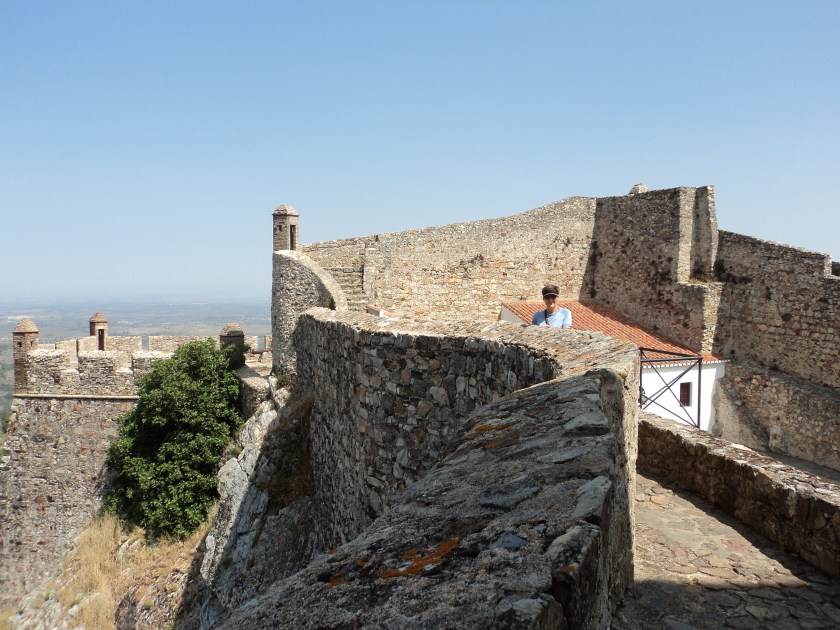
And just to finish – a few photos of beautiful Girona where we stayed a night or two on the way to/from Morocco. There was a flower festival happening so the city was covered in floral decorations.

Sailing in the Greek Islands 2009

It was too difficult to write during the week I spent on board ‘Rapport Lady’ with Chris and Hazel, whose Huntingdon home I was living in during the summer of 2009. Lots of sun, wine, swimming and Greek-style relaxing … but very limited wifi. So, this is mostly a photographic record of sunshine, sails and the beautiful Ionian Sea.

I hadn’t even met Chris and Hazel in person before our home swap. We’d crossed paths in the air between the UK and Oz, but had emailed a lot and felt like friends. However, it was still a massive surprise to get their email from Greece suggesting I hop on a plane and come on over! It took a micro-second to decide to accept, and a return email was on its way.

Planning the trip took somewhat longer … had to book a return flight from Stansted (UK) to Athens, work out even how to get to Stansted, and then book the car into a long-stay carpark. On arrival in Athens, I had to find somewhere to stay overnight, then find my way to the rather seedy out-of-town bus station to get a ticket for the 6-hour trip to Levkas. But – as always – things worked out, and I eventually met my fantastic hosts.

We set sail the same day and for the next week just drifted around – dropping anchor in secluded bays, or nosing our way in between yachts of all sizes to tie up at a little wharf. Being able to dive overboard for a quick swim, or jump ashore for a beer or wine was bliss, as was the Greek seafood, salads and other delicacies at the little tavernas. (Greek salads take on a totally different feel in Greece … one can never have enough olives, tomatoes and fetta….)

For the whole week I didn’t have to do anything nautical. Chris and Hazel had everything down to a fine art and made a great team when it came to pulling on ropes, dropping and hauling up the anchor, launching the dinghy and the 101 other tasks that come with sailing boats.

After six soporific days we headed back to Levkas for me to make the return trip to Huntingdon …. 6 hours in the bus to Athens, another hour to get out to the airport, 3 hour flight back to the UK, then 2 hours in the dark driving home. Sheer exhaustion, but worth every minute!

Rapport Lady – somewhere in the Ionian Sea
Chris and Hazel
Porto Spilia, Meganissi Island, Greece
Ready for dinner somewhere. Rapport Lady in the background.
(Hazel with hand in a sling after an accident with the anchor)
Typical Greek harbour taverna
Hazel in the galley
My bed – in the pointy end

Life on board

Chris at the helm

Cholsey, UK 2011

CHOLSEY 1:  23 August 2011

Joy, bliss, happiness…..  England!!     As beautiful as ever – and my spirits are singing.  

Back garden in my Cholsey home

My latest English home, in the village of Cholsey, is perfect….upstairs, downstairs, a big living room, kitchen/dining room and big windows overlooking a very pretty back garden.  Cholsey is quite rural but only 30 minutes by train from Oxford in an idyllic country environment.  London is only 60 minutes by train in the opposite direction, and Maidenhead is on the same line.   My home is just around the corner from the railway station.  And as well as all this, I have a magnificent Mercedes car to drive – and a bike.   Walking trails, including the Thames Path, abound in Oxfordshire, so there’ll be no excuses for not exploring far and wide over coming weeks.   I’ve already wandered around the village, and I drove into nearby Wallingford yesterday. 

I came up to Cholsey on Sunday after spending 3 nights in Maidenhead.   Struggled through a few days of Jet Lag (capital J, capital L) from which I’ve now fully recovered, thank goodness.   I think it was probably caused by a combination of the flights to and from Thailand only a few days before the long haul to Singapore and London, and the mad scramble to get ready for Rose (my current home exchangee) to move into my apartment.     But despite the fatigue I thoroughly enjoyed catching up with Maidenhead friends again and adored going to the charming little Theatre Royal in Windsor to see “Three Days in May”, a political thriller about the lead-up to WW2 in Britain.  Warren Clarke (of Dalziel & Pascoe fame) starred as Churchill and was very appropriately gruff and jowly.       

The flight over was as good as can be expected for so many hours trapped in a small space.     But I did have the best seat on the plane on the Singapore-London leg so can’t complain too much.    When flying on a Singapore Airlines A380, remember seat 48D stands alone… there’s no seat in front, so plenty of room to stretch out, stand up etc.   

Gin Slings at Raffles

The 2 night stopover in Singapore was fun with Doreen and Cyn (former CARA work colleagues), but we wouldn’t recommend the Excelsior Peninsula hotel where we stayed.    Next time we’ll save hard and upgrade to the Marina Bay Sands… it’s an awesome architectural structure of 3 huge pillars topped off with a great long ship, high above the Singapore skyline.    It looks a bit like a giant ironing board, but is no doubt exceedingly luxurious inside.  The whole city is awash with high-rise buildings, and huge cranes constructing more of them.  Immaculately clean and decked with flowers, Singapore now is nothing like the old colonial outpost it was in the days of Stamford Raffles 100 years ago.   We went to Raffles Hotel on our first evening of course, and had the obligatory Singapore Sling in the very gracious courtyard …outrageously expensive, but most enjoyable.  

Mahjong set in Chinatown

Other activities in Singapore included a wander along Clarke Quay (though clubs bars and restaurants are all still asleep at 11am), then a river boat ride to Marina Bay, a ramble along to Change Alley and a trip on the MRT underground to Chinatown.   The markets are great in this Chinese part of town – though not as cheap as Bangkok – and the Chinese Heritage Centre is well worth a visit.  It’s a little museum that tells the story of the Chinese settlers who poured in to seek their fortune.  Sadly most were destined to a life of poverty, in overcrowded shanty houses with opium dens, gambling, prostitution, gangs and cruel landlords.   These days the Chinese houses with their coloured wooden shutters attract tourists with money and cameras…. better than the dirt, disease and poverty of days gone by, I guess.   

We also took the Night Safari trip to Singapore Zoo.   This one gets a mixed review from me.  The buffet dinner and little train trip through the jungle were excellent, and we saw lots of animals in the special night lighting hidden in the trees.  It would be hard to fault the efficiency of the Singaporeans who run this attraction, one of the most popular in the country… but with dozens of tourist buses making the trip, and thousands of people being herded along, this wasn’t my idea of fun travel.   Having a guide who didn’t shut up didn’t help either.    Grump, grump, grump….

There are pros and cons to stopping over en route to the UK, I’ve decided.   It didn’t seem to prevent jet lag but it was interesting to sample a taste of Singapore – especially with friends.  

England is definitely my scene.   I still can’t get enough of the history, the green-ness, the country lanes, the villages, the trains and the whole general lifestyle.   The shops are far more attractive than those in Australia and the supermarkets are on a totally superior scale.  Food is excellent and comparable in price.   There’s no sign of riots or racism in Oxfordshire – only lots of evidence of a strong community spirit and pride in their surroundings.   Wallingford too is an extremely attractive small town about 6 miles from Cholsey, very historic, with the ruins of a castle built by William the Conqueror in 1067 when he was fresh from winning the Battle of Hastings.   But the town even predates William. It was established by King Alfred to defend his territory from the Vikings in the 6th Century.    These days it has lots of pretty shops, a fantastic antique centre, restaurants, coffee shops and an interesting museum. 

Cholsey is quite small – only a little Tesco shop, post office, a butcher and a barber near the village common, called the ‘Forty’.   The most famous person who lived around here was Agatha Christie who is buried with her archaeologist husband in the old village churchyard.    According to the guidebook, her books were translated into dozens of languages and, collectively, sold in the billions.   I found her grave with its rather elegant headstone. Her fans apparently still make pilgrimages to this little churchyard. 

CHOLSEY 2: Saturday 27th August

In Oxford yesterday I saw a quote from WB Yeats (the poet) which pretty well sums up how I feel about this gorgeous city.  He said “I wonder that anyone does anything at Oxford but dream and remember, the place is so beautiful….  One almost expects the people to sing instead of speaking.” 

 I think I probably walk around Oxford with a grin on my face too. It’s a place that makes me feel really happy.  It would have been even more beautiful when Yeats was alive, without all the traffic and tourists. But the ‘dreaming spires’ and lovely old colleges are still here and they still weave their magic.  You only have to step inside the gates of the colleges, or into a little chapel or crooked cobbled street, to feel the history and the silence.  Everywhere you go you’re reminded of the life and learning that’s gone on here for centuries.   If I had my life over again, this is one place I’d try to become part of.

It was so easy getting to Oxford by train on Tuesday for my first return visit since the Maidenhead days, and I spent most of the afternoon at the superb Ashmolean Museum.   Impossible to describe the treasures here but one could spend years in Oxford and still come upon wonderful things at the Ashmolean.    The way all these priceless exhibits are displayed is special too. Many are grouped to show how different civilizations have developed and cross-cultural ideas have emerged … for example, the influence of Greek and Roman sculpture on Buddhist carvings …. and vice versa; the way writing has developed over centuries in different parts of the world; the food culture of different civilizations etc.    And I can’t get over how popular this place is. There are people of all ages and nationalities wandering around, and yet there still seems to be space for everyone.  

 Yesterday (Friday 26th) was also spent in Oxford. And it was back to the Ashmolean for one of the free guided walks at 1pm.   This one was titled ‘Pilgrimages’ and we got to see treasures and icons of religious pilgrimages to the East and West over the millennia – all very beautiful and interesting.  (LATER 2020: A year after seeing this exhibition I walked the Camino de Santiago.

Although it was a drizzly kind of day yesterday it didn’t dampen the spirits.  I went into Trinity College, the Sheldonian Theatre and a special exhibition at the Bodleian Library about the making of the King James Bible (first edition 1601).   It was fascinating to see the changes over the centuries as so many learned scholars translated the original Latin texts into English and the monks illustrated them with superb calligraphy.   Interesting also to see how the various interpretations changed the meaning of words over time too.  (But somehow people still think it’s all the original word of God…)   My favourite exhibit was the so-called Wicked Bible from sometime in the 17th century.  The publisher made a misprint with his old wooden printing blocks, and the
7th Commandment came out as “Thou shalt commit adultery”.   Needless to say most of these Bibles were seized and burnt when the mistake was discovered, but a few escaped.  And the Bodleian has one – of course!  

The Sheldonian Theatre serves the same function as Bonython Hall at Adelaide Uni .  It’s a hexagonal building designed by Christopher Wren and still used for University ceremonies, graduation awards etc.   Climbing up the long spiral steps to the dome provides a chance to see the incredible architecture and wooden structure inside the building – and a good view over the city from the cupola at the top.  

Apart from all the history in Oxford, there’s also all the modern swing of a University town with lots of young people around (even though it’s still summer holidays) and lots of bookshops, cafes, pubs, quirky little shops, and a very tempting market with beautiful shoes, bags, gifts, toys and lots, lots more.  

Along the Thames path from Cholsey to Wallingford
Wallingford market square

But I haven’t spent all my time in Oxford.   On Wednesday 24th, I walked from home in Cholsey along the Thames to Wallingford.   It took about 2 hours – a lovely walk through meadows and woods, passing boats, watching swans and avoiding cows.   It was quite a warm day so very pleasant to sit for a while with a coffee and a book when I got to Wallingford.   I then rambled around the remains of the old Wallingford Castle.  There’s not much left of the old stone ramparts, but the whole area is now a very attractive park and garden which the good folk of Wallingford were out enjoying in the sunshine.    I like Wallingford with its old market centre, lovely antique shops, up-market dress shops, great tourist information centre etc– but after several hours of walking, I caught the bus home and hopped off just across the road from my place.     

On Wednesday evening, I went to the Cholsey Women’s Institute meeting.  The WI is a very old British organisation.   Every village and town seems to have a WI group – rather like the Australian CWA, I imagine.    At least these days they call one another by their first names, but I got the feeling that the days of ‘Mrs This’ and ‘Mrs That’ were not too long ago.   Cholsey WI meets in the local church hall, decorated with posters made by the Toddlers Play Group, the Girl Guides and other community groups.  The evening started with entertainment by a visiting actress who did Joyce Grenfell type monologues, sending up all the old Brit stereotypes.   Quite funny really.. .  and then came the General Business with all the arrangements for the next fundraiser, a report from the craft group, reading group, morning tea get-together etc.   I guess I’d probably get involved if I were to be here longer….

Peggy and James across the road asked me over for afternoon tea on Thursday afternoon. We munched lovely cucumber sandwiches in the garden.   They’re are a lovely couple, good friends of Rose’s.  

Pauline is coming to stay for the weekend, so we’re going to set off and explore the countryside of Oxfordshire.     More next time ….

CHOLSEY 3:   VISITORS

It’s been full house in Cholsey over the past two weekends with two lots of house guests and plenty of frivolity.  

Pauline came up from Maidenhead for the Bank Holiday weekend (27th-31st August) followed by Doreen, Cynthia and Doreen’s  86 year-old Mum for
2 nights this weekend.    The following notes are a jumbled attempt to record some of what we did.  

 Weekend 1 – with Pauline:       Drove to Abingdon, another lovely town on the Thames, and the one with that claims to be the oldest town in Britain.    This might seem a pretty grand claim in a land that boasts amazing archaeological finds in every town and village museum, but it’s supposedly based on the fact that the oldest remains from the Iron Age have been found in archaeological digs around the Abingdon area.    There’s also the ancient Abingdon Abbey – or what remains of it – which dates from Saxon times in 675AD.    There was a wedding in progress in the Abbey grounds when we were there so we couldn’t get in to see the Long Hall and other remaining buildings, but it was fun watching the bride and groom being photographed in the gorgeous gardens and cobbled lanes.    There was also a village fair in full swing in the market square….. a bit of a change from the Iron Age,  I guess, but they probably even had rituals and celebrations way back then.

From Abingdon, we meandered on to nearby Dorchester , the scene of much mayhem and violence because it’s where many of the Midsomer Murders episodes have been filmed.  It’s not at all hard to see why. All the houses and inns along the winding main street are like something out of a story book, extremely picturesque and quintessentially English.   

Dorchester Abbey was open and it’s still in remarkably good repair for such an ancient building.  The Abbey is still used today as the local place of worship, as well a setting for concerts, drama and exhibitions.  It dates from 635AD and once would have housed many monks before Henry VIII got to it and dissolved it as a functioning monastery.   The famous Jesse Window dates from the 14th century and combines stained glass and stone sculptures.   As in all these old churches, there are many effigies of saints, carved tombs, an ancient font and other beautiful features. 

Back in Wallingford, we had dinner at the Coach and Horses Inn.      

Sunday 28th found us in Wallingford for morning coffee and another wander around this town’s nooks and crannies and little streets with names like Turnaround Lane which lead to more old houses, mills and churches.  

With Pauline at Broughton Castle

From here we drove to Broughton Castle, near Banbury, about an hour’s drive away.   Broughton has been the stately home of the Fiennes family for several centuries – and yes, Ralph Fiennes is a grandson of the current Lord who owns the Castle.   It’s a lovely old castle, not too overwhelmingly large, surrounded by a moat and pretty gardens and it too has been the setting for many films and TV productions, including ‘Shakespeare in Love’ and others I’ve forgotten.    Various kings, lords, ladies and others have stayed in the castle’s bedrooms over time, or given paintings, or somehow contributed to the history and life of this lovely place.   I think I’d have been happy to have been born in Broughton Castle….  

Another English heritage house on our route home was Rousham Gardens, so we strolled around this idyllic pastoral setting through walled gardens and cow meadows, past ponds, cascades and statues. All very peaceful in the late afternoon sun.  c

The old church at Aston Tirrold

Next day (Monday 29th) we did a potter around the Parish of Cholsey – about a 4-mile walk through woods and fields to the twin villages of Aston Tirrold and Aston Upthorpe with their chocolate box cottages, old barns and 3 churches.   Had coffee at the Sweet Olive pub, then rambled on past Lollingdon Farm, the former home of poet laureate John Masefield. 

It was then back into Wallingford in the afternoon to explore the excellent town museum and the antiques shops.    

A little scholar in the stonework at one of the Colleges

Tuesday 30th:   OXFORD.    We did a fantastic free 2-hour walking tour around the city today with a very knowledgeable young guide who entertained us liberally with tales of madness, mayhem and martyrs, while also extolling the history and beauty of this city that he clearly loves.  We heard tall tales and true of many of the Colleges, student pranks and traditions, eminent scholars and lots of fascinating facts – such as the fact that there are 10 floors beneath the Bodleian Library, full of books… one copy of every book that has ever been published in England.   Incredible!  

Pauline and I had done a bit of our own wandering before the tour and enjoyed the calm and beauty of Balliol College (famous Fellows include 3 British PMs, a number of poets and 6 members of the Obama administration).   The College dates from the 1200’s.   We also dropped into Blackwells Book shop to see the Norrington Room, the biggest single room full of books in the world – it’s massive.  

Pauline went back to Maidenhead on Tuesday afternoon, so I caught up with washing etc – and did another Parish Potter on Thursday – before Doreen, Cynthia and Joyce arrived on Friday morning.  

Weekend 2 with the former CARA workmates 

Friday 2nd September:    A gorgeous sunny day, so after sandwiches and cake in the garden, we drove randomly off to see more of the glorious countryside.   Found our way to Wallingford, then Abingdon, enjoyed a drink in a pub garden by the river and strolled around the shops.   Joyce (Doreen’s Mum) is 86 and needs a wheelchair for getting around the streets – and it didn’t take long to discover that the quaintness and charm of little English towns doesn’t make life easy for people with mobility issues.    On the whole, I’ve been reasonably impressed with the level of accessibility for people with disabilities in England, but 16th century buildings, cobbled streets and narrow footpaths in the oldest towns certainly present challenges for both town planners and wheelchair-users.    However, we managed to get everywhere we wanted to go and Joyce was fiercely independent wherever possible.  

Had an excellent dinner at the Red Lion in Cholsey– fish and a glass of fizz, followed by delectable pudding.

Saturday 3rd September:   This was A Big Day Out, starting in the morning with the gigantic Jumble Sale at the Sue Ryder hospice at Nettlebed.   This event is held every 3 weeks and has to be the biggest Trash and Treasure sale in the world!!   I’d been told to get there early – before doors opened at 10.30am – but by 10am there must already have been hundreds of cars and thousands of people.   It’s huge!!  And fantastic!!   You can buy anything from furniture, carpets, designer clothes, gardening supplies, books, bric-a-brac, hats, bags, shoes, luggage, paintings and more and more and more.  Most stuff is only £1 or £2, with clothes only 50p (about $1 Aust dollar).   Needless to say, we couldn’t resist and came home with bags of stuff between us.  

The steam train on the Bunk line, Wallingford to Cholsey

This weekend was also the Wallingford Bunk Fest, a huge carnival and folk festival with live bands all day, Morris dancing, market stalls, food, beer and family fun.    And the Cholsey-Wallingford steam train was running throughout the day with buskers and ale on board.  This charming little train is run these days by volunteers along what’s called the Bunk Line.    We did the trip both ways, feeling like Harry Potter on his way to Hogwarts.   It’s all delightfully old-fashioned and fun.    The Kinecroft at Wallingford, normally a great big open green field, was full of people, marquees, dancing and Womad-type stalls.    It was another beautiful sunny day, so spirits were high and fun was had by one and all.  

Sunday 4th September:    This is England, so you can’t count on the weather.  The plan today had been to have lunch at Henley-on-Thames and enjoy a stroll along the river. But the heavens opened and it bucketed down all morning.   We still drove to Henley but I was really sorry the others couldn’t see it in all its royal regatta glory.   It’s a beautiful town with hundreds of boats and flowers and charming shops – but not today.    It seemed as if the rain had set in for the day (as it turned out, it hadn’t of course) so Doreen, Cyn and Joyce headed south for home and I caught the train back to Cholsey.    Then…  guess what ….the sun came out in a blaze of afternoon heat.   

I’ve just been down to the little railway bridge by the church to do a bit of train-spotting before the steam train gets put to bed until its next special outing.  

CHOLSEY 4:   DONKEYS and other DELIGHTS

The donkey farm

I’ve fallen in love again – this time with donkeys.   Eighty-three of these beautiful little animals live at Island Farm Donkey Sanctuary not far from here.   I’ve visited twice in the past week and am ready to ‘adopt’ two of them for Ben and Julie, Bron and Michael.   ‘Our’ donkeys are Brewster and Pollyanne… two of the dearest, gentlest little creatures you could ever meet.   Many of the resident donkeys at Island Farm had been neglected, abused or in pretty bad shape before they were rescued, with quite a few coming from horse fairs, gypsy camps and old farms all over the country.    They now live happily in lush green fields with straw to sleep on, regular vet checks and lots of love from volunteers and sponsors.    On Saturday, the Farm had a special fundraising event which I dragged Pauline along to.
We both felt it was like stepping back in time to a quaint old-fashioned jumble of stalls, animals, miniature steam engines and other sundry fun-of-the-fair activities, including a display of live owls!   Best of all are the donkeys though…..

I combined my first visit to Island Farm earlier in the week with a walk around Brightwell-cum-Sotwell, the nearby village.  Despite its funny name, this village is an absolute delight with many thatched cottages, winding lanes, an old manor house complete with moat and ducks, and even an old mansion which was supposedly used by smugglers and has its own ghost.   It’s a magical little village that almost feels as if it might disappear if you blink your eyes.   Pauline was just as enchanted when I led her around after our visit to the Farm.   Of course the cottages around here are probably worth £1 million … so there’s nothing quaint or fairy-tale about the real estate prices.

The gardens in all the villages are dripping with apples, plums, quinces, beautiful old English trees and flowers. And often you’ll find a barrel of apples outside a front gate with a notice to Help Yourself.  I’ve enjoyed some delicious stewed apples over the past week ….

This week I also took myself to the first meeting of a new Cholsey and Wallingford Reading Group that’s being established.    It turned out to be a group of mainly young Mums, so reminded me of days gone by in my own Book Club days in Adelaide.  However, these young women didn’t seem to mind an Australian senior citizen (probably older than their own mothers) dropping in….  I’ll only get to one more meeting before I leave Cholsey, but it was good to talk books again, and the book chosen for next month is ‘Pigeon English’, which is on the short-list for this year’s Man Booker prize.  

Much else has kept me very busy during the past 5 days, starting with a trip to Henley on Wednesday.    I adore Henley and wanted to see it again in the sunshine.   I did a circular walk by myself along the river and through the woods which took me about 2 ½ hours.    The riverside path in Henley passes by some impossibly beautiful houses, gardens and natural woodland, with boats of all shapes drifting by.   Then the path veers off through fields and bridle paths and autumnal woods passing more gorgeous houses and expensive horse properties.   It’s very upper class countryside around Henley-on-Thames – with a very comfortable lifestyle enjoyed by all who are fortunate enough to have been born into it.  Though having said that, I also have to say that all the people I meet on my wanderings around the country are friendly, helpful and not at all snooty or pretentious.   In fact, I find English people on the whole much friendlier and more open than people at home…. it’s so easy to talk to anyone on the trains, in cafes, shops, waiting in queues etc.   There’s a feeling of well-being here in this part of the world, despite the GFC, climate change and other bad news.   Maybe it’s got something to do with the strong sense of community in all these town and villages – something we miss in the suburbs of Adelaide. 

Greys Court

On the drive home from Henley – which should normally take about ½ hour – I wanted to visit Greys Court, a National Trust property.   After many wrong turns and miles of winding hedgerow roads, I finally found it just a couple of miles outside the town, but the maps and signposts had not made the task easy.   Normally I would find this quite frustrating, but when everywhere you go is all so pretty -and you have all the time in the world to get there – it really doesn’t matter.   And it’s always worth it at journey’s end.    Greys Court is a medieval mansion nestling amid rolling hills, the former home of Sir Felix and Lady Elizabeth Brunner.   It was given to the National Trust in 1969, with Lady Brunner continuing to live there until 2003.  It still has the feel of a 1930’s family home, with lovely rooms and a delightful series of walled gardens.   It also has a connection with donkeys, with its huge wooden Donkey Wheel which was used in the past to draw water from the well … a donkey would walk around inside the wheel to pull the big bucket up and down. 

This week has also included two visits to my neighbours in this street.   One of Rose’s friends, Pat, lives down the street, and makes the most exquisite miniature dolls house furnishings.   Rose had told me to contact her and I am so glad I did.   I can’t even begin to describe the quantity and quality of her amazing art and craft work .   She has superb Victorian and Edwardian dolls houses, completely fitted out with tiny hand-made tapestries, carpets, cushions, patchwork quilts and all the trimming and trappings of a home of the era.   But in addition, she’s  made the most amazing little ‘shops’ with tiny goods and chattels to suit … hundreds of little cakes and biscuits in the patisserie, tiny sausages, chops and other gourmet meat dishes in the butchers, and a vast array of miniature costumes for the fancy dress shop, with hats, shoes, gloves etc to match.   There’s enough to establish a little gallery but she doesn’t want to show her work, or sell it.   I’ve never seen anything like it and was quite captivated by her skill and the beauty of her work.

After afternoon tea with Pat, I was invited across the road for dinner with Peggy and James… delicious local roast pork, home-grown vegetables, French wine and a tasty cheese platter.   Is it any wonder I love this country and its people?    

But there’s still more….

On Friday, Pauline, the 2 Marys and I joined the Maidenhead U3A group for a fabulous guided walk around the hidden parks and gardens in the City of London.   This was my first trip into London this time – it was so easy to join the Maidenhead mob on the same train down from Cholsey.   Pauline, Mary W and I were probably the youngest in the overall group of about 10 women ( at least a couple of them were over 80) but they were a sprightly lot who managed the 2 hour walk easily.  We started with coffee in the crypt of St Pauls Cathedral and looked around the recently-refurbished Paternoster Square outside.  This part of London is all about trade, finance, corporate banking etc, and there still seems to be plenty of optimism in the market if the trendy young corporate yuppies in the square are anything to go by.   Or maybe they were just drinking champagne and enjoying posh nosh in the attractive eateries to drown the sorrows of the global financial crisis?  Anyway, London still looks pretty prosperous and full of energy to me.

A hidden garden in the City of London

The walk was led by Sally, one of London’s fantastically knowledgeable Blue Guides (and who has also become a good friend of mine in England … we’ve caught up several times since this first walk).  We wove our way around corners and churchyards, between towering city buildings and the rather spectacular Barbican, to find little pockets of gorgeous greenery and flowers where City workers have their lunch and birds and bees try to maintain their way of life in the busy metropolis.   Much of this area was destroyed in the Great Fire of London in 1666, and then destroyed again in the bombing during World War II – but it’s incredible how things re-grow and re-establish.  Many of the gardens are in old church sites that have been protected and all have fascinating stories to tell.   This part of London is also home to the Livery houses – the Goldsmiths, the Pewterists, the Wax Chandlers and all the other trades and industries that made London such a centre of commerce through the millennia.   Sally was a wealth of information about the history, and pointed out dozens of things I’d never have seen of known about otherwise.    It was an extremely interesting walk and well worth the cost of the train fare to get into London (nearly $40 Australian – yes, trains are expensive, even with a Senior Rail Card.)    

The Monument – built to commemorate the Great Fire of London

Following the guided walk, Pauline, Mary W, Mary O and I continued on our own ramble down to the Monument.  This tall, tall tower was erected as a monument to the people who died in the Great Fire, and it’s said that if it were laid down, the point at the top would touch the place in Pudding Lane where the fire started.   

After the train ride back, I just had time to whip home and change clothes before setting out on another train to Oxford – this time to go to the Playhouse to see a one-man performance of “Under Milk Wood” , the lovely story-poem by Dylan Thomas of life in a little Welsh fishing village.  The actor Guy Masterton played all 60-something characters with nothing more than one chair on the stage. Quite fantastic!    I just loved being at the theatre in Oxford at night, surrounded by all sorts of people I’d like to have as friends.    I didn’t actually speak to anyone, but still felt very much at home. 

This Diary entry is so long already, but i might as well finish it off with yesterday’s activities (Saturday 9/11).     Thoughts of Twin Towers and New York were furthest from my mind as I wandered through the beautiful towers of Oxford once more with Pauline.    (She’d come up to stay for the weekend again to see my donkeys and share the pleasures of Oxford’s Open Doors festival).

Oxford Canal – and my walk during the Open Doors weekend

Once a year, Oxford opens all its doors to visitors.  It’s a great chance to see the great Colleges and other buildings, free of charge.   They also do lots of guided walks around more unusual parts of the city.  I’d booked for the walk along the Oxford canals and waterways to learn about the economic and social importance of the river and the canals.    This turned out to be another treasure with a fantastic guide who actually lives on a river boat and is a river historian.   We heard all about the lives of the boatmen in the days when the canals were the highways of the country, with barges pulled by horses bringing all the manufactured goods down from the midlands and north of England for shipping to the world.  There’s a maze of these canals throughout England and it’s one of my ambitions to do a trip in a narrow boat some time.   The parts of the city bordering the canals were rough working-class areas in days gone by – and there are still many signs of the old way of life with horse stables, pubs with names like The Nag’s Head, and poorer little cottages.   But the walkways are now quite attractive leafy lanes and much of Jericho, the older part of Oxford, is a lively student quarter.   Oxford University Press still operates its printing works here too.  

The Bodleian Tower
Superb ceiling in the Divinity School

As well as the canal walk, Pauline and I visited the Bodleian Library and were able to go inside the Divinity School and see the magnificent fan-vaulted ceiling in the 15th Century room that has been described as the most beautiful room in Europe.   I’m not sure how this claim stands up against all the other wonders of architecture and design around this part of the world, but it certainly is very lovely.    Among the other Colleges we looked around were All Souls with its superb chapel, Jesus College, Hertford College, New College, Exeter College – and possibly more that I’ve forgotten.   Each one has its own beauty and special features, all designed around quadrangles of green, green grass and flower beds.   So many famous names from history emerge as one wanders from one of these stunning places to the next.   The sun shone for much of the day and Oxford was glorious.

We also walked along to Holywell Cemetery to see the graves of many eminent people.  Best-known is Kenneth Graham, author of ‘Wind in the Willows’.   It’s a peaceful, secluded little corner of Oxford that is now looked after by a volunteer group who are as much interested in the wildlife and flora of the area as the old tombstones and graves.   The charming one-armed woman who walked around with us and a small group of other visitors knew far more about the flowers, butterflies, lichens and grasses than she did about the famous souls who rest beneath them.    It was a very enjoyable little walk and talk. 

Today (Sunday) has been a kind of catch-up day for email, supermarket shopping etc – because Penny arrives tomorrow and it will all be on again with more sight-seeing, walking, driving, eating and drinking….    What a life…..

CHOLSEY 5:   Penny’s visit    (Monday 13th – Sunday 18th)

Penny has hitched onto part of my home exchanges for the past 3 years, en route to/ from Scotland visiting son Richard and family.  And we’ve seen more of the world together since our swinging ‘60s days in London.  But, lo and behold … the transport jinx struck again.   For 3 years in a row we’ve had dramas in our meeting plans.   Last year, Rome surpassed even its own normal low standards of inefficiency with late trains when it decided to throw in a full-blown train strike mid-way from the airport to my little house; and the previous year, Penny’s bus to our agreed rendezvous in the Lakes District was delayed. This year British Rail completely cancelled the Edinburgh train that was supposed to link with the one she’d booked from Newcastle to Oxford.  So she missed the connection!   

I’d gone up to Oxford to meet the Newcastle train, but when Penny didn’t step off it, I just headed back home to sit by the phone…. and sure enough, a couple of hours later the doorbell rang.   She’d caught the next train down from Newcastle, and found her way to Cholsey and my front door. And her phone battery was flat.

So with everything being well, this week has been action-packed with more sight-seeing, drives, walks, eating and drinking, a literary festival and a stately home or two.  

Bridge and lake at Blenheim Palace

Friday (16th) was a feast for the intellect at the Literary Festival at Blenheim Palace.   This 5-day Festival, run by the Independent newspaper, seems to be a tad more academic than the upcoming Henley Festival (for which I’ve also booked tickets) but we thoroughly enjoyed a full day of great talks and debates within the splendid grounds of Blenheim.   Unlike Adelaide’s fabulous Writers Week, people pay to attend these events over here, but the Festival does throw in coffee and cake, or a glass of wine, at several sessions. 

 We heard Hugo Vickers talk about his new book, “The Tragic Life of the Duchess of Windsor” which is somewhat controversial because he presents Wallis Simpson as more of a victim than a scheming divorcee who brought about Edward VIII’s abdication.    Then there was a talk about Lancelot “Capability” Brown, the esteemed landscape architect who designed so many of the lakes and gardens that surround England’s beautiful palaces and mansions, including Blenheim itself.   The afternoon sessions were presented by (1) a panel of journalists who discussed the events in the Arab countries this year and (2) a young woman envoy to the UN in Afghanistan about the failure of the Western nations in understanding the complexities of this fragile country.    It was all immensely interesting, and whilst it soon became clear to us how much we don’t know about current world affairs, we did pick up some new and fascinating insights into the Middle East and Afghanistan.

A cottage at Woodstock

During the day we also had time to explore some of the Palace grounds, and at day’s end we walked across to the very picturesque village of Woodstock, outside the Palace gate.   Being near to the Cotswolds, most of the village houses, shops and pubs are built of the beautiful, creamy Cotswold stone and old slate roofs, and they twist and lean along the little lanes that wind off the main market square.   I’d been to Blenheim 3 years ago, but didn’t explore Woodstock then so was delighted to have the chance this time. 

Most of the week’s activities didn’t require as much mental effort as the literary lectures – but neither did they need much physical effort. We did some walks around Cholsey and Wallingford, also visited the nearby village of Ewelme, Greys Court, Henley and the Maharajah’s Well – then spent a whole day in Oxford on Thursday along with Penny’s friend, Bev, from Dunedin. Bev was staying with her daughter in London so it was a great chance for her and Penny to catch up, and for the 3 of us (all Social Workers) to spend the day together.

The Maharajah’s Well

The Maharajah’s Well at Stoke Row, near Henley, is a fascinating piece of sculpture and engineering in an English village – and has an extraordinary story.    It was the gift of the Maharajah of Benares to Stoke Rowe in the mid-1800’s.   It looks very ‘Indian’ with gilded domes and a decorative elephant on top, so is quite out-of-keeping with the rest of the village.   However, it did serve a valuable purpose for over 70 years in helping this poor village community to get water without walking miles with heavy buckets.  The Maharajah was grateful for the assistance he’d been given by Great Britain, so when he learned of this village’s plight, this was his return gift.   The well is 368 feet deep (taller than St Pauls Cathedral and twice the height of Nelson’s column).    It was dug by hand, with only one man at a time being able to fit down the shaft.   It was renovated in 1983, and the Queen owns a replica of it.   Incredible – and a bit bizarre…

Alms houses at Ewelme

Ewelme is a little gem.  A tiny village tucked away in a vale between rolling hills and fields, its main claim to fame is its old Abbey and alms houses which date back centuries.   Thomas Chaucer (Geoffrey’s son) is buried in the Abbey, along with the Duchess of Suffolk who was the landowner of this part of the country.   The alms houses around the church are very pretty with their little cloisters and central garden…. they were originally built for the old (and poor) men of the village, but over time, women have managed to gain theright to move in too.   In earlier times, if a married couple lived there, the wife had to move out when her husband died… however a few enterprising women saw an opportunity to stay on if they married the incoming new male lodger!   These exquisite little houses still cost the princely sum of £5 per month for the residents.  
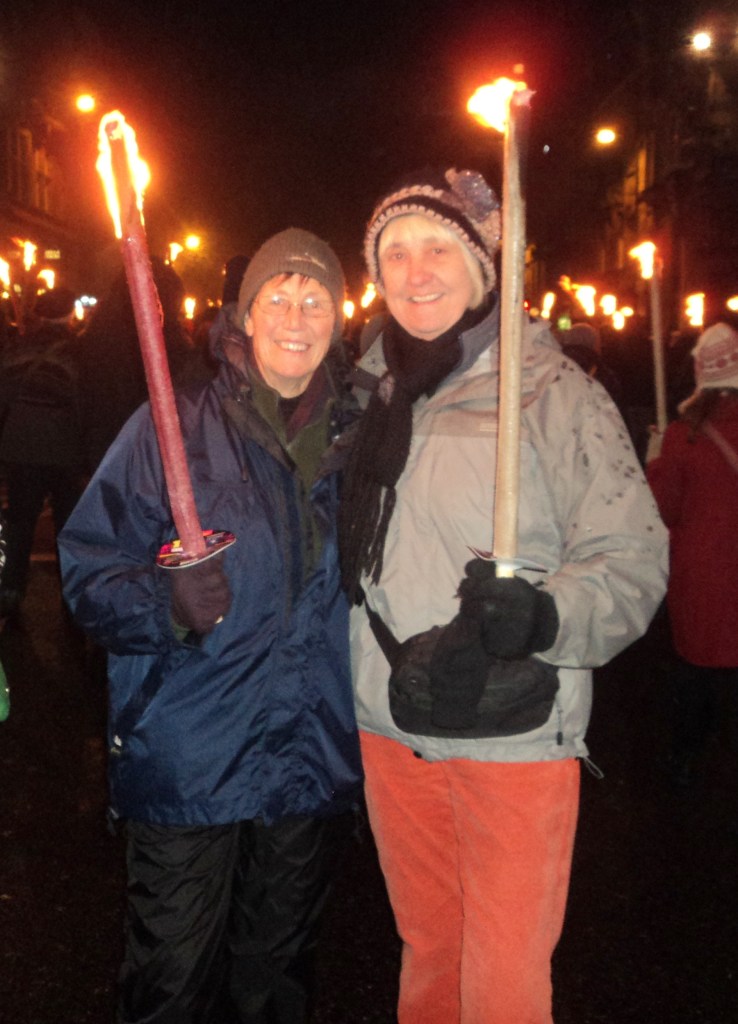
Ewelme’s other main attraction is its watercress beds.  Once upon a time, this village supplied all the watercress for England, transporting it to London, the Midlands, and everywhere.  Of course this is no longer financially viable, but a group of Ewelme volunteers still maintain the natural reserve and the beds of cress in the stream that flows through the village – and a very pretty sight it is too. 

Thursday in Oxford gave me a chance to act as tour guide and show Penny and Bev some of my favourite haunts.  All being book-lovers, we browsed for a while in Blackwells huge reading room, then visited Balliol College and adjourned to the Turf Tavern for lunch.   Afterwards, I left them to do the 2-hour free walking tour that Pauline and I had enjoyed last week, while I spent a couple of happy hours in the Oxford Museum and at Alice’s Shop (where Alice in Wonderland used to buy her sweets…)   It’s opposite Christs College where Lewis Carroll and Alice’s father were colleagues – and it’s full of Alice memorabilia at exorbitant prices.  

Penny and Richard at Goring

Another pleasant surprise this week was learning that Penny’s son, Richard, had to come down from Edinburgh to Reading on Wednesday for a meeting.   Even though she’d just spent 3 weeks with Richard and family, it was a great little bonus to be able to catch up again for dinner on Wednesday night.   I went along too and enjoyed meeting Richard again. When I saw him last in NZ, he was a teenager!    We met at Goring railway station and went to a lovely old pub on the River for dinner, then drove him back to his hotel in Reading.   

Yesterday (Saturday) I needed to catch up in my own space for a while, so Penny went off to Oxford alone.     (She enjoyed the Oxford Museum, the Covered Market and the Wine and Food Fair at Oxford Castle)

And this evening (Sunday) she’s gone to Heathrow to catch her flight home to New Zealand.   We spent most of the day doing a lovely walk through the fields and woods around Ewelme and visiting tiny St Botolph’s church at Swyncombe.    It was mostly sunny until near the end when we got drenched!   We then enjoyed a last late lunch and drink at the Red Lion in Cholsey before coming home for the final packing and departure. 

Tomorrow (Monday 19th) I’m off to Herefordshire to stay a few days with Daryl’s mother.   It’s all go in England – but I’m still one very happy traveller.  

CHOLSEY 6:  Herefordshire, Wales and the Cotswolds

Too much to see and do & not enough time to write…..I only wish I could pack all this beauty into a box and bring it home and share it round.  

The church at Weobley

This week was my driving holiday across to Herefordshire to visit Daryl’s mum in Weobley (pronounced Webly .  The nearest big town is Leominster, pronounced Lemster … they don’t seem to like the “o’s” …)   Anyway, however you say it, it’s a lovely little place, one of Herefordshire’s black-and-white villages.     Many of the buildings date from the 15th and 16th centuries, and are built in the Tudor style with exposed heavy black wooden beams, with whitewashed walls between the woodwork.   They twist and lean at all kinds of angles and look very quaint.    I wandered around the village on the morning that Sylvie went to her volunteer job at a school for kids with disabilities (which she’s been doing for over 25 years), and blazed away with the camera.   However, photos will never be good enough to capture the atmosphere of all these pretty places. 

Other activities during my 3 days in Weobley included some bracing country walks with Sylvie and Harvey, her friendly brown spaniel.   Once again I was captivated by the network of footpaths and walking tracks through the farms and woods.  Autumn is definitely the “season of mists and mellow fruitfulness” over here – apples, pears, coloured leaves and ploughed fields … quintessential English countryside in abundance.  

One day we did a longer walk (without Harvey) up onto part of Offa’s Dyke.   Offa’s Dyke Path is one of the Great Walks of Britain, along the border between England and Wales, 177 miles in total.  We did about 3 miles – all uphill – and had wonderful views over the English hills and dales and the Welsh mountains.    Offa was a powerful Saxon king in the 8th century who ruled over a huge part of the Anglo lands.  He built this massive earthwork construction to keep the marauding Welshmen out of his kingdom.   The Dyke is up to 20metres wide in parts and roughly follows the present-day border.      It’s a well marked walk and we had no trouble, but the guide books describe the whole walk as quite challenging – not a doddle.  From the highest point that we climbed to, we could look down into Welsh villages and across to some coal mines.  We also passed lots of wild Welsh ponies in the bracken on the way back down.  

Another day we enjoyed a visit to the Westonbury Mill Water Gardens.  Privately owned and established, this garden is laid out around ponds and streams behind an old mill.   Like all the English gardens I’ve seen, everything grows in a rambling profusion of colour and abundance.    Features here included a dovecote and gargoyles, and a fern grotto with a domed roof made of coloured wine bottles that sparkle in the sun like a cathedral window.   The garden has been featured on a BBC gardening program. 

On my last evening, we had dinner at Jules Restaurant in the village – thick stone walls, old wooden tables, French cuisine and a very cosy atmosphere.

The drives to and from Herefordshire were also a highlight of this mini-holiday.  I took a different route each way so I could see more of the countryside, and arranged a one night stopover in Bristol on the way back in order to visit the famous ss Great Britain.   The driving was quite easy – a mix of motorways and back roads, and a gazillion roundabouts.    I’m pleased to report that apart from a minor hiccup getting through the city of Hereford, I didn’t get lost once!    I stopped when I felt like it, and along the way ‘discovered’ the lovely little town of Ross-on Wye, the beautiful city of Cirencester, and some of the most exquisite Cotswolds villages.

In Bristol, I took a ride on one of the open-top hop-on, hop-off tourist buses because I didn’t have much time to spend there.   It’s the first time I’ve ever used one and I don’t think I’ll bother again.   You get bombarded with facts and dates and stuff you can’t remember, while lurching around streets and squares and parks and gardens that you probably don’t really want to see anyway.    I didn’t much like the ‘feel’ of Bristol, a bustling, noisy, sprawling, dirty, chaotic city.   It’s an old seaport on a tidal estuary with a wealth of history in trading wool, wheat and other British farm products to the new worlds of America.  It also became immensely wealthy through trading black African slaves to the cotton planters in the southern states of America.    These days there are lots of small boats in the docks, but Bristol seems to have lost its place to London, Liverpool and other major ports around the country.    I guess the system of locks and bridges along the river into the main dock is impressive, but I didn’t really have time to study it all. 

The major draw card for a visit to Bristol has to be the ss Great Britain.   Designed by Isambard Kingdom Brunel, the Great Britain was the first propeller-driven transatlantic steamship, and at the time, the largest ship ever built.   I first came across Brunel when I lived in Maidenhead – he was a great British engineer in the 19th century who built bridges, dockyards, railways and tunnels.  Among many other modern wonders, he designed the Maidenhead railway bridge with the widest single span of any brick bridge ever built.    However, the Great Britain is even more superb, both as an engineering marvel, and for its history.    Built in the Bristol dockyards in 1843, this ship is now back in its home dock after foundering in the Falkland Islands in the 1930s and being rescued and refloated in a mammoth operation in 1970.    It’s a massive iron ship which has been restored and opened to the public as a museum.  You first go down under the glass ‘sea’ to view the hull and huge propeller, then you go on board to see the engines and the passenger decks – splendour in First Class, rather cramped in steerage.  It’s very ‘real’ … even to the extent of onboard smells, from freshly-baked bread in the galley, to sea-sick vomit in the tiny cabins!  The Great Britain transported tons of cargo and thousands of passengers to the colonies, including to Australia during the gold rush days, and she was also used as a transport ship in the First World War    There’s a wealth of memorabilia on display, from passengers’ diaries, to photos, letters, videos of rounding Cape Horn, all kinds of nautical stuff, stories of the Captains, information about the food, on-board entertainment, cargo etc.   It’s wonderful!!    

The other Brunel-designed structure in Bristol is the massive iron suspension bridge over the Avon channel.   I didn’t go across it, but had a few good views of it as I drove or bussed along the road by the cliffs of the estuary.   It’s worth looking it up on the internet to see how huge it is.  

After a lazy sleep-in at the Travelodge in Bristol’s outer suburbs, I set off through Gloucestershire and Oxfordshire on the way home to Cholsey.   I’d decided to use mainly A-roads, rather than motorways and to go via Cirencester – and I’m so glad I did.  On this beautiful sunny day the countryside looked magnificent.    Many of the country roads are avenues of overhanging, sun-dappled oaks and elms and ash and – I really haven’t a clue what they are– but they’re all beautiful, especially at this time of the year with their autumn colours.   

As soon as I drove into Cirencester, I knew I had to spend some time there.   It’s an old Roman city and is now on my list of Must-Return-To places.    I spent 3 hours wandering around, having lunch and silently ooh-ing and aah-ing at everything.  I’ve never seen such gorgeous shops either – I was nearly tempted to toss aside my principles and just buy, buy, buy.   Honestly, if I lived in England, I would have cupboards full of fabulous clothes and a stunningly furnished house.  I’d also give tasteful hand-crafted gifts and eat gourmet delicacies every day.   All these treasures are to be found in quaint little shops and markets everywhere in England –but Cirencester was special.   Being in the heart of the Cotswolds, its old houses and buildings are soft cream in colour and very inviting.  As I was strolling down one lovely old street of original weavers’ cottages, camera in hand, a very nice woman asked where I was from, and then invited me inside her cottage to see what it looked like!   Do you reckon that would ever happen in Australia??  I don’t think so!!   Needless to say, the cottage was just as pretty on the inside as the outside and it went back quite a long way through a maze of little rooms to a beautiful conservatory and cottage garden.   I asked her if she’d be tempted to do a home exchange in Adelaide…..    I have to say that, in my experience, people in rural England are all friendly, kind and welcoming. 

There was a big funeral service happening in the Abbey while I was there, so I didn’t get to see it all, but I enjoyed the market place outside and the sweeping Abbey gardens and grounds.   The woman in the Tourist information office was also one of the nicest and friendliest I’ve met anywhere – she gave me some good ideas for villages to explore on the drive home.  So all in all, Cirencester was a winner. 

I headed from there to Bibury – once described by William Morris as the most beautiful village in England.   This would be a hard contest, but I do believe Bibury would make the short list.   As I was driving over the little stone bridge coming into the village, what should be coming the other way but a horse and carriage carrying a pretty bride and her groom!  With swans and ducks and flowers and old stone cottages all around, it was a perfect sight.    I found a park by the old church, then strolled through the village footpaths and treated myself to a Cotswold ice-cream.   How much bliss can there be in a day??

Beautiful Bibury in the Cotswolds

The back roads are definitely the way to go to explore this part of the country.  Enticing road signs along the way tempt you to visit other gorgeous villages with names like Much Marcle, Goosey, Hole-in-the-Wall and Wormelow Tump!  But I couldn’t do them all, so just soaked up the beauty of the country all around me.   In some places there are miles and miles of little stone wall fences around the fields, which must have taken years to build in days gone by.   At this time of the year, many of the fields have been ploughed, ready for the winter rains, I expect.   But there’s such variety in the colours everywhere, and something new and lovely around every bend.   One such surprise was Buscot Park, a National Trust property I’d intended to visit some time, but hadn’t got round to looking up exactly where it was.   And here it was on this lovely little back road in the Cotswolds.  

Buscot Park is the home of Lord Farringdon.  It’s a neo-classical house set in peaceful woodlands, and home to a wonderful collection of paintings and furnishings.   Lord Farringdon and family still live there – and I think I actually saw him.   As I was wandering through one of the stately hallways, a kindly gentleman with a little dog walked past and went down the stairs marked ‘Private’.  I’ll swear he was the man in the silver-framed photos on the piano.       

CHOLSEY 7

The weather is perfect in southern England right now – 27 degrees and a cloudless blue sky.  The Brits are loving it – they’re calling it a heat wave on the news!   We’ve had 4 days in a row of beautiful sunshine, and the forecast is for a continuation of ‘scorching’ days over the weekend.   It’s really too lovely to be sitting inside writing, but I’ve been out in the country soaking it up for the past few days and have a busy weekend ahead,  so today’s a day for catching up with other stuff.    I can’t believe how easy it is to be so totally self-indulgent…

This week is the Henley Literary Festival.   I spent all day on Wednesday at Bix Manor, a lovely old home (now a function centre), about 30 minutes from Cholsey, and 5 minutes from Henley.  It’s one of several venues they’re using for the Festival.  It couldn’t have been lovelier with the glorious sunshine, tables and umbrellas in the garden, wine, tea, coffee and delicious little cakes, very pleasant English people to chat to throughout the day, lots of books, and … the icing on the cake … some great writers and speakers to listen to.  

The first session was a panel of travel writers from magazines and newspapers, including ‘Vanity Fair’ and the ‘Daily Telegraph’.    They shared some amusing anecdotes, tips and inside information about the joys and pitfalls of travel journalism – all very entertaining.   The Telegraph travel editor read out 2 pages of his “banned word” list– words such as gorgeous; stunning; picturesque; winding lanes; cobble-stones; and heaps of other clichés about the joys of England!    (… lucky these Cholsey Chronicles are not being submitted for publication…)      

I also enjoyed hearing John Julius Norwich, the current Lord Norwich, an esteemed historian and monarchist, aged 82, talking about his latest book “England in 100 Places – from Stonehenge to The Gherkin”.    Then it was Colin Thubron recounting his pilgrimage to Mt Kailesh in Tibet, and Christopher Oondatje (brother of Michael) with his collection of “Boys Own” type adventure stories about his own life.    Rachel Johnson’s session was booked out. She’s editor of ‘The Lady’, a posh women’s weekly magazine, and sister of Boris, the colourful Lord Mayor of London.   But over afternoon tea I got chatting to a lovely English woman who had a ticket and had to leave early, so she offered to share it with me.   When she snuck out the side door, I snuck in – so we heard half the session each.    Rachel was another very engaging speaker. She must be rattling some of the conservative upper classes since she took over “The Lady”….   

But back to last weekend – and where I left off in the last Diary.  It was the Choko Beer Fest in Cholsey on Saturday.   Choko is a community project linking Cholsey and Kodumela in South Africa.  Over the past 4 years, Cholsey has raised over $80,000 to support development projects in Kodumela as well as local organisations.  They’ve also had an exchange program for people from the two communities. Rose has visited the African town.  The Beer Fest is one of many fundraising events in the annual calendar, so I went along to check it out.    It was absolutely nothing like you’d imagine a beer bash to be. There wasn’t a rowdy, drunken yobbo in sight.  It was a real family day on the lawns behind the church hall.   There was a wide variety of local ales and ciders for sampling, as well as wines and good food for sale.   And some great live music. 
I didn’t know anyone there, but I sat very happily, glass of wine in hand, listening to some really good bands and solo guitarists.    The Choko project is a perfect example of what communities can do – and the village of Cholsey demonstrates the kind of community spirit and action that happens all over rural England.  So often I wish I’d grown up in this country. 

On Monday (or was it Tuesday ?) I took myself for another Thames Path walk – this time from the Shillingford Bridge along the tow path, then across the fields to Benson and Warborough, before cutting back to the river at Shillingford again.   Warborough is another idyllic village of rustic cottages, thatched houses, a lovely village green, 1000-year old church, little store and pub.   I had some friendly conversations with other people out walking, a man fishing and some nice elderly women sitting in the sunshine – as well as many nods, smiles and waves from people in the village or cruising along in boats.  Everyone you meet along the way smiles and says ‘hello’.  Don’t anyone try to tell me the English are reserved. I love them.       

With a couple of free days between literary festival events, I decided on the spur of the moment yesterday afternoon to go for a drive to make the most of the weather.    I’d always wanted to see the famous White Horse on the chalk hills near Uffington, so headed in that direction with plenty of time to detour off to some of the villages on the side-roads.   I’m sure you could just stick a pin in a map of England and land on somewhere beautiful, but I chose Blewbury and East Hendredge because I recalled seeing them mentioned somewhere in my great pile of Oxfordshire tourist information.   By far the best way to explore these places is just to park the car anywhere in the village and then wander wherever the mood takes you.  There are so many interesting little footpaths leading down lanes lined with cob walls and gardens, and you just come across beautiful houses, duck ponds, old weathered barns, black and white thatched cottages – a picture opportunity around every corner.   Blewbury was particularly beautiful, but East Hendredge also had a quiet, rustic charm with lots of graceful, centuries-old houses.      

The White Horse on the hill is hard to describe.   It’s a huge, stylised galloping horse flat in the hill, created over 3000 years ago by some ancient tribe who dug deep trenches in the shape of a horse and filled them with chalk.  No-one knows exactly who these people were, but it’s thought that the horse dates back to the Bronze Age.   It’s high on the rolling hills that look over a great expanse of the Downs.  The views from up near the top are magnificent.  But the strange thing is that it’s very difficult to see the full shape of the horse from anywhere below, and even when you get up high and close to it, you can’t see the whole thing from any one single angle.  The only photographs that show the whole horse shape have been taken from the air.   So how did the ancient people make it?   And what is its meaning?    I managed to get a few photos that give some idea of the horse and the surrounding countryside – including the flat-top hill below the horse that has a large white chalk square in the middle, where folk-lore says St George fought the dragon.    It’s a mysterious place, but quite beautiful in the golden sunlight that shone everywhere yesterday.   I realised that if I’d done a bit of preparation before setting off in the car, I could have made a really good day’s walk in this area – there are paths everywhere around these hills, some leading to other ancient sites.  But it was actually quite hot climbing up the hill, so maybe not the best day for a long walk. 

Must mention one thing that got my hackles up this week … though seeing it’s the only black spot in all the weeks I’ve been here, I’m not grizzling too much, and it certainly hasn’t marred my love of England.    I got a nasty little fine from Oxfordshire City Council for being caught on CCTV in a bus-lane. Apparently an absolute no-no in Oxford.    The frustration is that I had never intended driving within the city of Oxford, but on the way up to Blenheim Palace a week or so ago with Penny, we took a wrong exit road from one of the many roundabouts on the ring road, and quite accidentally found ourselves in the centre.  Obviously while trying to find the way out, I must have got into a bus lane – and bingo!   I tried a written appeal (pleading the poor ignorant Australian tourist etc.) but got a load of bureaucratic clap-trap back, so it was easier to simply pay up and forget it.  

Tomorrow (Saturday) it’s back to Henley for more of the festival, then on to Maidenhead to stay with Pauline overnight.   She’s joining me on Sunday for a couple of sessions, including ‘Readings on the River’ when we get to float down the Thames while listening to someone reading passages from good books.   With the weather forecast as it is, it should be divine. 

CHOLSEY 8

Henley-on-Thames…. home of the Royal Regatta and the annual Literary Festival…. also some of the most expensive riverside real estate in England.    With the glorious summery weather last weekend, Henley looked more beautiful than ever, and thousands of people were there to enjoy its shops, cafes, flower-decked streets and the vast array of boats on the river. 

Parking the car was a challenge on Saturday morning, but I got there early to hear Linda Grant.  She’s a contemporary author whose latest book appealed to me, ”We Had it so Good” – a novelabout the baby boomer generation in England moving through from the heady days of the 1960’s to mid-life and beyond…. how hippies have somehow turned into corporate bankers, and world peace and freedom haven’t exactly become a reality.   She was entertaining and I’ll look for the book when I get home.

Following this session, I drove on down to Maidenhead – quite a familiar route now.   Had lunch with Pauline and we headed back to Henley together to hear Gervaise Phinn later in the afternoon.   He’s also extremely popular in England, rather like James Herriot, except that he writes about schools and children in the Yorkshire Dales, not vets and animals.    I read 3 of his books last time I was over here – gentle, funny tales about life in Yorkshire villages and his experiences as a teacher and school inspector.    He speaks just like he writes, with lots of amusing anecdotes and a genuine passion for education, and for children, particularly those who grow up in rural out-of-the-way places without the advantages that many others take for granted.      

It was heaven being in Henley.  We whiled away an hour or two between literary events with a drink in the sunshine in the main square, an extremely pleasant way to pass the time. 

Sunday morning saw us back again for more delights and decadence.   We heard Bella Bathurst talk about “The Bicycle Book” –a fascinating piece of research about the universality of bikes as a cheap and functional mode of transport everywhere in the world.   This talk was in a little French restaurant, a more intimate setting with a smaller audience, mostly cyclists of one kind or another.  There was a tinge of lycra in the air….    

In the afternoon we enjoyed another kind of transport – the mv Hibernia, a pleasure boat on the river, made even more pleasurable with actors reading poetry as we drifted along in the sunshine.    Sunday turned out to be the hottest day of the British heat wave.  The mercury actually climbed to 30 degrees and there were photos in the papers of people flocking to the beaches to enjoy this amazing weather.   (It turned out to be a record – the hottest October day ever recorded in Britain). 

I stayed with Pauline over the weekend.  Maidenhead is only 20 minutes from Henley so it was just as easy to stay there as drive home to Cholsey.    I love Pauline’s house and garden too … there are books in every room, including travel guides to every country you could ever think of, also photos on every wall.    In the computer room, she has all the certificates of long-distance walks she’s completed over a period of many years.   I noted them down:

  • Offa’s Dyke (177 miles)
  • Grand Union Canal (London to Birmingham)
  • Land’s End to John O’Groats
  • West Highland Way
  • Coast to Coast (St Bee’s Head to Robin Hood Bay)
  • The Dales Way (Ilkley to Bowness)
  • St Cuthbert’s Way           
    (……and part of the Spanish Camino that I’m doing next year).

Tuesday was a day of activities in and around Cholsey.   I joined the village Walking Group in the morning for a 5-mile stroll around the neighbouring village of Brightwell-cum-Sotwell.    This group only walks once a month and I haven’t managed to connect with them until now . And sadly I’ll be gone before the next walk.  About 12 local people turned up, all very interesting, knowledgeable and great company, including a naturalist, a writer, a couple of scientists and a bunch of others who were all good fun.   The walk included a stretch of an old Roman road – now just a path along the side of a field.   We also happened upon a farmer with his border collie rounding up a small flock of sheep.  It was fascinating watching the dog respond to calls and whistles. He got the sheep into the next field very easily.    At the end of the walk we had lunch at the local pub.   This is the life ….

On Tuesday evening it was the Book Group meeting in the village tea-room, with yet another bunch of lovely local people – this time all young women.   The book we read, “Pigeon English”. has been short-listed for the Man Booker prize.  Most of us found it extremely worthwhile, funny, sad and clever.    It’s told in the voice of an 11-year-old boy from Ghana, recently-arrived in England and learning to survive in an East London housing estate.    Recommended reading if you want an insight into another culture of class, race, hardship and misogyny.        

Pauline came up here by train on Wednesday, and we drove to the twin villages of Streatley and Goring to do a walk described in one of the many fantastic walking guide-books about the Thames Valley.    We covered approx 5 miles up hills, through woods and valleys, beside fields and past a golf course.  There were wild grouse everywhere in the open fields. Big fat birds with bright plumage.   Back in Streatley we enjoyed tea and cakes at “The Swan”, the hotel where Penny, Richard and I had dinner a couple of weeks ago.  It was good to see it in the day time – another very pretty part of the river with lots of boats, ducks, swans and masses of flowers.  

After so much walking, driving and having fun, I’m now having a few days off, catching up at home.   Hey…. I need a holiday!!    Next week there’s another busy schedule lined up, including a day in London, theatre in Wallingford and a couple of days in Huntingdon with former home-exchangees and sailing-in-Greece friends, Chris and Hazel.        

LATER:  Monday 10th    Got bored sitting at home yesterday, so checked the “What’s On in Oxford” and found there was a matinee performance of “Strictly Gershwin” by the English National Ballet.   So, hopped on the train, bought a ticket at the theatre and spent an afternoon high up in the cheap seats enjoying a combination of superb dancing and all the razzamatazz of Broadway.  
I learned later that this show had had a sell-out season at Royal Albert Hall and is now touring the country.    England is in a dancing frenzy at present with the hottest show on TV being “Strictly Come Dancing”…. the same celebrity dance-off competition that we have at home, the name of which I’ve forgotten.    Have to say I’m watching the UK version and enjoying it.  

CHOLSEY 9 – the last week

This will be the last one from Cholsey…  I didn’t think I’d even get to Journal number 9, but there’s so much to record that I must get it all down.  

Let’s start with last weekend (14th-16th Oct).   I drove up to Huntingdon (near Cambridge) on Friday afternoon, a 3-hour drive on motorways, A & B roads, and another million roundabouts.   I’m reasonably confident driving on British roads now, but still have to concentrate extra hard when negotiating roundabouts and junctions.  And I still make the occasional mistake… such as on the drive back on Sunday when I missed the exit off the M4 and had to go many miles further on before finding a way back…… ho, hum …. I guess these little challenges happen to stop us from getting too complacent.

It was great to see Chris and Hazel again, and they proved equally good hosts on land as at sea.   We’d only spent time together on the yacht before – in Greece in 2009 & 2010.  Hazel’s sister Isobel also came down from Norwich for the weekend – I’d also visited her in 2009- and the neighbours, John & Pauline, called in for drinks.  So it was a real reunion.    

Over the weekend we visited villages I hadn’t explored during my Huntingdon exchange. Also went for a couple of good walks along the River Ouse calling in at pubs along the way – I even got to have a coffee at The Bridge Hotel this time, a very fine and gracious old establishment.   It felt good re-visiting a place I knew, and I felt very much at home again. 

Last week, before the trip to Huntingdon, Pauline (from Maidenhead) and I spent more time together too, with one day in London and another up here in Oxfordshire.     It seems strange, but I’ve only been to London twice during this stay, and still it remains absolutely my most favourite city in the world.  I get an incredible buzz in this great city….the people, the traffic, the theatres, the shops…. it’s so alive and so fantastic.   On this visit, Pauline introduced me to the new Docklands area around Canary Wharf which I hadn’t seen since the 1960’s.   Before WW2 this part of London rang to the sounds of old steam ships and horses and men working in one of the busiest trading ports in the world.  The whole area was bombed heavily during the Battle of Britain and my rather faded memories of it during the 1960’s are of a dark, dirty river frontage with derelict warehouses…. though I do recall at least one ancient seafarers’ pub overhanging the riverwhich had become a drinking haunt for the 60’s generation.    (Was it called The Ship Inn??? – I did spend an evening there way back then.) 

Nowadays, in the 21st century, Docklands is full of tall, glitzy buildings – banks, commercial centres and apartments – fabulous architecture and design with many little bays and basins crammed with a mix of old working boats and pleasure craft.    There are pubs, restaurants and shopping plazas, and a few old wharf buildings have been transformed into the Docklands Museum and upmarket restaurants – somewhat similar to the Rocks area in Sydney.    There’s not much left of the character of the old docks, though.  Pauline and I did a walk around the area with a map downloaded from the internet, and found a few fascinating remnants of history, including an old Victorian pumping station with the most ornately decorated exterior.   The few remaining old buildings and workers’ cottages could no doubt tell many a tale of the vibrant past. And it’s not hard to imagine the ghosts of old sailors still haunting the place. 

Another futuristic feature is the Docklands Light Railway, a computerised, driverless train that does a loop around the docks. It connects with the Tube and only takes minutes to get to Canary Wharf.  I think it connects with the main London Olympics venues too, so Docklands will be an even greater hive of activity in 2012.  

After our stroll around the docks, we headed back to the Prince Edward Theatre near Leicester Square to see a matinee performance of “Jersey Boys” – the story of Frankie Valli and the Four Seasons, a show packed full of hits from the 50’s and 60’s.   I bopped along very happily and loved it.   

Waterperry Gardens

The following day (Wednesday 12th), Pauline came up to Cholsey and we drove to Waterperry Gardens, near Oxford.   This place had been highly recommended to me by the man who led the Cholsey walking group.  He’s a well-known botanist and natural history expert in the area, so I figured it must be good – and it was.   It’s a large flower, fruit and sculpture garden on the original site of a 14th century stately manor which has had several reincarnations through the centuries, one of the most recent being a Ladies Horticultural College in the early part of the 20th century.   Apart from the beautiful gardens, there’s a plant nursery, an art gallery, a garden and gift shop, tea-room and an amazing little museum housing a private collection of old and unusual farm tools and rural bric-a-brac.   The elderly gentleman who put the collection together was there and we spent nearly an hour being entertained by his stories and demonstrations of how some of his strange but practical things worked.   

A 14th century church has survived on the site too, with some of the oldest mediaeval glass windows in the country.    England never ceases to amaze me with its all hidden treasures and history.   I’m also astounded that these wonderful items have lasted so long. How can it be that some small boy (or vandal) hasn’t thrown a stone during the past 600 years or more and broken these precious little windows??  

In the evening, we went to a play performed by the Sinodun Players in the Wallingford Corn Exchange theatre.   Agatha Christie was a strong supporter of this local amateur theatre group during her time in Wallingford, so I’d assumed that it would be a fairly high quality company, but I was disappointed.   The play was “The Devil’s Gateway” a story of the women’s movement in the 1980’s, including the famous Greenham Common protest against nuclear weapons… however the acting wasn’t great and the whole thing felt quite dated.  

Thursday turned out to be another magnificent day weather-wise. In fact most of the past week has been warm and sunny, so I did another local walk from the Thames Pub Walks guide-book.    Starting in the nearby village of South Stoke, I walked to North Stoke (via Little Stoke) along a beautiful stretch of the Thames, then back across the fields and over stiles. About 5 miles, or 8 km in total.   It was a stunning day and the views across the hills and fields were glorious.  All three Stoke villages were pretty with the thatched cottages, country churches, apple-trees and rambling gardens that I’ve become so familiar with in these parts.    

And so now back to this week ….
I spent today and yesterday in Oxford, trying to soak up as much of it as possible before having to fly back to Oz.    Yesterday I did an extended guided tour of the Bodleian Library, one of the oldest and most distinguished libraries in the country, founded by Sir Thomas Bodley in 1602.   Monarchs, Prime Ministers, Nobel Prize winners, famous authors and eminent scholars have studied there over the centuries and it has the most wonderful atmosphere of old books, beautiful ceilings and timber nooks and crannies.   The extended tour took in the oldest reading rooms where the library began in the Middle Ages, right through to the newly restored underground tunnel that links to newer sections of the library.  We also visited the Radcliffe Camera which is not normally accessible to visitors.   There are over 9 million books in the Bodleian and vast quantities of other materials such as maps, manuscripts, journals etc.    An added bonus was seeing the current exhibition, titled “Treasures of the Bodleian”.  On display are some of the most precious items held by the library … such as a copy of the Gutenberg Bible, the Magna Carta, ancient maps, a hand-written draft of one of Jane Austen’s novels, a draft of Mary Shelley’s Frankenstein with comments scribbled in the margins by husband Percy, a letter written by Mahatma Ghandi, and a poem by Wilfred Owen with suggestions pencilled in by Siegfried Sassoon.    

The Wilfred Owen poem was the main reason for my return trip to Oxford today.   The Library has a series of free lectures happening during the month to accompany the Treasures Exhibition, and today’s talk, about the Wilfred Owen poem, was by Professor John Stallworthy, Emeritus Professor of English at Oxford University.    It was held in the magnificent Convocation Room (next to the superb Divinity School), so I was truly in my element attending a very informative and entertaining ‘lecture’ at Oxford University in one of the most significant rooms in the history of England.    Sheer bliss!  

The weather is still bright and sunny, but it’s definitely coat and scarf season now.   Today was a lovely, brisk day with a clear blue sky, so Oxford shone.   I walked around a lot, taking streets and paths I hadn’t explored before.  I visited the Botanic Gardens – not a patch on Adelaide’s – though to be fair it is more of a scientific and research garden here with a large collection of medicinal plants and herbs.    Also today I gained a clearer idea of the various rivers, streams and canals that meander through Oxford… the Thames, the Cherwell, the Mill Trill Stream and the Oxford Canal.  There are lovely walking paths along the waterways and through the gardens and meadows that surround the Colleges. 

It’s so sad to be leaving this beautiful place but I’ve enjoyed every minute of it and will return one day.     

CHOLSEY 10… the really last one.

I have to do it.  It’s Sunday afternoon 23rd and I’ve got time, so here’s an account of the last few days. 

This morning I actually went to church…. but only into the bell tower to watch the bell-ringing.   While the congregation gathered below, the bell-ringers gathered up in the tower to pull the ropes to ring out the call across the village and surrounding fields.   The tower is accessed up a narrow spiral stone stairway and there’s an open room half-way up where the ropes hang down through the ceiling.   There were 8 ringers this morning, pulling individually or in pairs to make different peal patterns.    It was fascinating watching them but impossible to tell just how each pattern was rung.   Every so often, the leader would call out some instruction, and different pairs would pull together – then they’d change again on command.   Rose and her daughter, Saskia, are both bell-ringers when they’re at home in Cholsey and they’re both now involved in churches in Adelaide.  (I only learned from Saskia that there are several churches in Adelaide with real bells and bell-ringers… it’s amazing what you learn on home exchanges….)     

Cholsey Church

Cholsey church is built on the site of an old abbey dating back at least 1000 years, and bells have been rung here for most of this time.  The biggest bell was made by a local blacksmith in about 860AD – and it’s still in use.  I was able to go right to the top of the tower and actually see the bells swinging when someone below pulled – they’re big and very loud up at the top.    Most of the ringers went home after completing their task, rather than down to the service.  So I did too.   As Jenny (the bell-ringing leader) said as we walked out, “I enjoy the tradition and the history of the church, but the ‘faith’ bit is a problem”.  My sentiments exactly! 

On both Friday and Saturday I went for 2 more lovely walks around the countryside – both of which I found almost by accident.  

Cows at Wittenham Clumps

There are two round hills outside Cholsey that dominate the countryside – they’re called Wittenham Clumps, probably because they both have neat clumps of trees perched on top – rather like funny tufts of hair on a round,  bald head.   You can see them (and also the massive chimneys of the Didcot nuclear power plant) from everywhere around the district and I’d always meant to drive over and have a look.   So, on Friday I did just that, with no idea what to expect. A pleasant surprise awaited.   There are walks all over and around the Clumps, through Wittenham Woods, and right down to the Thames below, then across the fields to Dorchester.   I hadn’t had any intention of going for a longish walk, but once I got started I couldn’t resist going all the way to Dorchester and visiting the ancient abbey over there once again.     The previous visit had been by car, but it was much more enjoyable just finding the tracks and the footpaths – exactly as people must have done for centuries.   The area is quite a popular spot for walkers. There were lots of people and dogs scattered across the hills and fields, amongst the trees and cows, all enjoying the sunshine and scenery.    Wish I’d discovered it sooner.

Similarly, on Saturday, after a quick trip to Wallingford, I decided just to wander down to the bridge for what would probably be my last look at the river for this year – and I just found myself walking further and further along the Thames Path because it was so gorgeous.    I hadn’t been in this direction before so didn’t know what to expect, but the path led to Benson Lock, one of the many locks along this river.  I watched a couple of river boats go through, then crossed the lock-bridge and continued walking through the outskirts of Benson, past more thatched cottages and stately houses, until I came to a side road to take me back into Wallingford.   One of the crooked old houses along the way had a blue plaque outside saying that Jethro Tull had lived there in from 1700-1710… (the original one, not the 70’s rock band).   Old Jethro apparently invented some piece of farm machinery way back then, which put him into the history books.    

Time is really drawing to a close now.  The packing has started and I’m finishing up the leftovers in the fridge.   James and Peggy across the road have kindly asked me over for dinner tomorrow night (I had them here one night last week), and Pauline is coming up on Tuesday to say goodbye and help me drag my luggage to the station.  I’ve decided to get to Heathrow by train. Pauline will get off at Maidenhead while I continue to Hayes-and-Harlington to pick up the Heathrow Connect.    

So that’s it… two-and-a-half wonderful months in Oxfordshire almost over.   
I will return!